Smart Fabrics
A smart fabric does something plain cloth cannot: it conducts, senses, changes color, gives off light or manages heat. This page explains the main families of smart textiles and links the main technology pages.
What Makes a Fabric Smart
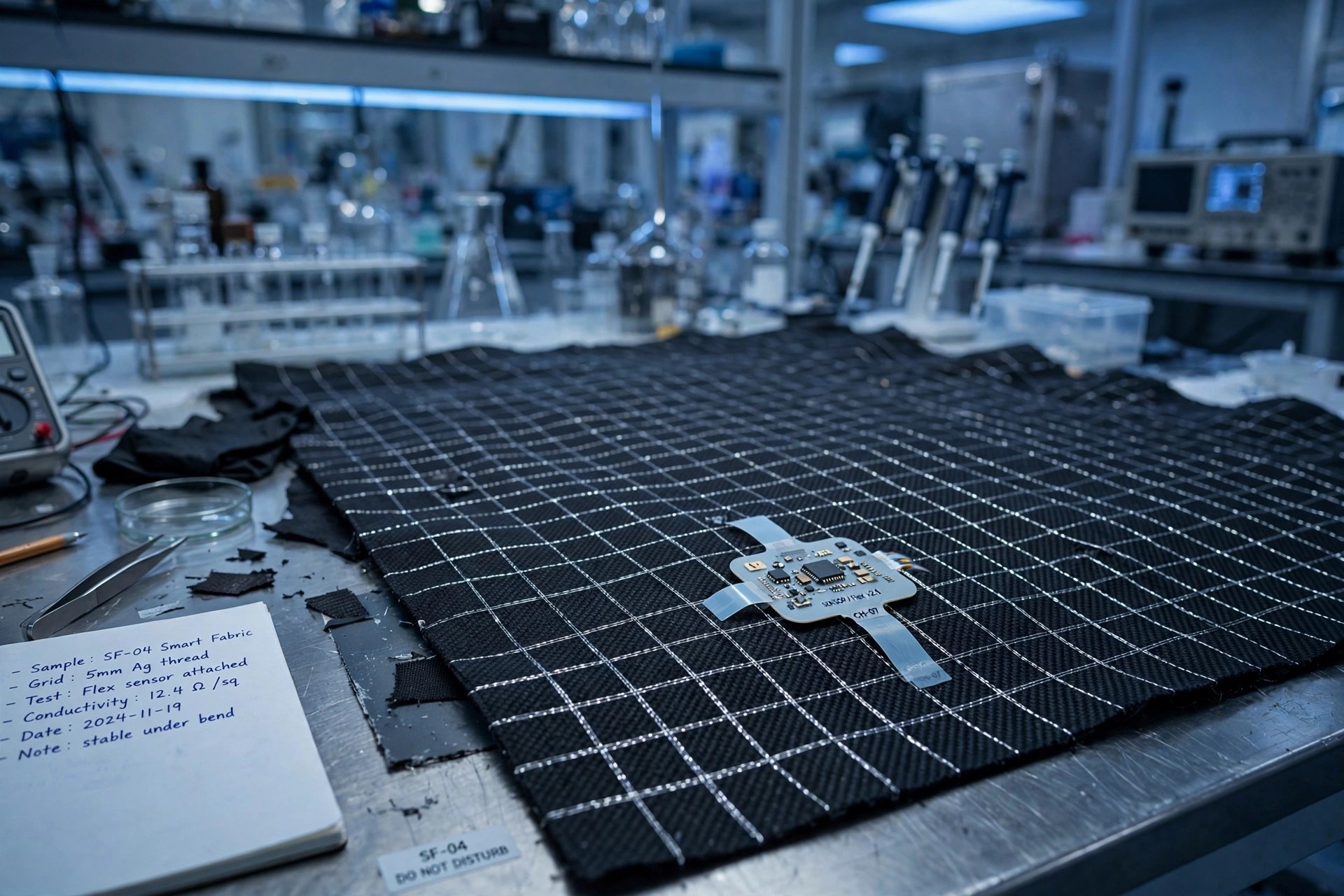
In short, smart fabrics are fabrics manufactured to be technologically advanced. Textile engineers usually sort them into two generations. Passive smart fabrics sense or respond to the environment without electronics: phase-change materials that absorb and release heat, shape-memory fibers, color-changing chromic dyes that react to light, heat or moisture, and membranes that open or close with temperature. Active smart fabrics go further, carrying conductive yarns, printed circuits, sensors and sometimes power, so the cloth itself becomes part of an electronic system - a garment that measures heart rate, a sleeve that controls a phone, a uniform that reports its wearer's position or exposure.
The site's own glossary treatment is linked from this page: the Smart Fabrics term in the fashion terms section, alongside the broader Apparel Technology and Technology Based Clothing pages, which cover the industry side of wearable technology.
How Smart Fabrics Are Made
Conductivity is the foundation technology, and there are three main routes to it: weaving or knitting metal or metal-coated yarns (silver-coated nylon is the workhorse) directly into the fabric; printing conductive inks in circuit patterns onto finished cloth; and embroidering conductive thread to form sensors, antennas and interconnects. Each route trades wash durability, stretch and cost differently, and every smart-fabric program has to solve the same unglamorous problems: how the electronics disconnect for laundering, how connectors survive flexing, and how a garment factory - built for sewing, not soldering - assembles the product.
The best-known consumer experiment is Google's Project Jacquard, which wove touch-sensitive threads into denim jackets so a cuff swipe could control a phone, and Project Soli, its radar-based gesture work; the Apparel Search fashion blog covered it in smart fabrics from Google. Jacquard's commercial run ended, but its lesson stands: the technology worked, and the hard part was making products people wanted at prices they would pay.
Where Smart Fabrics Are Actually Used
Away from the headlines, smart textiles earn their living in medicine, the military and sport. Hospital and elder-care garments monitor heart rhythm, respiration and falls; military fabrics integrate power and data buses, heating and signature management; sports apparel measures muscle activity and movement for coaching. Industrial uses - heated workwear, sensing composites, electrostatic protection - are quieter but steady. In mainstream fashion the surviving applications are modest and useful: heated jackets, phase-change comfort layers, and antimicrobial and moisture-managing finishes that borrow smart-fabric chemistry without the electronics.
The one mill listed here, Elekson Group Plc., belongs to this field's first commercial wave: the company built fabric touch interfaces - cloth keyboards and controls woven from conductive textiles. Its profile is below. And a piece of Apparel Search humor: if you know a fabric that is not very smart, you are welcome to send it to a fashion school - you can find one in the fashion school directory.
For buyers and product developers, the practical advice is to separate the two halves of any smart-fabric claim. The textile half - hand, drape, durability, wash performance - can be tested with ordinary fabric methods, and should be. The electronic half needs its own questions: where does the power come from, what exactly is measured and how accurately, what happens to the data, and who services the system when a sensor fails in year two. Suppliers who answer both halves plainly are the ones whose products survive contact with production. The rest tend to become demonstration pieces - interesting, photogenic, and quietly discontinued, which is the pattern this category has repeated since its first wave in the early 2000s.
Fabric Mills and Factories in This Directory
The mill below is the listing on this page. Each name opens that company's profile in the Fabric Mills by Name directory.
Elekson Group Plc.
Profiled in the Apparel Search Fabric Mills by Name directory and listed among the mills supplying this fabric type.
Common Questions
What is a smart fabric?
A fabric engineered to do more than cover: passive types respond to heat, light or moisture, while active types carry conductive yarns and sensors so the textile itself senses, heats, lights or communicates.
Can smart fabric garments be washed?
That is the field's central practical problem. Most designs make the electronics detachable before washing; fully integrated washable systems exist but cost more and are usually aimed at medical or military use.
What was Google's smart fabric project?
Project Jacquard wove touch-sensitive conductive threads into clothing - famously a denim trucker jacket whose cuff controlled a phone. The Apparel Search blog covered Jacquard and the related Soli radar work in 2015.
More to Explore
- Antibacterial Fabric
- Apparel Technology
- Bamboo
- Basalt
- Boucle
- Breathable
- Broadcloth
- Brocade
- Burlettes
- Canvas
- Carbon
- Chambray
- Chenille
- Chiffon
- Circular
- Clothing Industry Employment
- Clothing Industry Factories
- Conversion Charts
- Corduroy
- Cotton
- Crepe
- Crochet
- Damask
- Denim
- Dobby
- Double Knit
- Drill
- Duck
- Dyed Fabric
- Elekson Group Plc.
- Embroidered
- Fabric
- Fabric Definitions
- Fabric Directory
- Fabric Retail
- Fabric Wholesalers
- Fashion Industry News
- fashion school directory
- Fiberglass
- Fibers Directory
- Fil-a-Fils
- Filter Cloth
- Flame Retardant
- Fleece
- French Terry
- Gabardine
- Gauze
- Georgettes
- Ginghams
- Greige Fabric
- Herringbone
- Horse Hair
- Interlining
- Interlock
- Jacquard
- Jersey Fabric
- Lace
- Lacoste
- Linen
- Lining
- Long Fiber Reinforced Thermalplastics
- Mesh
- Metallic
- Muslin
- Narrow
- Net
- Non Woven Fabric
- Novelty
- Nylon
- Ottoman
- Oxford
- Percale
- Pile
- Pique
- Pointelle
- Polar Fleece
- Polyester
- Poplin
- Printed
- Quilted
- Raschel
- Reflective
- Rib
- Sateen
- Satin
- Seersucker
- Silk Fabric
- Single Jersey
- Smart Fabrics
- smart fabrics from Google
- Stretch
- Suede
- Taffeta
- Tassars
- Technology Based Clothing
- Terry
- Textile Machinery
- Textiles
- Thermal
- Tricot
- Tulle
- Tweed
- Twill
- Velcro
- Velour
- Velvet
- Viole
- Vynil
- Waffle
- Waterproof
- Wool
- Yarn Dyed
- Yarn Factories
Looking for Fabric Mills and Suppliers?
The wider directory behind these pages is the Fabric section hub, which opens the whole Apparel Search fabric mill directory: fabric types from A to Z, the Fabric Mills by Name profiles, and the dyeing, printing and finishing directories that support them.