Rib Fabric Factories Directory
Rib knit is the stretch-and-recover fabric of cuffs, collars and waistbands: vertical columns of knit and purl stitches that pull in tight and spring back. This directory explains 1x1 and 2x2 rib, where ribbing earns its place on a garment, and how to specify it, and carries all twenty mills this section lists under rib fabric factories, from India, the USA and China to Turkey, Canada, Pakistan, Indonesia, Taiwan and the United Kingdom.
Shop Rib Knit Fabric Now
Shop Rib Knit Fabric on Amazon Shop Rib Knit Fabric on eBayThese links open the Apparel Search shopping guides for Amazon and eBay, where the product links are kept in one place.
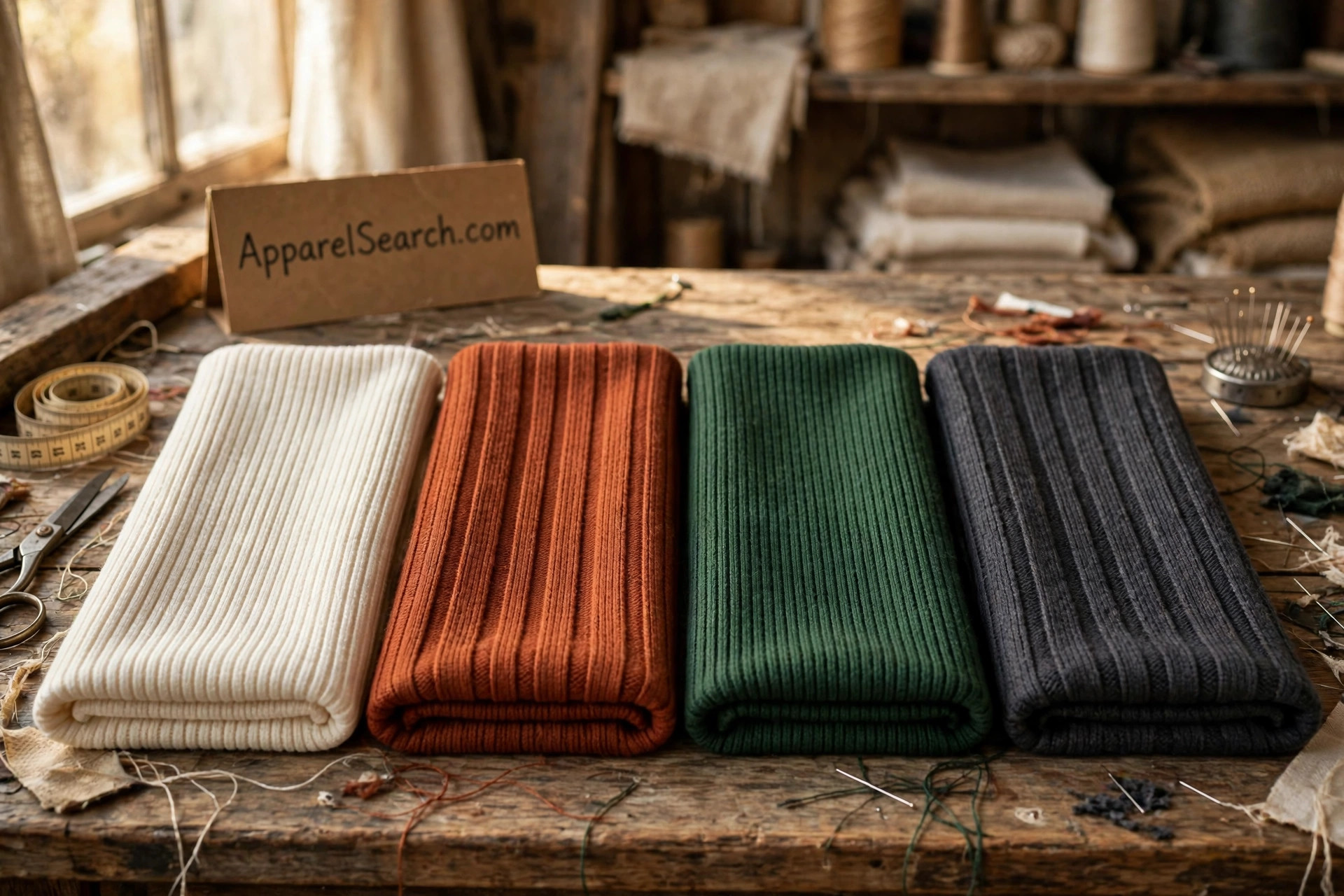
What Rib Knit Is
A rib knit is built from alternating columns, called wales, of face stitches and reverse stitches. The face columns stand forward and the reverse columns retreat, so the cloth shows the vertical ridges that give rib its name and look. The geometry is also the function: pulled across its width, the ridges open like a concertina and the fabric stretches far beyond what a plain knit allows, then the same geometry pulls it back to its resting width when released. No elastane is required for that behaviour, though adding a little makes the recovery crisper and longer lived.
Ribs are named by their repeat. In a 1x1 rib, one wale of face stitches alternates with one wale of reverse stitches, giving a fine, even rib that lies the same on both sides and suits most cuffs and neckbands. In a 2x2 rib, pairs of wales alternate, giving a bolder ridge, more contraction and a chunkier hand that suits sweater cuffs, waistbands and whole ribbed garments. Wider and irregular repeats exist for fashion effects. Because the reverse stitches hide between the ridges, a relaxed rib fabric is much narrower than the same yarn count knitted flat, a fact that drives both its price per garment and its specification.
Where Rib Fabric Is Used
The classic jobs are the edges of garments. A cuff, collar, neckband or waistband has to stretch over a hand, head or hips and then grip gently for the life of the garment, and rib is the knit that does it without elastic tape or drawcords. T-shirt neckbands, sweatshirt cuffs and hems, sweater welts, sock tops and beanie hats are ribbed for the same reason. Rib also works as a body fabric in its own right, in fitted tops, dresses and thermal underwear, where its contraction gives a close fit that moves with the wearer and its ridges give a plain garment its texture.
The twenty listings below are this directory's rib fabric factories, each linked to its Fabric Mills by Name profile. India supplies seven of them, the USA four and China two, with Turkey, Canada, Pakistan, Indonesia, Taiwan and the United Kingdom also represented, a spread that reflects how widely circular knitting for rib is established wherever knitwear and jersey garments are made. Several names here also appear elsewhere in this fabric section, knitting or dyeing related cloths, which is normal for mills whose machines run more than one structure. No listing has been removed: none was verified dead, and the standing rule here is to keep a listing when in doubt.
Specifying and Sewing Rib Fabric
A rib specification should state the repeat (1x1, 2x2 or another), the fibre and any elastane content, the finished width and weight, and above all the recovery the buyer expects, because two ribs that look alike can behave very differently after a season of stretching. Ask how the width was measured: rib is traded in a relaxed state, and a supplier stretching the roll to make width will leave the garment maker short. Colour matching between a rib trim and the body fabric it must sit against deserves its own approval step, since the ridged surface reads colour differently from a flat jersey in the same dyebath.
In the sewing room, rib trim is usually applied slightly stretched, eased onto the longer garment edge so the finished band lies flat and keeps its grip, and panels cut from rib body fabric need resting time after cutting so they return to their true dimensions before measuring. Stitching should stretch with the cloth, and bands should never be stretched to force a fit during sewing, because a band sewn in over-stretched relaxes into puckers afterward. Care follows the fibre: cotton ribs soften and can lose a little recovery over time, ribs with elastane keep their snap longer, and gentle washing and flat drying protect both.
Rib Fabric Factories Listed Here
A K Dyeing (India)
Listed in this directory. Follow the company name to its Fabric Mills by Name profile, which carries its full directory record.
Alok Textile Industries (India)
Listed in this directory. Follow the company name to its Fabric Mills by Name profile, which carries its full directory record.
Antex Knitting Mills (USA)
Listed in this directory. Follow the company name to its Fabric Mills by Name profile, which carries its full directory record.
Carolina Apparel Group, Inc. (USA)
Listed in this directory. Follow the company name to its Fabric Mills by Name profile, which carries its full directory record.
Carolina Cotton Works, Inc. (USA)
Listed in this directory. Follow the company name to its Fabric Mills by Name profile, which carries its full directory record.
Ceyteks Tekstil (Turkey)
Listed in this directory. Follow the company name to its Fabric Mills by Name profile, which carries its full directory record.
Changshu Sunwell Knitting Textile Co., Ltd. (China)
Listed in this directory. Follow the company name to its Fabric Mills by Name profile, which carries its full directory record.
Dimple International Corporation (Taiwan)
Listed in this directory. Follow the company name to its Fabric Mills by Name profile, which carries its full directory record.
Gideon Textiles Inc. (Canada)
Listed in this directory. Follow the company name to its Fabric Mills by Name profile, which carries its full directory record.
Glacial Exports (India)
Listed in this directory. Follow the company name to its Fabric Mills by Name profile, which carries its full directory record.
G R Garments (India)
Listed in this directory. Follow the company name to its Fabric Mills by Name profile, which carries its full directory record.
Hands On (India)
Listed in this directory. Follow the company name to its Fabric Mills by Name profile, which carries its full directory record.
International technotexPvt. Ltd. (India)
Listed in this directory. Follow the company name to its Fabric Mills by Name profile, which carries its full directory record.
Lincoln Textile Sales, Inc (USA)
Listed in this directory. Follow the company name to its Fabric Mills by Name profile, which carries its full directory record.
Nutex International (Pvt) Ltd. (Pakistan)
Listed in this directory. Follow the company name to its Fabric Mills by Name profile, which carries its full directory record.
PT. Frans Putratex (Indonesia)
Listed in this directory. Follow the company name to its Fabric Mills by Name profile, which carries its full directory record.
Shahtex (Leicester) Limited (United Kingdom)
Listed in this directory. Follow the company name to its Fabric Mills by Name profile, which carries its full directory record.
Sriyansh Ispat Limited (India)
Listed in this directory. Follow the company name to its Fabric Mills by Name profile, which carries its full directory record.
Wujiang Hengyu Textile Dyeing Finishing Co.,Ltd. (China)
Listed in this directory. Follow the company name to its Fabric Mills by Name profile, which carries its full directory record.
Xiamen C and D Inc. (China)
Listed in this directory. Follow the company name to its Fabric Mills by Name profile, which carries its full directory record.
Common Questions
What does 1x1 and 2x2 rib mean?
The repeat of the stitch columns. In 1x1 rib, one column of face stitches alternates with one of reverse stitches, a fine even rib. In 2x2 rib the columns alternate in pairs, giving bolder ridges, more contraction and a chunkier fabric. The original directory headed this page with exactly those terms: 1x1 Rib, 2x2 Rib.
Why is rib knit used for cuffs and collars?
Its ridged structure stretches widely across the width and springs back, so a cuff or neckband can pass over a hand or head and then grip gently without elastic tape. The same stretch-and-recover behaviour makes rib a good body fabric for fitted tops, thermals and sock tops.
Which mills does this directory list for rib fabric?
Twenty factories, each linked to its Fabric Mills by Name profile, including A K Dyeing, Alok and Glacial Exports (India), Antex Knitting Mills, Carolina Apparel Group and Carolina Cotton Works (USA), Changshu Sunwell and Xiamen C and D (China), Ceyteks Tekstil (Turkey), Shahtex (United Kingdom) and ten more.
More to Explore - The Full Fabric Directory A-Z
- Raschel Fabric Mills
- Reflective Fabric
- Registered Trade Marks - Textile Industry
- Quilted Fabric Mills
- Sateen Fabric
- Fabric Mills - Fabric Section Hub
- Textile Machinery
- Embroidery Directory
- Printing Directory
- A K Dyeing
- Alok Textile Industries
- Antex Knitting Mills
- Carolina Apparel Group, Inc.
- Carolina Cotton Works, Inc.
- Ceyteks Tekstil
- Changshu Sunwell Knitting Textile Co., Ltd.
- Dimple International Corporation
- Gideon Textiles Inc.
- Glacial Exports
- G R Garments
- Hands On
- International technotexPvt. Ltd.
- Lincoln Textile Sales, Inc
- Nutex International (Pvt) Ltd.
- PT. Frans Putratex
- Shahtex (Leicester) Limited
- Sriyansh Ispat Limited
- Wujiang Hengyu Textile Dyeing Finishing Co.,Ltd.
- Xiamen C and D Inc.
- Clothing Industry Factories
- Yarn Factories
- Fabric Retail
- Fabric Wholesalers
- Fibers Directory
- Fabric Definitions
- Fashion Industry News
- Clothing Industry Employment
- Conversion Charts
- Antibacterial Fabric
- Bamboo
- Basalt
- Boucle
- Breathable
- Broadcloth
- Brocade
- Burlettes
- Canvas
- Carbon
- Chambray
- Chenille
- Chiffon
- Circular
- Corduroy
- Cotton
- Crepe
- Crochet
- Damask
- Denim
- Dobby
- Double Knit
- Drill
- Duck
- Dyed Fabric
- Embroidered
- Fiberglass
- Fil-a-Fils
- Filter Cloth
- Flame Retardant
- Fleece
- French Terry
- Gabardine
- Gauze
- Georgettes
- Ginghams
- Greige Fabric
- Herringbone
- Horse Hair
- Interlining
- Interlock
- Jacquard
- Jersey Fabric
- Lace
- Lacoste
- Linen
- Lining
- Long Fiber Reinforced Thermalplastics
- Metallic
- Mesh
- Muslin
- Narrow
- Net
- Non Woven Fabric
- Novelty
- Nylon
- Ottoman
- Oxford
- Percale
- Pile
- Pique
- Pointelle
- Polar Fleece
- Polyester
- Poplin
- Printed
- Satin
- Seersucker
- Silk Fabric
- Single Jersey
- Smart Fabrics
- Stretch
- Suede
- Taffeta
- Tassars
- Terry
- Thermal
- Tricot
- Tulle
- Tweed
- Twill
- Velcro
- Velour
- Velvet
- Viole
- Vynil
- Waffle
- Waterproof
- Wool
- Yarn Dyed
- Textiles
- Fabric
Looking for Fabric Mills and Suppliers?
Return to the Fabric Directory hub for the full fabric section, or browse the Fabric Manufacturers Directory page for the wider mill trade.