Net Textiles Directory
Net is the most open textile of all: yarns knotted, knitted or extruded into a grid of holes with almost no solid surface between them. This directory explains the net families from bridal tulle to fishing and safety netting, and carries the two mills this section lists under net factories — Edley Associates, Inc of the USA and Wujiang Hengyu Textile Dyeing Finishing Co.,Ltd. of China.
Shop Net & Tulle Fabric Now
Shop Net & Tulle Fabric on Amazon Shop Net & Tulle Fabric on eBayThe Amazon and eBay links on this page are affiliate links. If you make a purchase through them, Apparel Search may earn a commission.
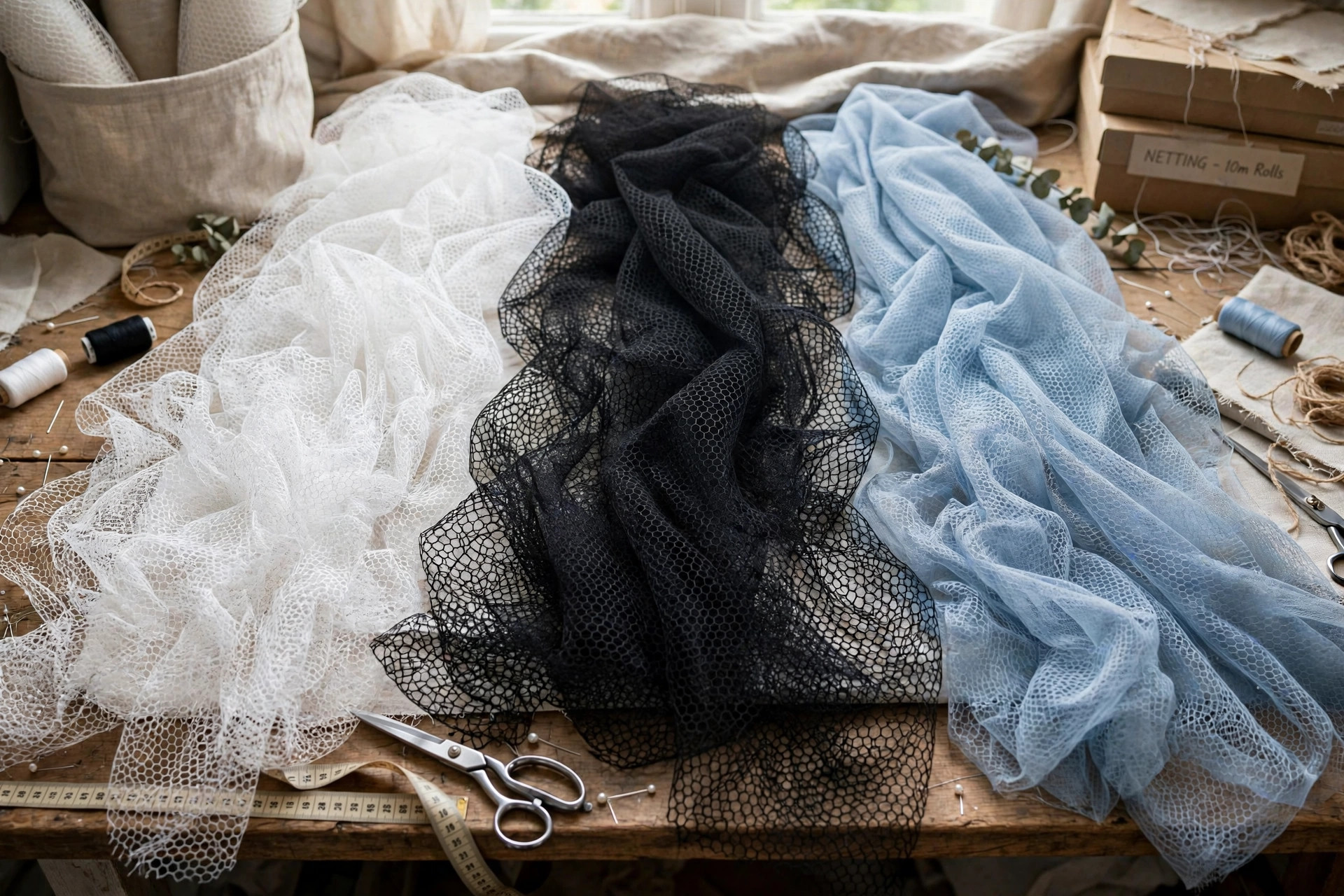
How Net Is Made
Every net is mostly hole. The differences lie in how the yarns are joined at the crossings. Knotted net — the oldest construction, still used for fishing and sports nets — ties each intersection, so a cut cord cannot run. Raschel warp knitting forms net without knots at production speed, and it is the construction behind most apparel and household netting, from tulle and veiling to laundry and produce nets. Extruded plastic net is not textile in origin at all: polymer is pushed through rotating dies into a ready-made grid for garden, packaging and industrial uses. Mesh size, yarn thickness and stiffness decide which family a job belongs to.
Fibre follows exposure. Nylon net is strong and elastic, the choice for sports and fishing nets that take impact; polyester net holds its dimensions, resists sunlight better and dominates apparel tulle, mosquito netting and industrial screens; cotton net appears in fashion and food uses where a natural fibre is wanted; and monofilament nets — knitted or woven from single clear strands — serve veiling, filtration and agriculture. Finishes stiffen dress nets, soften bridal tulle and add flame-retardant or anti-microbial behaviour where the end use demands it.
Where Net Textiles Are Used
In apparel, net lives at both ends of the wardrobe: tulle and illusion net build veils, gowns, ballet skirts and the sheer yokes of evening dresses, while coarse nets line trainers, bags and caps and form the pockets of travel clothing. Around the home it becomes mosquito netting, laundry bags, curtain voile and storage nets. Industry and sport take the heavy end — goal and safety nets, fishing nets, cargo nets, scaffolding debris netting, filtration screens and agricultural shade and bird netting all run on the same open principle at larger gauges. The neighbouring Mesh Fabric Mills directory covers the knitted mesh relatives of net, and the Tulle Fabric page covers its finest form.
The two listings below are this directory's net specialists: Edley Associates, Inc of the USA and Wujiang Hengyu Textile Dyeing Finishing Co.,Ltd. of China — the pairing is typical of the trade, a US specialist house alongside a large Chinese knitter-dyer-finisher producing nets and net-adjacent knits at volume. Both are linked to their Fabric Mills by Name profiles, where their directory records live. Below the listings, the full fabric directory menu links every fabric family in this section, from antibacterial fabrics to yarn-dyed mills. Thank you for using the Apparel Search Fabric Mill Directory.
Choosing Net: Mesh Size, Hand and Strength
Specifying net starts with the hole: quote the mesh size and check it on a sample, because a net that must keep out insects, hold grapes or catch a ball fails completely at the wrong gauge. Next comes hand — dress nets are sold across a stiffness range from fluid tulle to boardy crinoline net, and only handling the cloth tells you where a sample sits. For load and impact nets, ask for the breaking and burst figures and whether the net is knotted or knotless, since knotted intersections localise damage. Finally check the edges: quality net is sold with stable selvedges or is meant to be bound, and a net that ladders from a cut edge will waste more than it costs.
Insect netting has its own arithmetic worth stating: protection is a matter of holes per area and hole size, fine enough to exclude the insect in question while still passing air, and the World Health Organization's specifications for mosquito netting exist precisely because a net sold by appearance alone may fail at that single job. The same principle — test the net against its actual purpose, not its look — applies to every grade in this directory.
Net Textile Mills Listed Here
Edley Associates, Inc (USA)
Listed in this directory. Follow the company name to its Fabric Mills by Name profile, which carries its full directory record.
Wujiang Hengyu Textile Dyeing Finishing Co.,Ltd. (China)
Listed in this directory. Follow the company name to its Fabric Mills by Name profile, which carries its full directory record.
Common Questions
What is the difference between net and mesh fabric?
They are close relatives. Net is the most open construction — yarns knotted, warp-knitted or extruded into a plain grid of holes — while mesh usually describes a knitted open fabric with a more regular, engineered hole pattern, such as athletic mesh or power mesh. Tulle is the finest dress net.
What fibres are nets made from?
Nylon for strength and elasticity in sports and fishing nets, polyester for dimensional stability and sunlight resistance in tulle, mosquito and industrial nets, cotton for fashion and food uses, and monofilament yarns for veiling, filtration and agriculture.
Which mills does this directory list for net textiles?
Edley Associates, Inc of the USA and Wujiang Hengyu Textile Dyeing Finishing Co.,Ltd. of China, each linked to its Fabric Mills by Name profile on this site.
More to Explore - The Full Fabric Directory A-Z
- Narrow Fabric Mills
- Nonwovens
- Novelty Fabric
- Nylon Fabric Mills
- Mesh Fabric Mills
- Tulle Fabric
- Raschel Fabric
- Polyester Fabric Mills
- Fabric Mills - Fabric Section Hub
- Textile Machinery
- Embroidery Directory
- Printing Directory
- Edley Associates, Inc
- Wujiang Hengyu Textile Dyeing Finishing Co.,Ltd.
- Clothing Industry Factories
- Yarn Factories
- Fabric Retail
- Fabric Wholesalers
- Fibers Directory
- Fabric Definitions
- Fashion Industry News
- Clothing Industry Employment
- Conversion Charts
- Antibacterial Fabric
- Bamboo
- Basalt
- Boucle
- Breathable
- Broadcloth
- Brocade
- Burlettes
- Canvas
- Carbon
- Chambray
- Chenille
- Chiffon
- Circular
- Corduroy
- Cotton
- Crepe
- Crochet
- Damask
- Denim
- Dobby
- Double Knit
- Drill
- Duck
- Dyed Fabric
- Embroidered
- Fiberglass
- Fil-a-Fils
- Filter Cloth
- Flame Retardant
- Fleece
- French Terry
- Gabardine
- Gauze
- Georgettes
- Ginghams
- Greige Fabric
- Herringbone
- Horse Hair
- Interlining
- Interlock
- Jacquard
- Jersey Fabric
- Lace
- Lacoste
- Linen
- Lining
- Long Fiber Reinforced Thermalplastics
- Metallic
- Muslin
- Ottoman
- Oxford
- Percale
- Pile
- Pique
- Pointelle
- Polar Fleece
- Poplin
- Printed
- Quilted
- Reflective
- Rib
- Sateen
- Satin
- Seersucker
- Silk Fabric
- Single Jersey
- Smart Fabrics
- Stretch
- Suede
- Taffeta
- Tassars
- Terry
- Thermal
- Tricot
- Tweed
- Twill
- Velcro
- Velour
- Velvet
- Viole
- Vynil
- Waffle
- Waterproof
- Wool
- Yarn Dyed
- Textiles
- Fabric
Looking for Fabric Mills and Suppliers?
Return to the Fabric Directory hub for the full fabric section, or browse the Fabric Manufacturers Directory page for the wider mill trade.