Fiberglass Fabric
Fiberglass fabric is woven from glass fiber yarns - a cloth stronger in tension than steel wire of the same diameter, far lighter, and incombustible. This directory explains how glass cloth is made and specified, and lists the one fiberglass mill in this directory.
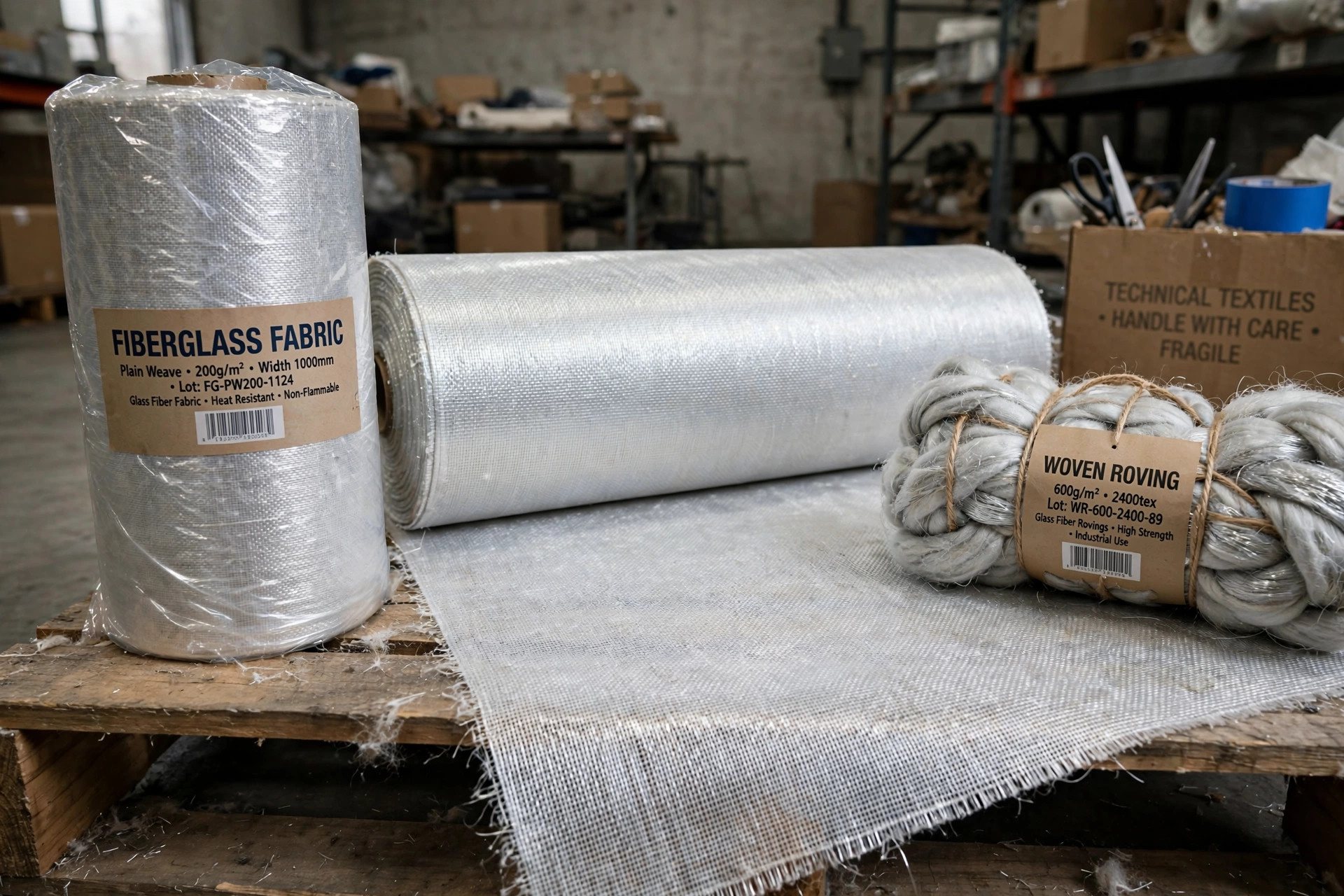
What Glass Fiber Fabric Is
Glass fiber is one of the fibers with the highest tensile strength: its weight is far lighter than steel wire of the same diameter, but its tensile strength is greater. The fiber is made by drawing molten glass through fine bushings into filaments, gathering the filaments into strands and twisting or texturising them into yarns that can be woven on looms much like any other yarn - with the difference that glass does not stretch, does not burn and does not rot. Woven, it becomes fiberglass fabric: a cloth manufactured in various kinds of thickness, weight and width by fabrication method, from tissue-light veils used as composite surfacing to heavy woven rovings and textured cloths a centimetre thick in effect. Plain weave is the workhorse construction; satin weaves drape better over moulds, and leno and mesh constructions serve reinforcement and filtration.
Because glass fiber fabrics are made of inorganic materials, they are inflammable - meaning incombustible - and they are applied in high-temperature working conditions and especially at dangerous places of fire. Continuous-filament glass cloth keeps useful strength at temperatures that destroy organic fibers, and with coatings it becomes a family of working materials: silicone-coated cloth for flexible high-temperature seals and curtains, PTFE-coated cloth for release sheets and conveyor belts, vermiculite and graphite coatings that raise the temperature ceiling further, and aluminised cloth that reflects radiant heat back at its source for protective clothing and shields. Uncoated cloth is the reinforcement inside fiberglass composites - boats, panels, pipes, printed-circuit laminates - where resin supplies the stiffness and the glass supplies the strength.
Specifying and Handling Glass Cloth
A fiberglass fabric specification names the yarn, the weave, the weight per square metre or yard, the thickness and the finish or coating. Weight and weave together set the strength and the drape; finish decides what the cloth will bond to or resist - a composite cloth is treated for resin compatibility, a welding blanket for spatter and abrasion, an insulation cloth for the temperature it will meet. Buyers should also state the working temperature honestly: glass fiber itself tolerates heat that destroys most coatings, so the coating, not the cloth, is usually the limit. Handling asks respect rather than ceremony - glass filaments are brittle in sharp folds and the dust from cutting irritates skin and lungs, so cloth is cut with shears or rotary blades, stored rolled rather than creased, and handled with gloves in the cutting room, standard practice wherever the material is worked daily.
Around this directory, glass cloth belongs to the technical end of the fabric section, near the Basalt Fabric page - basalt is glass's volcanic cousin, drawn from melted rock - and the Flame Retardant Fabric directory, where incombustible cloth is one answer among several. The wider section is indexed from the Fabric Directory hub, with the Wool Fiber Directory at the opposite, natural pole of the fiber world. This directory lists one mill: You Chang Company of China, linked to its own profile in the Fabric Mills by Name section. When you enquire, state the weight, weave, width and coating you need and the temperature the cloth must withstand; glass cloth is quoted against those five facts. Thank you for using the Apparel Search Fabric Mill Directory.
Fiberglass Fabric Mill Listed in This Directory
You Chang Company (China)
Company listed in the Apparel Search fabric mill directory under its own profile in the Fabric Mills by Name section. Open the linked profile for the company's directory record and contact details.
Common Questions
How strong is fiberglass fabric?
Glass fiber is one of the highest-tensile-strength fibers: a glass yarn weighs far less than steel wire of the same diameter yet exceeds it in tensile strength. The woven cloth's working strength depends on yarn, weave and weight, which is why specifications name all three.
Why is fiberglass fabric used around heat and fire?
It is woven from inorganic glass, so it is incombustible and keeps useful strength at temperatures that destroy organic fibers. Coated versions - silicone, PTFE, vermiculite, aluminised - serve as welding blankets, heat curtains, seals and radiant-heat shields.
Which mill is listed for fiberglass fabric?
One company: You Chang Company (China), linked to its profile in the Fabric Mills by Name section.
More to Explore - The Full Fabric Directory A-Z
- Fabric Scents & Aromas
- Fabric Finishes
- Fabric Mills Directory Page 2
- Fabric Mills Directory Page 3
- Fabric Mills Directory Page 4
- Fabric Mills Directory Page 5
- Fiberglass Fabric
- Fil-a-Fils Fabric
- Filter Cloth Mills
- Flame Retardant Fabric
- Flannel Fabric Mills
- Fleece Fabric
- Flock
- French Terry Fabric Mills
- Electromagnetic Shielding Fabrics
- Embroidered Fabric
- Gabardine Fabric Mills
- Gauze Fabric Mills
- Georgette Fabric Mills
- Gingham Fabric
- Greige Fabric
- Fabric Mills - Fabric Section Hub
- Wool Fiber Directory
- Textile Machinery
- Embroidery Directory
- Printing Directory
- You Chang Company
- Clothing Industry Factories
- Yarn Factories
- Fabric Retail
- Fabric Wholesalers
- Fibers Directory
- Fabric Definitions
- Fashion Industry News
- Clothing Industry Employment
- Conversion Charts
- Antibacterial Fabric
- Bamboo
- Basalt
- Boucle
- Breathable
- Broadcloth
- Brocade
- Burlettes
- Canvas
- Carbon
- Chambray
- Chenille
- Chiffon
- Circular
- Corduroy
- Cotton
- Crepe
- Crochet
- Damask
- Denim
- Dobby
- Double Knit
- Drill
- Duck
- Dyed Fabric
- Herringbone
- Horse Hair
- Interlining
- Interlock
- Jacquard
- Jersey Fabric
- Lace
- Lacoste
- Linen
- Lining
- Long Fiber Reinforced Thermalplastics
- Metallic
- Mesh
- Muslin
- Narrow
- Net
- Non Woven Fabric
- Novelty
- Nylon
- Ottoman
- Oxford
- Percale
- Pile
- Pique
- Pointelle
- Polar Fleece
- Polyester
- Poplin
- Printed
- Quilted
- Raschel
- Reflective
- Rib
- Sateen
- Satin
- Seersucker
- Silk Fabric
- Single Jersey
- Smart Fabrics
- Stretch
- Suede
- Taffeta
- Tassars
- Terry
- Thermal
- Tricot
- Tulle
- Tweed
- Twill
- Velcro
- Velour
- Velvet
- Viole
- Vynil
- Waffle
- Waterproof
- Wool
- Yarn Dyed
- Textiles
- Fabric
Looking for Fabric Mills and Suppliers?
Return to the Fabric Directory hub for the full fabric section, or browse the Fabric Manufacturers Directory page for the wider mill trade.