Velvet Fabric Factories
Velvet is the woven pile fabric whose dense, upright fibers catch light like nothing else in the textile world - formal, fluid and unmistakable. This page explains how it is made, lists the mills that make it, and links to the Velvet glossary page.
Shop Velvet Fabric Now
Shop Velvet Fabric on Amazon Shop Velvet Fabric on eBayThese links open the Apparel Search shopping guides for Amazon and eBay, where the product links are kept in one place.
How Velvet Is Made
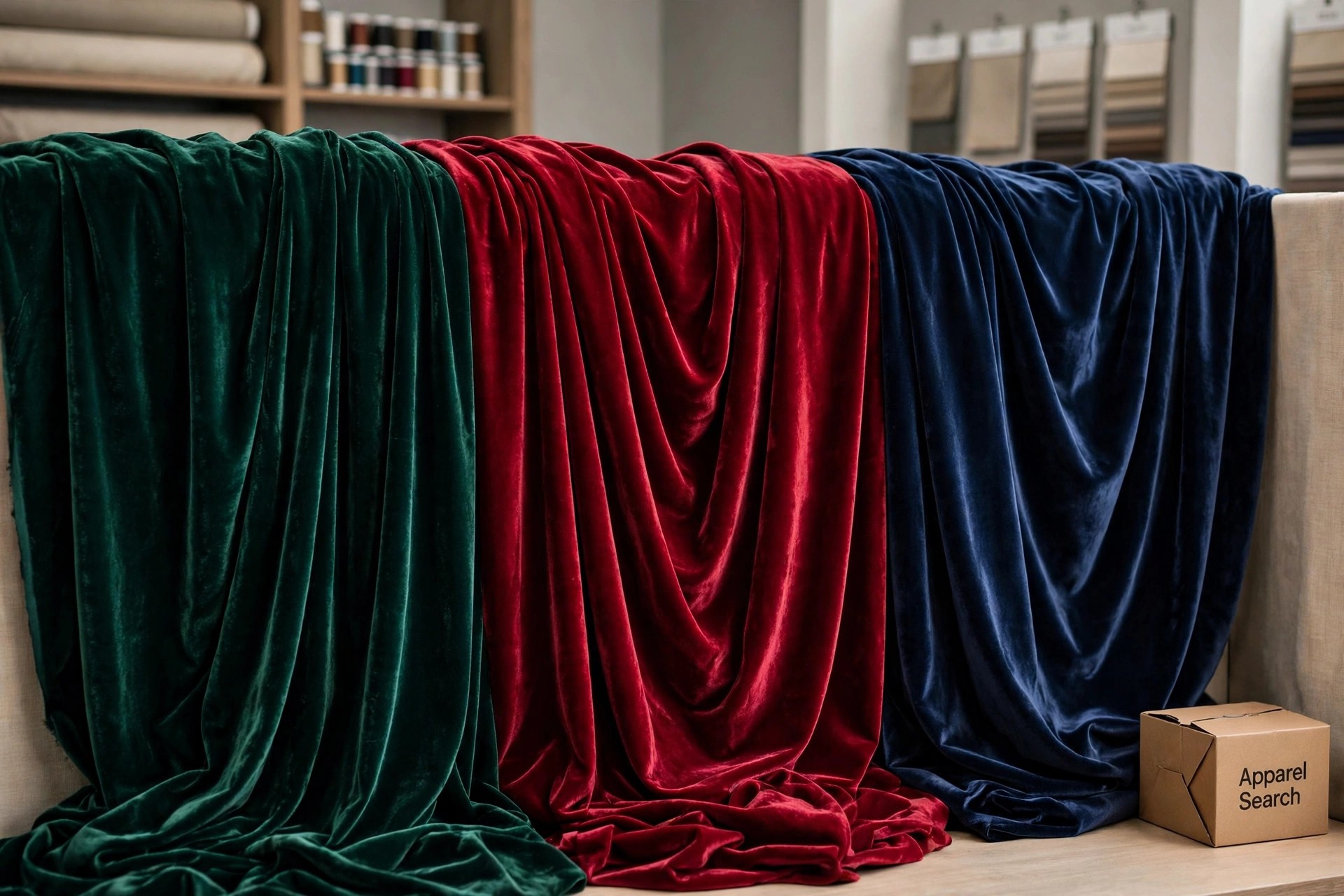
Velvet is woven with two sets of warp threads: a ground warp that forms the cloth and a pile warp that rides over it. In the classic method two lengths of cloth are woven face to face at once, joined by the pile warp, and a blade traveling between them cuts the pile threads, so the loom delivers two complete velvets from a single weaving. The result is a fabric whose surface is thousands of short, upright cut ends, so dense that the ground weave disappears and light plays across the pile as the cloth moves, dark looking down the nap and bright looking across it.
Fiber decides the velvet's character. Silk velvet, the historic luxury, drapes like water and shines softly but crushes and water-spots easily and costs accordingly. Cotton velvet is firmer, more matte and more practical, the standard for tailored jackets and upholstery. Viscose and silk-viscose velvets give much of silk's fluid shine at workable prices, and polyester velvets add washability and crush resistance for costumes, curtains and contract interiors. Devore velvet, where a chemical print burns the pile away in a pattern, and crushed or panne velvets, where the pile is pressed in one direction, are finishing variations on the same woven idea.
Velvet in Fashion and Interiors
Fashion returns to velvet whenever richness is wanted: evening dresses and gowns, tailored blazers, trousers and skirts for winter, waistcoats, scarves, bags and shoes, and the bridal and occasionwear that borrow its depth of color. Because the pile absorbs and reflects light unevenly, a velvet garment changes tone as the wearer moves, an effect no flat fabric reproduces. Designers cut it with the nap running consistently - traditionally down the garment for a darker, richer look - and accept its bulk at seams by grading and pressing on a needle board so the pile is never flattened by a hot iron on its face.
Interiors use velvet for the same light-play at room scale: curtains that hang in heavy, light-swallowing folds, upholstery on chairs and headboards, cushions and theater seating. Upholstery grades are woven denser and often backed for stability, and contract velvets in synthetic fibers meet flammability and abrasion standards that apparel cloth is never asked to pass. A buyer must therefore name the end use before comparing prices, because apparel velvet and upholstery velvet are different goods sharing a name and a loom principle.
Care and Handling
Velvet's enemy is pressure on the pile. Garments should hang, never fold for long, and be stored with room around them; creases are steamed from the back, never ironed on the face, and a velvet hanger or padded hanger keeps shoulder points from marking. Silk and viscose velvets are dry-cleaned; cotton and polyester grades may tolerate gentle washing if the maker says so, but the safe rule is to follow the specific cloth's care label, since one velvet's tolerance says nothing about the next bolt's construction or dye.
The Velvet glossary page is linked in this page's link list below, alongside the mill profiles. Glossary and directory work together here: the glossary defines the fabric and its varieties, while this page records the factories the directory profiled for it, so a reader can move from understanding the cloth to sourcing it without leaving the section.
The Mills in This Directory
Five listings follow: Ceyteks Tekstil of Turkey; Changshu Huarui Knitting Textile Co., Ltd, Changshu Sunwell Knitting Textile Co., Ltd. and Wujiang Longshen Enterprise of China; and SGS Interknits (p) ltd of India. The spread is typical of modern velvet supply - Turkish quality knits and woven goods, the great Jiangsu textile clusters around Changshu and Wujiang, and Indian knit production - and the knit names among them are a reminder that much commercial velvet-look yardage today is knitted pile finished to a velvet hand, which a buyer should confirm rather than assume.
Ask each mill which construction it is offering - woven warp pile, or knitted pile - plus fiber content, pile weight, width and the finish applied, and request a cutting from the production quality, not a showroom swatch. Check the nap direction is marked, confirm color against a standard light, and agree a tolerance for shade between rolls: velvet shows dye-lot differences more honestly than any flat cloth, and a dispute about shade after cutting is one no mill can settle in the buyer's favor.
Fabric Mills and Factories in This Directory
Each name below opens the company's profile in the Fabric Mills by Name directory, and each listing gives the company's country.
Ceyteks Tekstil
Country: Turkey.
Changshu Huarui Knitting Textile Co., Ltd
Country: China.
Changshu Sunwell Knitting Textile Co., Ltd.
Country: China. The same mill also appears in this directory's velour listings.
SGS Interknits (p) ltd
Country: India.
Wujiang Longshen Enterprise
Country: China.
Common Questions
How is velvet made?
Two cloths are woven face to face, joined by a pile warp, and a blade cuts between them, producing two velvets whose surface is dense, upright cut pile. That pile is why velvet changes tone as light and viewing angle change.
What fibers are used for velvet?
Traditionally silk; today also cotton for a firmer, matte cloth, viscose blends for fluid shine at lower cost, and polyester for washable, crush-resistant curtains, costumes and upholstery.
Which mills does this directory list for velvet?
Five: Ceyteks Tekstil (Turkey), Changshu Huarui, Changshu Sunwell and Wujiang Longshen (China), and SGS Interknits (India). A Velvet glossary link is also included in the links below.
More to Explore
- Antibacterial Fabric
- Bamboo
- Basalt
- Boucle
- Breathable
- Broadcloth
- Brocade
- Burlettes
- Canvas
- Carbon
- Ceyteks Tekstil
- Chambray
- Changshu Huarui Knitting Textile Co., Ltd
- Changshu Sunwell Knitting Textile Co., Ltd.
- Chenille
- Chiffon
- Circular
- Clothing Industry Employment
- Clothing Industry Factories
- Conversion Charts
- Corduroy
- Cotton
- Crepe
- Crochet
- Damask
- Denim
- Dobby
- Double Knit
- Drill
- Duck
- Dyed Fabric
- Embroidered
- Embroidery Directory
- Fabric
- Fabric Definitions
- Fabric Directory
- Fabric Retail
- Fabric Wholesalers
- Fashion Industry News
- Fiberglass
- Fibers Directory
- Fil-a-Fils
- Filter Cloth
- Flame Retardant
- Fleece
- French Terry
- Gabardine
- Gauze
- Georgettes
- Ginghams
- Greige Fabric
- Herringbone
- Horse Hair
- Interlining
- Interlock
- Jacquard
- Jersey Fabric
- Lace
- Lacoste
- Linen
- Lining
- Long Fiber Reinforced Thermalplastics
- Mesh
- Metallic
- Muslin
- Narrow
- Net
- Non Woven Fabric
- Novelty
- Nylon
- Ottoman
- Oxford
- Percale
- Pile
- Pique
- Pointelle
- Polar Fleece
- Polyester
- Poplin
- Printed
- Printing Directory
- Quilted
- Raschel
- Reflective
- Rib
- Sateen
- Satin
- Seersucker
- SGS Interknits (p) ltd
- Silk Fabric
- Single Jersey
- Smart Fabrics
- Stretch
- Suede
- Taffeta
- Tassars
- Terry
- Textile Machinery
- Textiles
- Thermal
- Tricot
- Tulle
- Tweed
- Twill
- Velcro
- Velour
- Velvet glossary
- Viole
- Vynil
- Waffle
- Waterproof
- Wool
- Wujiang Longshen Enterprise
- Yarn Dyed
- Yarn Factories
Looking for Fabric Mills and Suppliers?
The wider directory behind this page is the Fabric section hub, which opens the whole Apparel Search fabric mill directory: fabric types from A to Z, the Fabric Mills by Name profiles, and the dyeing, printing and finishing directories that support them.