Stretch Fabric Directory
Stretch changed how clothes fit: a few percent of elastane, or the right yarn and weave engineering, lets fabric move with the body and recover. This directory page explains both routes and keeps the original mill listings.
Shop Stretch Fabric Now
Shop Stretch Fabric on Amazon Shop Stretch Fabric on eBayThese links open the Apparel Search shopping guides for Amazon and eBay, where the product links are kept in one place.
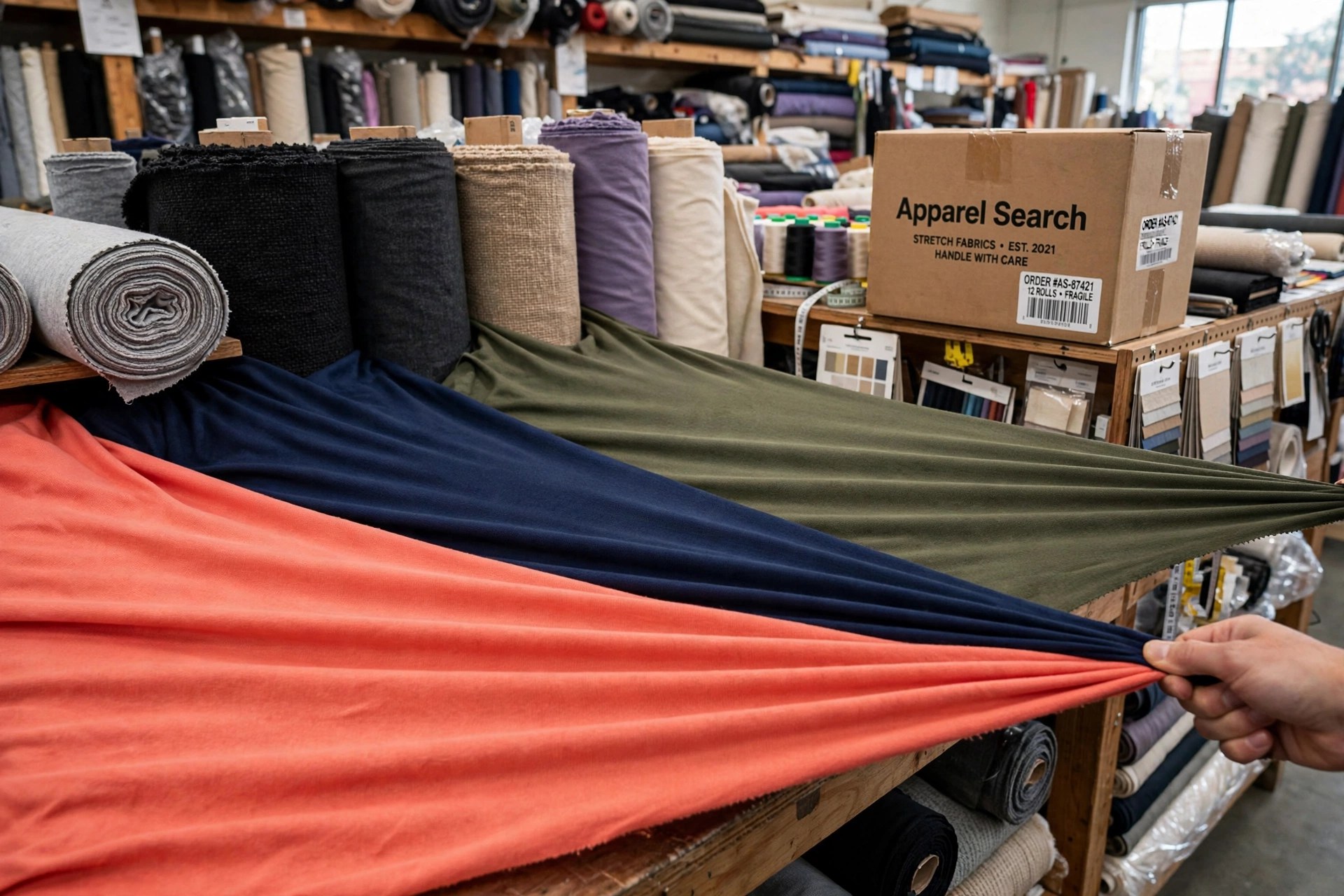
Two Ways Fabric Stretches
The first way is elastane - the segmented polyurethane fiber sold under names such as spandex and Lycra - which can stretch to five times its length and snap back. It is never used alone: a few percent, core-spun or intermingled with cotton, polyester, nylon or wool, turns a rigid cloth into a comfort-stretch fabric, and 15-40 percent builds the power stretch of activewear and swimwear. The second way needs no elastane at all. Mechanical stretch comes from the structure - every knit stretches because its loops deform - and from yarn engineering: textured and false-twist polyester yarns, bicomponent fibers that crimp as they cool, and weave constructions that build give into a woven cloth.
The distinction matters commercially. Elastane gives the strongest, most reliable recovery but degrades with chlorine, heat and time, and it complicates recycling. Mechanical-stretch fabrics cost more to engineer but wear longer and recycle with mono-material programs, which is why denim, trousering and suiting brands have invested heavily in them.
Stretch in Knits and Wovens
In knits, stretch is measured by how far the fabric extends under a standard load and how completely it recovers; two-way stretch extends across the width, four-way in both directions, and the jersey, interlock and warp-knit pages of this directory lead to mills working in all of them. In wovens, stretch is usually weft-wise only - the direction a pair of jeans or a fitted shirt needs to give - though bi-stretch suiting and shirting exist. Woven stretch quality is judged on growth: how much the fabric bags after wear. Good mills keep residual growth to a few percent through yarn choice, weave density and heat-setting.
Buyers should specify stretch and recovery numbers, not just elastane percentage, and should test after washing and tumble drying, since elastane loses power fastest in the dryer. Chlorine-resistant elastane is standard for swimwear programs, and black elastane is preferred for dark fabrics because standard elastane can grin through - showing pale at the surface when the fabric is stretched.
The Mills on This Page
The original stretch fabric directory listed ten mills, and all ten are kept below with their profiles: Ahmed Fine Textile Mills of Pakistan, Alok Textile Industries of India, Best Textiles International of China, Beximco Group of Bangladesh, Ceyteks Tekstil of Turkey, Gulshan Weaving Mills of Pakistan, Kuanging Industrial of Taiwan, PT. Frans Putratex of Indonesia, Safer Textile Processing Corp. of the USA and Shahtex (Leicester) Limited of the United Kingdom - a genuinely global list, reflecting how completely stretch has spread through every fabric-producing region.
Care and garment engineering decide whether stretch performs in the field. Elastane should never meet chlorine bleach, high dryer heat or prolonged hot pressing, all of which break the polymer chains that provide recovery; care labels on elastane garments exist for chemical reasons, not caution. Pattern makers must cut stretch garments differently - negative ease in four-way knits, reduced ease in comfort-stretch wovens - and factories need walking-foot or differential-feed machines so seams extend with the cloth instead of popping. Mills support this end of the chain by supplying stretch test data with each lot: extension under load, recovery after a set rest, and growth after repeated cycling. A quotation that includes those figures is worth more than a cheaper one that leaves the garment factory to discover them.
The category keeps widening: stretch has moved from jeans and activewear into suiting, shirting, footwear uppers and even tailored coats, and each new use pushes mills to deliver give without the rubbery hand that early stretch fabrics had. Modern stretch cloth is engineered to feel like the fabric it replaces, only kinder.
Fabric Mills and Factories in This Directory
The mills below are the listings the original Apparel Search directory carried on this page. Each name opens that company's profile in the Fabric Mills by Name directory.
Ahmed Fine Textile Mills Limited
A fabric mill based in Pakistan, profiled in the Apparel Search Fabric Mills by Name directory and listed among the mills supplying this fabric type.
Alok Textile Industries
A fabric mill based in India, profiled in the Apparel Search Fabric Mills by Name directory and listed among the mills supplying this fabric type.
Best Textiles International Co.,Ltd
A fabric mill based in China, profiled in the Apparel Search Fabric Mills by Name directory and listed among the mills supplying this fabric type.
Beximco Group
A fabric mill based in Bangladesh, profiled in the Apparel Search Fabric Mills by Name directory and listed among the mills supplying this fabric type.
Ceyteks Tekstil
A fabric mill based in Turkey, profiled in the Apparel Search Fabric Mills by Name directory and listed among the mills supplying this fabric type.
Gulshan Weaving Mills
A fabric mill based in Pakistan, profiled in the Apparel Search Fabric Mills by Name directory and listed among the mills supplying this fabric type.
Kuanging Industrial Co. Ltd.
A fabric mill based in Taiwan, profiled in the Apparel Search Fabric Mills by Name directory and listed among the mills supplying this fabric type.
PT. Frans Putratex
A fabric mill based in Indonesia, profiled in the Apparel Search Fabric Mills by Name directory and listed among the mills supplying this fabric type.
Safer Textile Processing Corp.
A fabric mill based in USA, profiled in the Apparel Search Fabric Mills by Name directory and listed among the mills supplying this fabric type.
Shahtex (Leicester) Limited
A fabric mill based in United Kingdom, profiled in the Apparel Search Fabric Mills by Name directory and listed among the mills supplying this fabric type.
Common Questions
What is the difference between stretch and elastane content?
Elastane is one way to get stretch, but not the only one: knits stretch structurally, and textured or bicomponent yarns give woven fabrics mechanical stretch with no elastane at all.
What do two-way and four-way stretch mean?
Two-way stretch fabric extends in one direction, usually across the width. Four-way stretch extends across both width and length, common in activewear and swimwear.
How do I keep stretch fabric from losing its recovery?
Wash cool, avoid chlorine bleach, and tumble dry low or line dry - heat is elastane's main enemy, and most recovery loss happens in hot dryers.
More to Explore
- Ahmed Fine Textile Mills Limited
- Alok Textile Industries
- Antibacterial Fabric
- Bamboo
- Basalt
- Best Textiles International Co.,Ltd
- Beximco Group
- Boucle
- Breathable
- Broadcloth
- Brocade
- Burlettes
- Canvas
- Carbon
- Ceyteks Tekstil
- Chambray
- Chenille
- Chiffon
- Circular
- Clothing Industry Employment
- Clothing Industry Factories
- Conversion Charts
- Corduroy
- Cotton
- Crepe
- Crochet
- Damask
- Denim
- Dobby
- Double Knit
- Drill
- Duck
- Dyed Fabric
- Embroidered
- Embroidery Directory
- Fabric
- Fabric Definitions
- Fabric Directory
- Fabric Retail
- Fabric Wholesalers
- Fashion Industry News
- Fiberglass
- Fibers Directory
- Fil-a-Fils
- Filter Cloth
- Flame Retardant
- Fleece
- French Terry
- Gabardine
- Gauze
- Georgettes
- Ginghams
- Greige Fabric
- Gulshan Weaving Mills
- Herringbone
- Horse Hair
- Interlining
- Interlock
- Jacquard
- Jersey Fabric
- Kuanging Industrial Co. Ltd.
- Lace
- Lacoste
- Linen
- Lining
- Long Fiber Reinforced Thermalplastics
- Mesh
- Metallic
- Muslin
- Narrow
- Net
- Non Woven Fabric
- Novelty
- Nylon
- Ottoman
- Oxford
- Percale
- Pile
- Pique
- Pointelle
- Polar Fleece
- Polyester
- Poplin
- Printed
- Printing Directory
- PT. Frans Putratex
- Quilted
- Raschel
- Reflective
- Rib
- Safer Textile Processing Corp.
- Sateen
- Satin
- Seersucker
- Shahtex (Leicester) Limited
- Silk Fabric
- Single Jersey
- Smart Fabrics
- Suede
- Taffeta
- Tassars
- Terry
- Textile Machinery
- Textiles
- Thermal
- Tricot
- Tulle
- Tweed
- Twill
- Velcro
- Velour
- Velvet
- Viole
- Vynil
- Waffle
- Waterproof
- Wool
- Yarn Dyed
- Yarn Factories
Looking for Fabric Mills and Suppliers?
The wider directory behind these pages is the Fabric section hub, which opens the whole Apparel Search fabric mill directory: fabric types from A to Z, the Fabric Mills by Name profiles, and the dyeing, printing and finishing directories that support them.