Mesh Fabric Mills Directory
Mesh is the open fabric: a knit (or woven) structure full of evenly spaced holes, built for airflow, stretch and lightness. This directory explains the mesh families and carries the eight mills this section lists under mesh fabric factories - four in China, two in Taiwan and two in the USA, each linked to its Fabric Mills by Name profile.
Shop Mesh Fabric Now
Shop Mesh Fabric on Amazon Shop Mesh Fabric on eBayThe Amazon and eBay links on this page are affiliate links. If you make a purchase through them, Apparel Search may earn a commission.
What Mesh Fabric Is
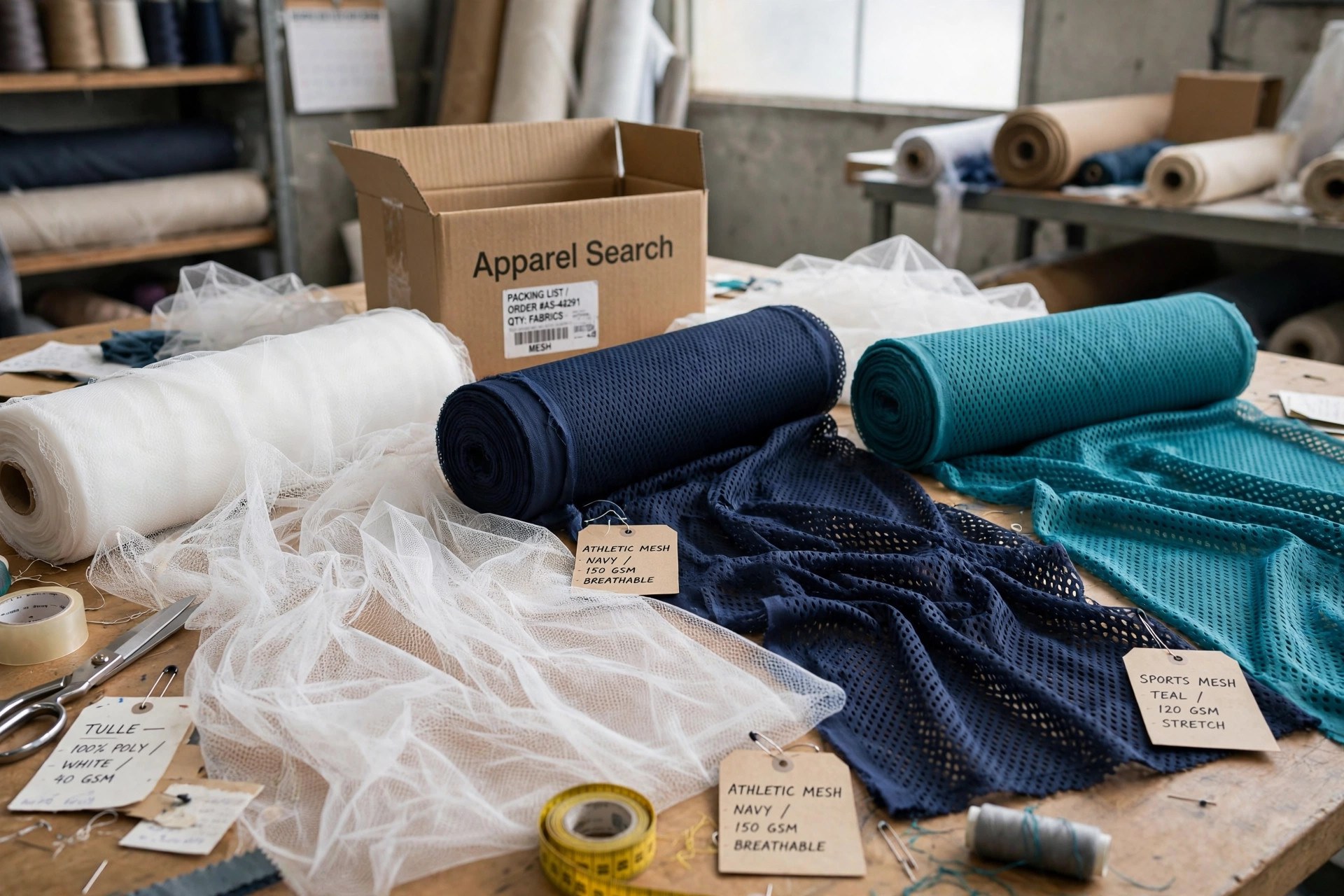
A mesh is defined by its holes. Instead of a solid surface, the yarns are knitted or woven into a net of open spaces, so air and light pass straight through and the finished cloth weighs very little for its area. Most apparel mesh is knitted - warp-knitted on tricot and raschel machines, or weft-knitted - because knitting gives the openings stability while keeping the fabric flexible and, with elastane in the mix, stretchy. The size of the hole is the first design choice: a fine, almost invisible mesh behaves like a sheer lining cloth, a medium hexagonal mesh is the familiar sports jersey fabric, and a coarse, stiff net holds a shape of its own in bags, hats and shoe uppers.
Fibre follows end use. Polyester dominates athletic and industrial mesh because it is strong, quick to dry and holds the knitted openings without sagging; nylon mesh is softer and tougher against abrasion, which suits shoe uppers and luggage; cotton and viscose meshes appear in fashion and lingerie where hand feel matters more than drying speed. Finishes change the character further - moisture-management treatments for sportswear, flame-retardant finishes for contract uses, anti-microbial treatments for footwear linings - so two fabrics that look alike on the roll can be specified very differently underneath.
The Mesh Families and Where They Are Used
Athletic mesh - the perforated knit of team jerseys, shorts and cap panels - is the volume member of the family, valued because the openings vent heat exactly where a garment would otherwise trap it. Power mesh (also called power net) adds strong elastane stretch and compression, and is the unseen structure inside bras, shapewear and dancewear. Tulle and bridal net sit at the fine, soft end, layered for veils, skirts and overlays where the holes are small enough to read as haze rather than net. Tricot mesh, warp-knitted and run-resistant, lines shoes, bags and helmets, while spacer mesh - two mesh faces joined by a pile of monofilament yarns - cushions footwear uppers, backpack panels and medical supports.
Outside apparel the same structures filter, screen and carry: laundry and produce bags, beekeeping veils, tent windows, speaker covers and industrial filtration all run on mesh of one gauge or another. The mills listed below are this directory's mesh specialists, and the mix of countries is typical of the trade - high-volume knitters in Changshu, Wujiang and the Shenghong group in China, established knit factories in Taiwan such as Lu Her, and US converters and processors such as Lincoln Textile Sales and Safer Textile Processing. Readers comparing open fabrics should also see the Net Textiles directory and the Tulle Fabric page. Thank you for using the Apparel Search Fabric Mill Directory.
Specifying and Buying Mesh
A useful mesh specification names five things: the fibre, the hole size and pattern, the finished weight, the stretch (and elastane content, if any), and the finish the end use requires. Hole size is the trap for the unwary - it is quoted differently across suppliers, so a swatch, not a number, settles whether a mesh will work as a breathable jersey or collapse as a lining. Check recovery on stretch meshes by pulling a corner: the openings should return to shape evenly, without grin-through or distortion, and check the edges, because a mesh that curls hard at the cut edge will fight the sewing line. For sportswear programmes, confirm the moisture and odour finishes survive the wash count the garment promises; for footwear and bags, ask about abrasion testing, where nylon usually outlasts polyester at the same weight.
Mesh Fabric Mills Listed Here
Changshu Huarui Knitting Textile Co., Ltd (China)
Listed in this directory under mesh fabric mills. Follow the company name to its Fabric Mills by Name profile, which carries its full directory record.
Changshu Sunwell Knitting Textile Co., Ltd. (China)
Listed in this directory under mesh fabric mills. Follow the company name to its Fabric Mills by Name profile, which carries its full directory record.
Dimple International Corporation (Taiwan)
Listed in this directory under mesh fabric mills. Follow the company name to its Fabric Mills by Name profile, which carries its full directory record.
Lincoln Textile Sales, Inc (USA)
Listed in this directory under mesh fabric mills. Follow the company name to its Fabric Mills by Name profile, which carries its full directory record.
Lu Her Knitting Factory (Taiwan)
Listed in this directory under mesh fabric mills. Follow the company name to its Fabric Mills by Name profile, which carries its full directory record.
Safer Textile Processing Corp. (USA)
Listed in this directory under mesh fabric mills. Follow the company name to its Fabric Mills by Name profile, which carries its full directory record.
Shenghong Group Co Ltd (China)
Listed in this directory under mesh fabric mills. Follow the company name to its Fabric Mills by Name profile, which carries its full directory record.
Wujiang Longshen Enterprise (China)
Listed in this directory under mesh fabric mills. Follow the company name to its Fabric Mills by Name profile, which carries its full directory record.
Common Questions
What is mesh fabric made from?
Most apparel mesh is polyester or nylon, knitted into an open net of evenly spaced holes; cotton and viscose meshes exist for fashion uses, and power mesh adds elastane for strong stretch. Polyester dominates sportswear mesh because it is light, strong and quick to dry.
What is the difference between mesh, net and tulle?
They are one family at different scales. Mesh is the general term for an open hole structure; net is usually stiffer and coarser, used for bags and structure; tulle is the finest, softest version, used for veils, overlays and bridal wear.
Which mills does this directory list for mesh fabric?
Eight companies: Changshu Huarui, Changshu Sunwell, Shenghong Group and Wujiang Longshen in China; Dimple International and Lu Her Knitting Factory in Taiwan; and Lincoln Textile Sales and Safer Textile Processing in the USA - each linked to its Fabric Mills by Name profile.
More to Explore - The Full Fabric Directory A-Z
- Metallic Fabric
- Muslin Fabric Mills
- Net Textiles
- Tulle Fabric
- Tricot Fabric
- Raschel Fabric
- Fabric Mills - Fabric Section Hub
- Textile Machinery
- Embroidery Directory
- Printing Directory
- Changshu Huarui Knitting Textile Co., Ltd
- Changshu Sunwell Knitting Textile Co., Ltd.
- Dimple International Corporation
- Lincoln Textile Sales, Inc
- Lu Her Knitting Factory
- Safer Textile Processing Corp.
- Shenghong Group Co Ltd
- Wujiang Longshen Enterprise
- Clothing Industry Factories
- Yarn Factories
- Fabric Retail
- Fabric Wholesalers
- Fibers Directory
- Fabric Definitions
- Fashion Industry News
- Clothing Industry Employment
- Conversion Charts
- Antibacterial Fabric
- Bamboo
- Basalt
- Boucle
- Breathable
- Broadcloth
- Brocade
- Burlettes
- Canvas
- Carbon
- Chambray
- Chenille
- Chiffon
- Circular
- Corduroy
- Cotton
- Crepe
- Crochet
- Damask
- Denim
- Dobby
- Double Knit
- Drill
- Duck
- Dyed Fabric
- Embroidered
- Fiberglass
- Fil-a-Fils
- Filter Cloth
- Flame Retardant
- Fleece
- French Terry
- Gabardine
- Gauze
- Georgettes
- Ginghams
- Greige Fabric
- Herringbone
- Horse Hair
- Interlining
- Interlock
- Jacquard
- Jersey Fabric
- Lace
- Lacoste
- Linen
- Lining
- Long Fiber Reinforced Thermalplastics
- Narrow
- Non Woven Fabric
- Novelty
- Nylon
- Ottoman
- Oxford
- Percale
- Pile
- Pique
- Pointelle
- Polar Fleece
- Polyester
- Poplin
- Printed
- Quilted
- Reflective
- Rib
- Sateen
- Satin
- Seersucker
- Silk Fabric
- Single Jersey
- Smart Fabrics
- Stretch
- Suede
- Taffeta
- Tassars
- Terry
- Thermal
- Tweed
- Twill
- Velcro
- Velour
- Velvet
- Viole
- Vynil
- Waffle
- Waterproof
- Wool
- Yarn Dyed
- Textiles
- Fabric
Looking for Fabric Mills and Suppliers?
Return to the Fabric Directory hub for the full fabric section, or browse the Fabric Manufacturers Directory page for the wider mill trade.