Printed Fabric Factory Directory
Printed fabric is pattern applied to cloth rather than woven into it: screens, rollers or inkjets lay dye or pigment in a design on a prepared ground, so a single base fabric can become a thousand different fabrics in a season. This directory explains the main printing methods and what separates a durable print from a fading one, and carries the fourteen factories this section lists under printed fabric factories, in China, Taiwan, the USA, India and Pakistan.
Shop Printed Fabric Now
Shop Printed Fabric on Amazon Shop Printed Fabric on eBayThe Amazon and eBay links on this page are affiliate links. If you make a purchase through them, Apparel Search may earn a commission.
How Fabric Printing Works
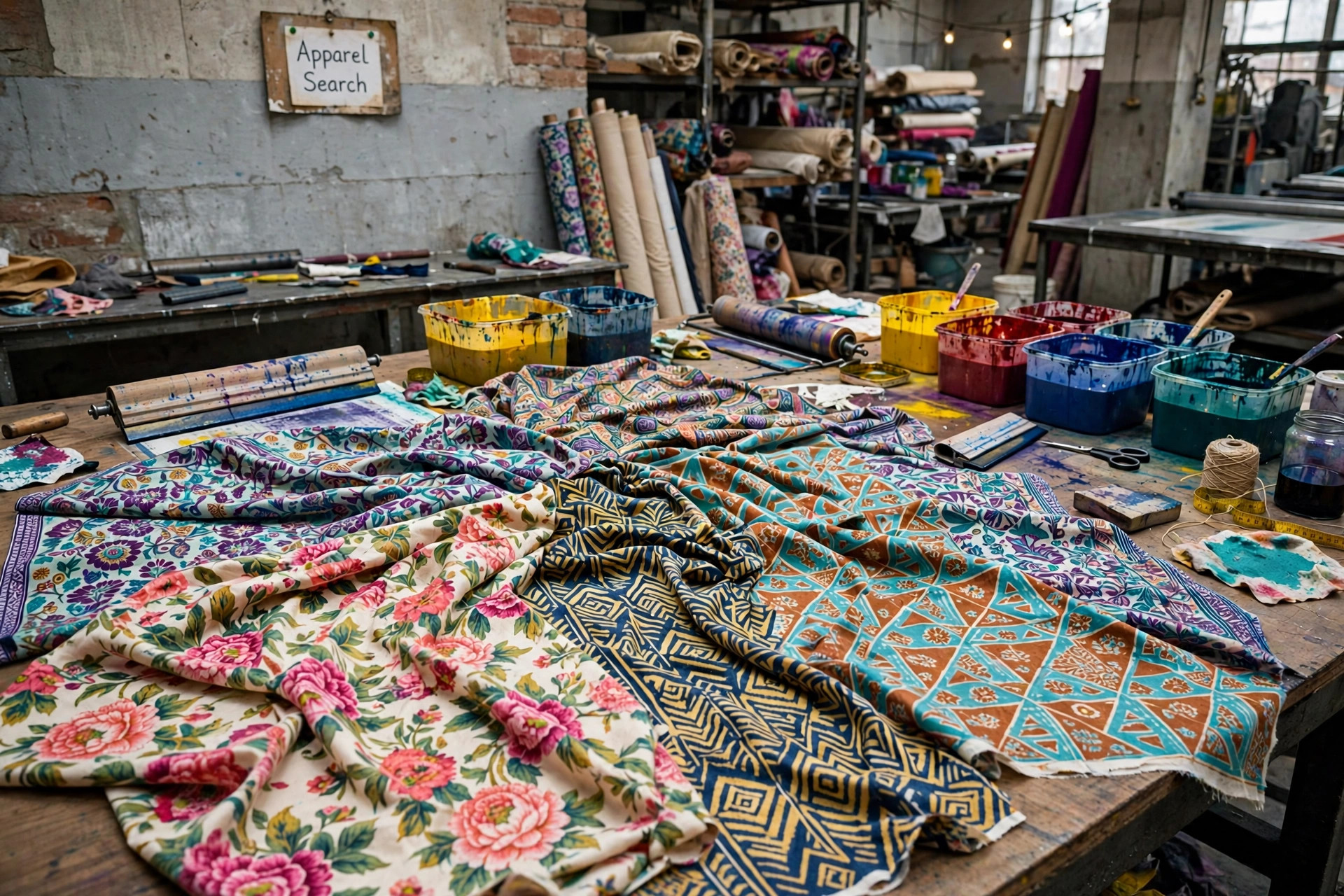
All printing starts with a prepared ground: the base cloth, cotton, polyester, blends, silk or rayon, is scoured, bleached and often mercerised so it takes colour evenly, because any unevenness in preparation prints through as cloudiness no design can hide. Rotary screen printing is the industry workhorse, forcing paste through engraved rotating screens, one per colour, at high speed for long runs. Flat screen printing suits shorter, finer work; copper roller printing, the oldest mechanised method, survives in niches; and digital inkjet printing has redrawn the trade by removing screens entirely, letting mills print photographs, huge repeats and runs of a few metres at the cost of speed and a different ink chemistry.
The chemistry sets the durability. Pigment prints sit on the surface in a binder: economical, workable on almost any fibre, but stiffer and less wash-proof at heavy coverage. Reactive dyes bond chemically into cotton and rayon for soft, wash-fast fashion prints; disperse dyes sublime into polyester with excellent fastness; vat and discharge printing serve workwear and special effects where the print must survive industrial washing or where a pattern is bleached out of a dyed ground. A print buyer judges all of it by registration, the alignment of the colours, handle, and fastness to washing, rubbing and light, in that order on a production sample rather than a strike-off.
Where Printed Fabric Is Used
Fashion is the visible market: dresses, shirts, skirts and scarves in florals, geometrics, animal prints and seasonal novelties, where print is the fastest way to make last season's base cloth this season's garment. Home textiles take printed cloth for curtains, bedding, upholstery and table linen, children's products for its licensed characters and bright repeats, and quilting for the coordinated cotton print collections that are an industry of their own. Uniform and promotional work uses printing for logos and camouflage, and technical users print everything from medical textiles to flags and banners, where the base cloth and ink are specified as one system. The same factory often prints its own woven or knitted base and buys in greige cloth to print for others.
The fourteen listings below are this directory's printed fabric factories, each linked to its Fabric Mills by Name profile: Best Textiles International Co.,Ltd, Shanghai Best Linen Cotton Textile Factory, Shenghong Group Co Ltd and Zhejiang Nanyixiang Textile CO.,LTD of China, Dimple International Corporation of Taiwan, Safer Textile Processing Corp. and Unitex International of the USA, Sri Jaisri Export of India, Usman Enterprises of Pakistan, and Glacial Exports, Lotus Mills, Rashid Textile Printing Ind. (Pvt.) Ltd., Sahiba Exports and The West Coast Weaving Establishment. None has been removed: no listing was verified dead, and this directory's standing rule is to keep a listing when in doubt. Thank you for using the Apparel Search Fabric Mill Directory.
Specifying and Buying Printed Fabric
Specify a print by base cloth, print method, dye or pigment system, number of colours, repeat size and fastness standards, and approve a production-range sample, not only the strike-off, because registration drift and colour variation appear at speed and distance into a run. Check the handle where coverage is heavy, since a stiff pigment area on a soft ground is the most common disappointment in printed fashion cloth, and confirm the pattern's repeat against the garment's pattern pieces, because a repeat that does not fit the marker wastes cloth or forces mismatched seams. For digital printing, confirm resolution, colour gamut expectations and wash fastness in writing, since inkjet prints vary more by mill than screen prints do.
Care for printed fabric follows the print system as much as the fibre. Wash prints inside out, cool to warm, with similar colours, because the first washes release loose surface colour from pigment and reactive prints alike; avoid bleach on any print and strong detergent on discharge and metallic effects. Dry printed cloth out of harsh direct sun, which fades surface prints faster than the ground beneath them, and iron on the reverse so heat and friction never meet the printed face directly. Stored rolled or folded with tissue, a good print keeps its colour for the life of the cloth under it.
Printed Fabric Factories Listed Here
Best Textiles International Co.,Ltd (China)
Listed in this directory. Follow the company name to its Fabric Mills by Name profile, which carries its full directory record.
Dimple International Corporation (Taiwan)
Listed in this directory. Follow the company name to its Fabric Mills by Name profile, which carries its full directory record.
Glacial Exports
Listed in this directory. Follow the company name to its Fabric Mills by Name profile, which carries its full directory record.
Lotus Mills
Listed in this directory. Follow the company name to its Fabric Mills by Name profile, which carries its full directory record.
Rashid Textile Printing Ind. (Pvt.) Ltd.
Listed in this directory. Follow the company name to its Fabric Mills by Name profile, which carries its full directory record.
Safer Textile Processing Corp. (USA)
Listed in this directory. Follow the company name to its Fabric Mills by Name profile, which carries its full directory record.
Sahiba Exports
Listed in this directory. Follow the company name to its Fabric Mills by Name profile, which carries its full directory record.
Shanghai Best Linen Cotton Textile Factory (China)
Listed in this directory. Follow the company name to its Fabric Mills by Name profile, which carries its full directory record.
Shenghong Group Co Ltd (China)
Listed in this directory. Follow the company name to its Fabric Mills by Name profile, which carries its full directory record.
Sri Jaisri Export (India)
Listed in this directory. Follow the company name to its Fabric Mills by Name profile, which carries its full directory record.
The West Coast Weaving Establishment
Listed in this directory. Follow the company name to its Fabric Mills by Name profile, which carries its full directory record.
Unitex International (USA)
Listed in this directory. Follow the company name to its Fabric Mills by Name profile, which carries its full directory record.
Usman Enterprises (Pakistan)
Listed in this directory. Follow the company name to its Fabric Mills by Name profile, which carries its full directory record.
Zhejiang Nanyixiang Textile CO.,LTD (China)
Listed in this directory. Follow the company name to its Fabric Mills by Name profile, which carries its full directory record.
Common Questions
What are the main fabric printing methods?
Rotary screen printing is the workhorse for long runs, with one engraved rotating screen per colour. Flat screen suits shorter, finer work, roller printing is the oldest mechanised method, and digital inkjet printing needs no screens, allowing photographic designs, large repeats and very short runs at lower speed.
What is the difference between pigment and reactive printing?
Pigment print sits on the cloth surface in a binder, works on almost any fibre and is economical, but can feel stiffer and wear faster at heavy coverage. Reactive dyes bond chemically into cotton and rayon fibres, giving a softer hand and excellent wash fastness, which is why fashion cottons are usually reactive printed.
Which factories does this directory list for printed fabric?
Fourteen factories, each linked to its Fabric Mills by Name profile, including Best Textiles International, Shanghai Best Linen Cotton, Shenghong Group and Zhejiang Nanyixiang (China), Dimple International (Taiwan), Safer Textile Processing and Unitex International (USA), Sri Jaisri Export (India) and Usman Enterprises (Pakistan).
More to Explore - The Full Fabric Directory A-Z
- Percale Fabric
- Pile Fabric
- Pique Fabric
- Pointelle Fabric
- Polar Fleece Fabric
- Polyester Fabric Mills
- Poplin Fabric
- Ottoman Fabric Mills
- Oxford Fabric Mills
- Nylon Fabric Mills
- Quilted Fabric
- Fabric Mills - Fabric Section Hub
- Printed Fabric Search
- Textile Machinery
- Embroidery Directory
- Printing Directory
- Best Textiles International Co.,Ltd
- Dimple International Corporation
- Glacial Exports
- Lotus Mills
- R ashid Textile Printing Ind. (Pvt.) Ltd.
- Safer Textile Processing Corp.
- Sahiba Exports
- Shanghai Best Linen Cotton Textile Factory
- Shenghong Group Co Ltd
- Sri Jaisri Export
- The West Coast Weaving Establishment
- Unitex International
- Usman Enterprises
- Zhejiang Nanyixiang Textile CO.,LTD
- Clothing Industry Factories
- Yarn Factories
- Fabric Retail
- Fabric Wholesalers
- Fibers Directory
- Fabric Definitions
- Fashion Industry News
- Employment Directory Clothing Industry
- Conversion Charts
- Textiles
- Fabric
Looking for Fabric Mills and Suppliers?
Return to the Fabric Directory hub for the full fabric section, or browse the Fabric Manufacturers Directory page for the wider mill trade.