Raschel Fabric Mills Directory
Raschel fabric is warp knitted on a Raschel machine, the versatile member of the warp-knit family that makes everything from fine lace and tulle to power net, spacer fabrics and heavy technical textiles. This directory explains how Raschel knitting works and where the cloth goes, and carries the one mill this section lists under Raschel fabric, Carolina Apparel Group, Inc. in the USA.
Shop Raschel Fabric Now
Shop Raschel Fabric on Amazon Shop Raschel Fabric on eBayThese links open the Apparel Search shopping guides for Amazon and eBay, where the product links are kept in one place.
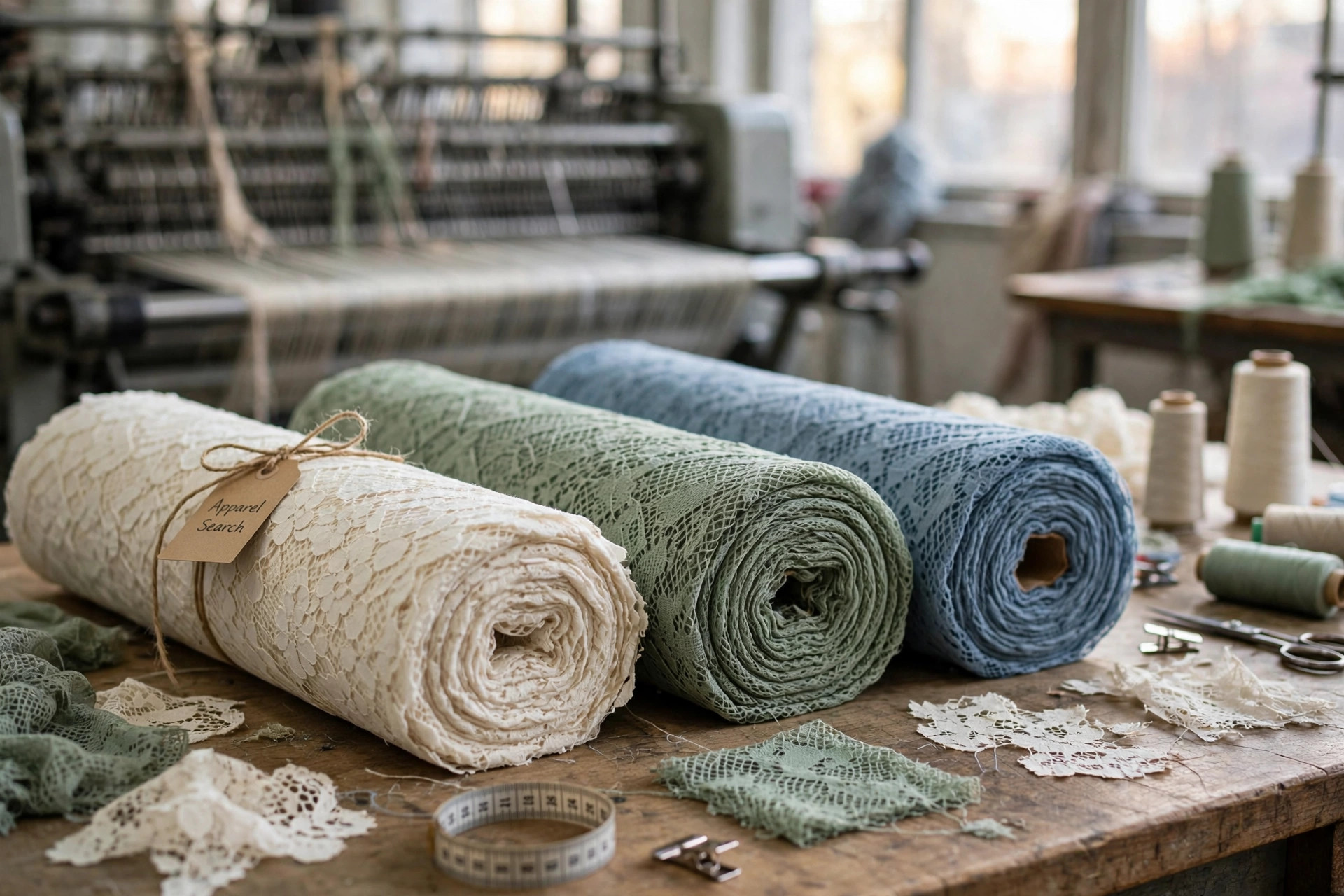
What Raschel Knitting Is
Warp knitting feeds many yarns at once, one for every needle across the machine width, and loops them together lengthwise so the fabric grows in the warp direction. The Raschel machine is the most flexible of the warp-knit machines: it works with a plate that the loops are formed over rather than the sinkers of its cousin the tricot machine, it handles yarns from the finest filament to coarse spun and even tape-like yarns, and it can lay extra yarns straight into the structure without looping them, which is how it builds patterns, grounds and effects that a tricot machine cannot. The result is an unusually wide family of fabrics carrying one machine name.
That range is the point of a Raschel directory. At the fine end, Raschel machines knit the lace, tulle, veiling and mesh that dressmaking and bridal work depend on. In the middle sit power net and elastic meshes for foundation garments, sportswear meshes, and mosquito and safety netting. At the heavy end, the same principle produces spacer fabrics for shoe uppers and seating, geotextiles, and open structures for agriculture and construction. A buyer asking for Raschel fabric therefore has to say which Raschel: the machine family guarantees the loop structure, not the weight, fibre or hand of the finished cloth.
Raschel Compared With Tricot and Weft Knits
Tricot, the other common warp knit, is the smoother, finer, more limited sibling: it excels at plain, uniform fabrics such as lining, lingerie and swimwear cloth, usually at lighter weights. Raschel trades some of that smoothness for patterning power and range, and Raschel fabrics are often more open, more textured and less run-prone in ways that suit lace and nets. Against weft knits such as jersey, where one yarn loops across the width, both warp knits are more dimensionally stable, resist laddering better, and hold an edge that can often be cut without the curling that makes weft-knit cutting awkward.
The one listing below is this directory's Raschel mill, linked to its Fabric Mills by Name profile: Carolina Apparel Group, Inc. of the USA. This section also points onward to Raschel fabric machinery, because for this fabric family the machine and the mill are natural companions: the patterning a buyer wants is set by the machine a mill runs, its gauge, its number of guide bars and whether it can lay in yarns, so machinery questions and mill questions belong on the same shortlist. No listing has been removed: none was verified dead, and the standing rule here is to keep a listing when in doubt.
Specifying and Handling Raschel Fabric
A workable Raschel specification names the end use first, then fibre, weight, width, mesh or pattern repeat, and any elasticity, including the elastane content and the direction of stretch. For lace and net, add the pattern scale relative to the garment pieces, because a large motif cut across small pieces wastes cloth and breaks the design. For technical Raschel fabrics, the test numbers matter more than the look: strength, elongation, and how the open structure behaves under load should come from the mill's data, checked against a production sample rather than a showroom swatch.
Handling follows the structure. Open meshes and laces snag, so they travel and store rolled or flat, away from hooks and rough surfaces, and they cut best with sharp blades and a stable lay. Elastic Raschel fabrics should rest after cutting so the panels recover before sewing, and stitching should use needles and stitch types that move with the cloth rather than perforating it. Care is set by the fibre: synthetic Raschel nets generally wash cool and dry quickly, while cotton and viscose versions want gentler handling to keep the pattern edges crisp through the garment's life.
Raschel Fabric Mills Listed Here
Carolina Apparel Group, Inc. (USA)
Listed in this directory. Follow the company name to its Fabric Mills by Name profile, which carries its full directory record.
Common Questions
What is Raschel fabric?
Fabric warp knitted on a Raschel machine, the most versatile warp-knit machine. Depending on the yarns and settings it produces lace, tulle, mesh and power net at the fine end and spacer fabrics, nets and technical textiles at the heavy end, all with the stable, lengthwise loop structure of warp knitting.
How does Raschel differ from tricot?
Both are warp knits. Tricot machines make smoother, finer, more uniform fabrics such as linings and lingerie cloth. Raschel machines handle a far wider range of yarns, can lay extra yarns into the structure for patterning, and make the open, textured and technical fabrics tricot cannot.
Which mill does this directory list for Raschel fabric?
One mill, linked to its Fabric Mills by Name profile: Carolina Apparel Group, Inc. (USA).
More to Explore - The Full Fabric Directory A-Z
- Reflective Fabric
- Registered Trade Marks - Textile Industry
- Rib Fabric Factories
- Quilted Fabric Mills
- Sateen Fabric
- Fabric Mills - Fabric Section Hub
- Raschel Fabric Machinery
- Textile Machinery
- Embroidery Directory
- Printing Directory
- Carolina Apparel Group, Inc.
- Clothing Industry Factories
- Yarn Factories
- Fabric Retail
- Fabric Wholesalers
- Fibers Directory
- Fabric Definitions
- Fashion Industry News
- Clothing Industry Employment
- Conversion Charts
- Antibacterial Fabric
- Bamboo
- Basalt
- Boucle
- Breathable
- Broadcloth
- Brocade
- Burlettes
- Canvas
- Carbon
- Chambray
- Chenille
- Chiffon
- Circular
- Corduroy
- Cotton
- Crepe
- Crochet
- Damask
- Denim
- Dobby
- Double Knit
- Drill
- Duck
- Dyed Fabric
- Embroidered
- Fiberglass
- Fil-a-Fils
- Filter Cloth
- Flame Retardant
- Fleece
- French Terry
- Gabardine
- Gauze
- Georgettes
- Ginghams
- Greige Fabric
- Herringbone
- Horse Hair
- Interlining
- Interlock
- Jacquard
- Jersey Fabric
- Lace
- Lacoste
- Linen
- Lining
- Long Fiber Reinforced Thermalplastics
- Metallic
- Mesh
- Muslin
- Narrow
- Net
- Non Woven Fabric
- Novelty
- Nylon
- Ottoman
- Oxford
- Percale
- Pile
- Pique
- Pointelle
- Polar Fleece
- Polyester
- Poplin
- Printed
- Satin
- Seersucker
- Silk Fabric
- Single Jersey
- Smart Fabrics
- Stretch
- Suede
- Taffeta
- Tassars
- Terry
- Thermal
- Tricot
- Tulle
- Tweed
- Twill
- Velcro
- Velour
- Velvet
- Viole
- Vynil
- Waffle
- Waterproof
- Wool
- Yarn Dyed
- Textiles
- Fabric
Looking for Fabric Mills and Suppliers?
Return to the Fabric Directory hub for the full fabric section, or browse the Fabric Manufacturers Directory page for the wider mill trade.