Embroidered Fabric
Embroidered fabric carries its pattern in thread stitched into a ground cloth - the oldest surface decoration in textiles, industrialised by the schiffli and multi-head machine. This directory explains the main techniques and lists the nine embroidered fabric mills Apparel Search carries.
Shop Embroidered Fabric Now
Shop Embroidered Fabric on Amazon Shop Embroidered Fabric on eBayThe Amazon and eBay links on this page are affiliate links. If you make a purchase through them, Apparel Search may earn a commission.
What Embroidered Fabric Is
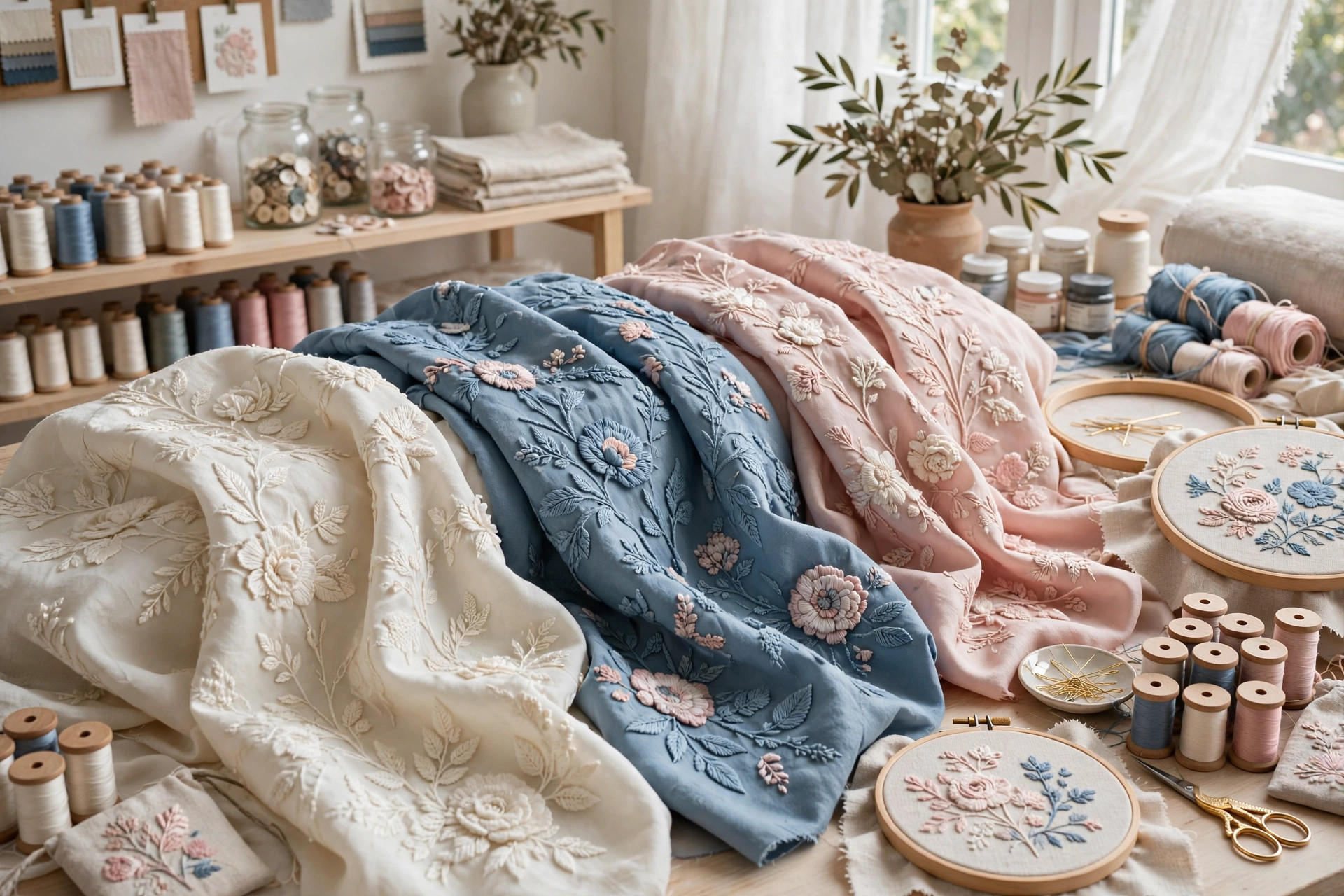
Embroidery decorates a ground fabric with stitched thread - a design worked into the cloth rather than woven into its structure or printed onto its surface. As a fabric category it means cloth embroidered across its full width for cutting into garments, as distinct from the motif and logo embroidery applied to a finished garment, which this site covers in its Embroidery Directory; the formal Embroidery Definition in the definitions section states the craft precisely. Full-width work is done on two machine families: the schiffli machine, whose hundreds of needles stitch a repeating design across a wide ground at once - the historic engine of the Swiss and Indian embroidered-cloth trade - and multi-head machines, which repeat smaller motifs and borders. Eyelet embroidery (broderie anglaise), with its punched holes edged in stitch, and guipure, where the stitching itself forms a lace with no ground at all, are the family's best-known forms.
Almost any ground can carry embroidery - cotton voile and cambric for the classic whitework trade, organza and tulle for bridal cloth, denim and canvas for fashion workwear effects, knitted grounds for embellished jersey - and the thread decides the character as much as the design: matte cotton thread for traditional work, rayon and polyester for sheen and color range, metallic thread for ceremony, wool for crewel-style texture. Because the decoration is added after the ground is woven or knitted, an embroidered fabric combines two supply chains in one cloth, which is why its mills cluster where skilled embroidery industries already exist.
Buying and Using Embroidered Fabrics
The specification points are ground, design repeat and stitch density. The ground comes first because it fixes the garment the cloth can become - its weight, drape and care all follow the base fabric, with the embroidery adding stiffness roughly in proportion to how much of the surface it covers. Repeat size decides cutting economics: a large schiffli repeat wastes cloth if garment panels cannot be placed to use the design well, and borders and scalloped edges must be planned into the pattern before cutting, not discovered at the table. Stitch density is the quality dial - denser stitching gives richer coverage and a firmer hand and costs more in thread and machine time; a sample washed before bulk ordering shows whether ground and thread shrink together or pucker against each other, the classic fault of a badly matched embroidery specification.
Care follows the more delicate of the two partners: metallic and rayon threads and open eyelet work ask gentler handling than a plain ground would need, and heavy embroidery on a light ground should be supported in wear and storage so the stitching does not drag the cloth out of shape. Around this directory, the Fabric Directory hub covers the full fabric family A-Z - the menu carried at the foot of this page is that directory in full - and the trade runs through the Textile Machinery directory, Clothing Industry Factories, Yarn Factories, Fabric Retail and Fabric Wholesalers, with the Fibers Directory and Fabric Definitions alongside.
Using This Directory
The listings below are the complete set for this category as Apparel Search carries it: nine mills across India, China and Pakistan, each linked to its own profile in the Fabric Mills by Name section. No listing has been added or removed. Several of these mills appear elsewhere in the fabric directory under their ground-cloth specialities as well, which reflects how the trade works - an embroidery mill is usually also a weaver or knitter of grounds, selling the finished decorated cloth. Industry readers also use Fashion Industry News, Clothing Industry Employment and Conversion Charts. When you enquire, send a photograph of the design type you want with the ground cloth and width you need; embroidery is quoted from artwork, and a picture settles in one exchange what a description cannot. Thank you for using the Apparel Search Fabric Mill Directory.
Embroidered Fabric Mills Listed in This Directory
Alok Textile Industries (India)
Company listed in the Apparel Search fabric mill directory under its own profile in the Fabric Mills by Name section. Open the linked profile for the company's directory record and contact details.
Flytex Fabric Company Limited (China)
Company listed in the Apparel Search fabric mill directory under its own profile in the Fabric Mills by Name section. Open the linked profile for the company's directory record and contact details.
Glacial Exports
Company listed in the Apparel Search fabric mill directory under its own profile in the Fabric Mills by Name section. Open the linked profile for the company's directory record and contact details.
G R Garments (India)
Company listed in the Apparel Search fabric mill directory under its own profile in the Fabric Mills by Name section. Open the linked profile for the company's directory record and contact details.
Hands On (India)
Company listed in the Apparel Search fabric mill directory under its own profile in the Fabric Mills by Name section. Open the linked profile for the company's directory record and contact details.
Sriyansh Ispat Limited (India)
Company listed in the Apparel Search fabric mill directory under its own profile in the Fabric Mills by Name section. Open the linked profile for the company's directory record and contact details.
Supreme Textile Industries (Pvt) Limited (Pakistan)
Company listed in the Apparel Search fabric mill directory under its own profile in the Fabric Mills by Name section. Open the linked profile for the company's directory record and contact details.
The West Coast Weaving Establishment
Company listed in the Apparel Search fabric mill directory under its own profile in the Fabric Mills by Name section. Open the linked profile for the company's directory record and contact details.
Zhejiang Nanyixiang Textile CO.,LTD (China)
Company listed in the Apparel Search fabric mill directory under its own profile in the Fabric Mills by Name section. Open the linked profile for the company's directory record and contact details.
Common Questions
What is the difference between embroidered fabric and garment embroidery?
Embroidered fabric is decorated across its full width before cutting - the pattern is part of the cloth a garment is made from. Garment embroidery applies a motif, monogram or logo to a finished piece. This directory lists mills selling the full-width cloth; the site's Embroidery Directory covers the garment-decoration trade.
What is schiffli embroidery?
Schiffli is full-width machine embroidery worked by hundreds of needles at once, stitching a repeating design across a wide ground cloth in a single pass. It is the historic production method behind Swiss and Indian embroidered cottons, eyelet cloth and embroidered laces, and the standard route to embroidered fabric in quantity.
How many mills are listed in this embroidered fabric directory?
Nine: Alok Textile Industries (India), Flytex Fabric Company Limited (China), Glacial Exports, G R Garments (India), Hands On (India), Sriyansh Ispat Limited (India), Supreme Textile Industries (Pakistan), The West Coast Weaving Establishment and Zhejiang Nanyixiang Textile CO.,LTD (China).
More to Explore - The Full Fabric Directory A-Z
- Electromagnetic Shielding Fabrics
- Embroidered Fabric
- Damask Fabric Factory
- Denim Fabric Directory
- Dobby Textile Factory
- Double Knit Fabric Factories
- Drill Fabric Mills
- Duck Fabric Directory
- Dyed Fabric Manufacturers
- Canvas Fabric Directory
- Carbon Fabric
- Chambray Fabric Directory
- Chenille Fabric Mills
- Chiffon Fabric Directory
- Circular Knit Fabric Mills
- Corduroy Fabric Mills
- Cotton Fabric Mills
- Crepe Fabric Directory
- Crochet Fabric Mills
- Bamboo Fabric Mill Directory
- Basalt Fabric
- Boucle Fabric Mills
- Breathable Knit Fabric
- Broadcloth Fabric Directory
- Brocade Fabric Mills
- Burlettes Fabric Mills
- About Fabrics
- About Knitted Fabrics
- About Woven Fabrics
- Antibacterial Fabric Mills
- Fabric Mills - Fabric Section Hub
- Textile Machinery
- Embroidery Directory
- Embroidery Definition
- Alok Textile Industries
- Flytex Fabric Company Limited
- Glacial Exports
- G R Garments
- Hands On
- Sriyansh Ispat Limited
- Supreme Textile Industries (Pvt) Limited
- The West Coast Weaving Establishment
- Zhejiang Nanyixiang Textile CO.,LTD
- Clothing Industry Factories
- Yarn Factories
- Fabric Retail
- Fabric Wholesalers
- Fibers Directory
- Fabric Definitions
- Fashion Industry News
- Clothing Industry Employment
- Conversion Charts
- Fiberglass
- Fil-a-Fils
- Filter Cloth
- Flame Retardant
- Fleece
- French Terry
- Gabardine
- Gauze
- Georgettes
- Ginghams
- Greige Fabric
- Herringbone
- Horse Hair
- Interlining
- Interlock
- Jacquard
- Jersey Fabric
- Lace
- Lacoste
- Linen
- Lining
- Long Fiber Reinforced Thermalplastics
- Metallic
- Mesh
- Muslin
- Narrow
- Net
- Non Woven Fabric
- Novelty
- Nylon
- Ottoman
- Oxford
- Percale
- Pile
- Pique
- Pointelle
- Polar Fleece
- Polyester
- Poplin
- Printed
- Quilted
- Raschel
- Reflective
- Rib
- Sateen
- Satin
- Seersucker
- Silk Fabric
- Single Jersey
- Smart Fabrics
- Stretch
- Suede
- Taffeta
- Tassars
- Terry
- Thermal
- Tricot
- Tulle
- Tweed
- Twill
- Velcro
- Velour
- Velvet
- Viole
- Vynil
- Waffle
- Waterproof
- Wool
- Yarn Dyed
- Textiles
- Fabric
Looking for Fabric Mills and Suppliers?
Start with the Embroidery Directory and the Embroidery Definition, or return to the Fabric Directory hub for the full fabric section.