Long Fiber Reinforced Thermoplastics Directory
Long fiber reinforced thermoplastics - LFRT - are engineering composite materials: continuous or long fibres, usually glass or carbon, carried in a thermoplastic resin and supplied as pellets for injection moulding into stiff, strong, light parts. This page explains the material family and carries the company this directory lists under long fiber reinforced thermoplastic factories, You Chang Company of China. (The page's historic filename keeps the spelling 'thermalplastics'.)
What Long Fiber Reinforced Thermoplastics Are
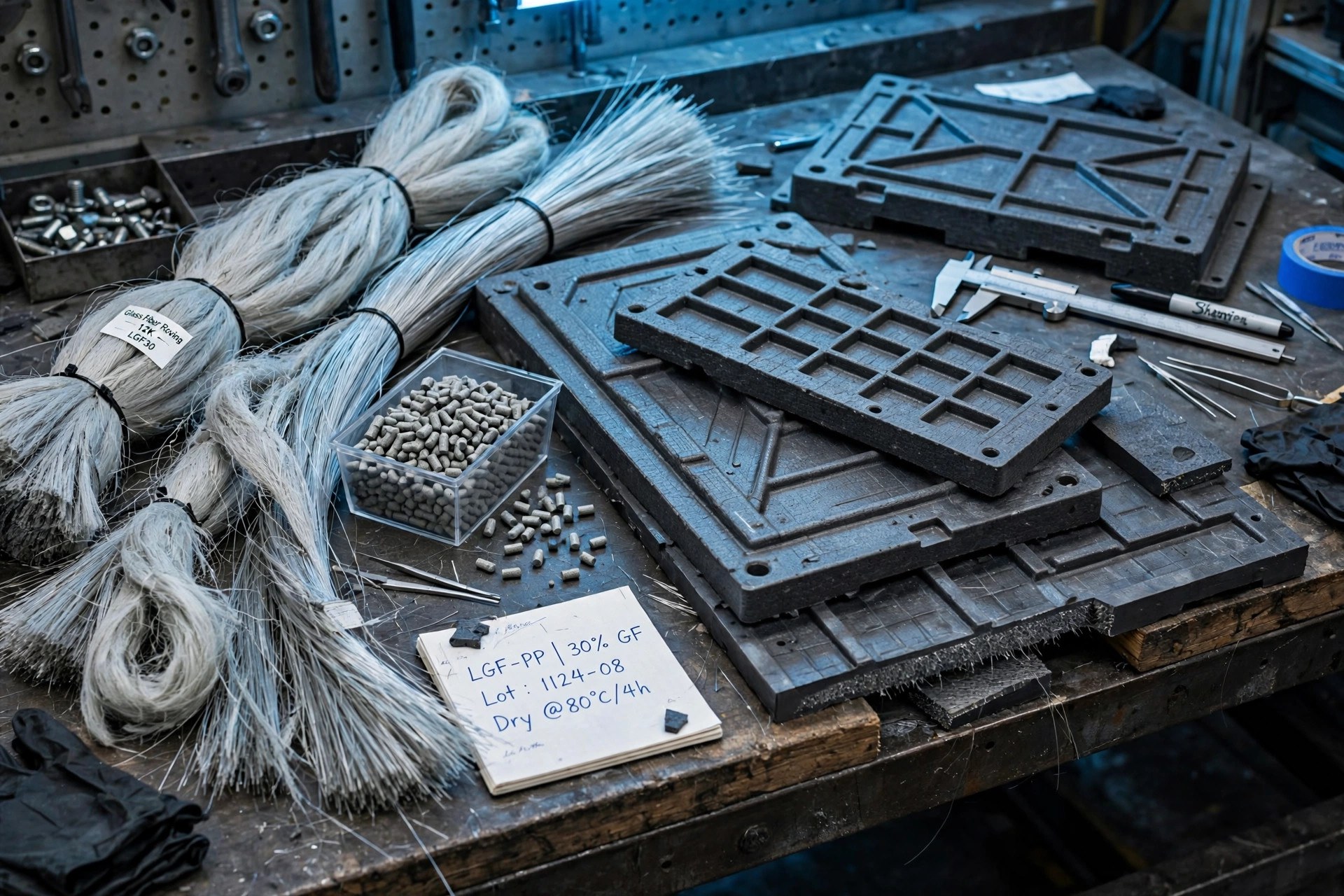
A reinforced thermoplastic is a partnership: the resin - polypropylene, polyamide (nylon), polyester or a higher-temperature polymer - gives the material its shape, chemical resistance and mouldability, while embedded fibres carry the loads. In short-fibre compounds the fibres arrive chopped to a few millimetres and the reinforcement is modest. In long fiber material the fibres run to ten millimetres and far beyond - in pultruded pellet production, effectively the full length of the pellet and, inside the moulded part, long enough to form an interlocking fibre skeleton. That skeleton is the performance story: stiffness and impact strength rise together, parts resist creep under sustained load, and large mouldings stay dimensionally stable in heat that would soften the unfilled resin.
Production explains the form. Continuous fibre rovings are pulled through molten resin (pultrusion-style impregnation), coated, cooled and cut into pellets, each pellet a bundle of fully wetted fibres at a set fibre content - commonly twenty to sixty percent by weight. The moulder then injection-moulds or compression-moulds those pellets with screws and gates designed gently enough not to grind the fibres short again. Because the matrix is thermoplastic rather than thermoset, parts can be reheated, welded and, at end of life, reground and recycled into lower-duty applications - one reason the family has grown wherever metal parts are being replaced by lighter mouldings.
Where LFRT Materials Are Used
The established applications are structural and semi-structural parts that used to be pressed steel or die-cast metal: automotive front-end carriers, door modules, seat structures, underbody shields and battery housings; appliance and power-tool housings; pallets, crates and load-bearing logistics parts; pump and fan components; and sporting and luggage shells. The apparel connection on this site is indirect but real - fibre and composite producers overlap with the technical textile trade, moulded components appear in footwear, luggage, protective equipment and garment-industry machinery, and this directory's listing sits in the fabric factories section because its supplier was catalogued with the fibre and mill trade. Buyers evaluate LFRT by fibre type and content, resin family, the moulded properties in the supplier's data sheet - tensile, flexural and notched impact values - and by moulding trials, since fibre length retention in the actual part decides what the material delivers.
The company listed below, You Chang Company of China, is carried in this site's Fabric Mills by Name section, where its profile holds a long technical specification record centred on carbon-fibre products; follow the link for the full record. For the textile side of advanced fibres, this section's Carbon Fabric page covers woven carbon cloth and its mills, and the Fiberglass Fabric page covers glass-fibre fabrics - the woven relatives of the fibres that reinforce the materials on this page. Thank you for using the Apparel Search Fabric Mill Directory.
Forms of the Material: Pellets, Direct Compounding and Sheet
Long fibre thermoplastics reach the moulder in three main forms. The standard is the pultruded pellet described above, cut to a set length with the fibres running its full span. Direct long fibre thermoplastic processing (D-LFT) skips the pellet: the moulder compounds fibre and resin inline at the press, which lowers material cost and lets fibre content be tuned per part, at the price of more complex machinery. Glass mat thermoplastic (GMT) sheet takes the opposite route - a semi-finished sheet of glass mat in a thermoplastic matrix, heated and compression moulded into large panels. The three forms compete on part size, volume and finish, and a supplier conversation normally starts by fixing which form the intended part actually needs.
Long Fiber Reinforced Thermoplastic Suppliers Listed Here
You Chang Company (China)
The company this directory lists under long fiber reinforced thermoplastic fabric factories. Follow the company name to its Fabric Mills by Name profile, which carries its full technical specification record.
Common Questions
What does LFRT stand for?
Long fiber reinforced thermoplastic - a composite material of long glass or carbon fibres (typically ten millimetres and longer in the pellet) embedded in a thermoplastic resin such as polypropylene or polyamide, supplied as pellets for injection or compression moulding.
How is LFRT different from short-fibre reinforced plastic?
Fibre length. Short-fibre compounds use fibres of a few millimetres; long fibres form an interlocking skeleton inside the moulded part, giving higher impact strength, stiffness, creep resistance and heat stability at the same fibre content.
Which company does this directory list for long fiber reinforced thermoplastics?
You Chang Company of China, linked to its Fabric Mills by Name profile on this site, where its full technical specification record is carried.
More to Explore - The Full Fabric Directory A-Z
- Lacoste Fabric Mills
- Linen Fabric Mills
- Lining Fabric Mills
- Pique Fabric
- Jersey Knit Fabric
- Interlock Knit Fabric
- Knit Fabric Mills
- Fabric Mills - Fabric Section Hub
- Wool Fiber Directory
- Textile Machinery
- Embroidery Directory
- Printing Directory
- You Chang Company
- Clothing Industry Factories
- Yarn Factories
- Fabric Retail
- Fabric Wholesalers
- Fibers Directory
- Fabric Definitions
- Fashion Industry News
- Clothing Industry Employment
- Conversion Charts
- Antibacterial Fabric
- Bamboo
- Basalt
- Boucle
- Breathable
- Broadcloth
- Brocade
- Burlettes
- Canvas
- Carbon
- Chambray
- Chenille
- Chiffon
- Circular
- Corduroy
- Cotton
- Crepe
- Crochet
- Damask
- Denim
- Dobby
- Double Knit
- Drill
- Duck
- Dyed Fabric
- Embroidered
- Fiberglass
- Fil-a-Fils
- Filter Cloth
- Flame Retardant
- Fleece
- French Terry
- Gabardine
- Gauze
- Georgettes
- Ginghams
- Greige Fabric
- Herringbone
- Horse Hair
- Interlining
- Jacquard
- Lace
- Metallic
- Mesh
- Muslin
- Narrow
- Net
- Non Woven Fabric
- Novelty
- Nylon
- Ottoman
- Oxford
- Percale
- Pile
- Pointelle
- Polar Fleece
- Polyester
- Poplin
- Printed
- Quilted
- Raschel
- Reflective
- Rib
- Sateen
- Satin
- Seersucker
- Silk Fabric
- Single Jersey
- Smart Fabrics
- Stretch
- Suede
- Taffeta
- Tassars
- Terry
- Thermal
- Tricot
- Tulle
- Tweed
- Twill
- Velcro
- Velour
- Velvet
- Viole
- Vynil
- Waffle
- Waterproof
- Wool
- Yarn Dyed
- Textiles
- Fabric
Looking for Fabric Mills and Suppliers?
Return to the Fabric Directory hub for the full fabric section, or browse the Fabric Manufacturers Directory page for the wider mill trade.