Filter Cloth Mills
Filter cloth is the working surface of industrial filtration - the fabric that separates solids from liquids in filter presses, centrifuges and belt filters. This directory explains how filter cloths are specified and carries the filter cloth mill Apparel Search lists.
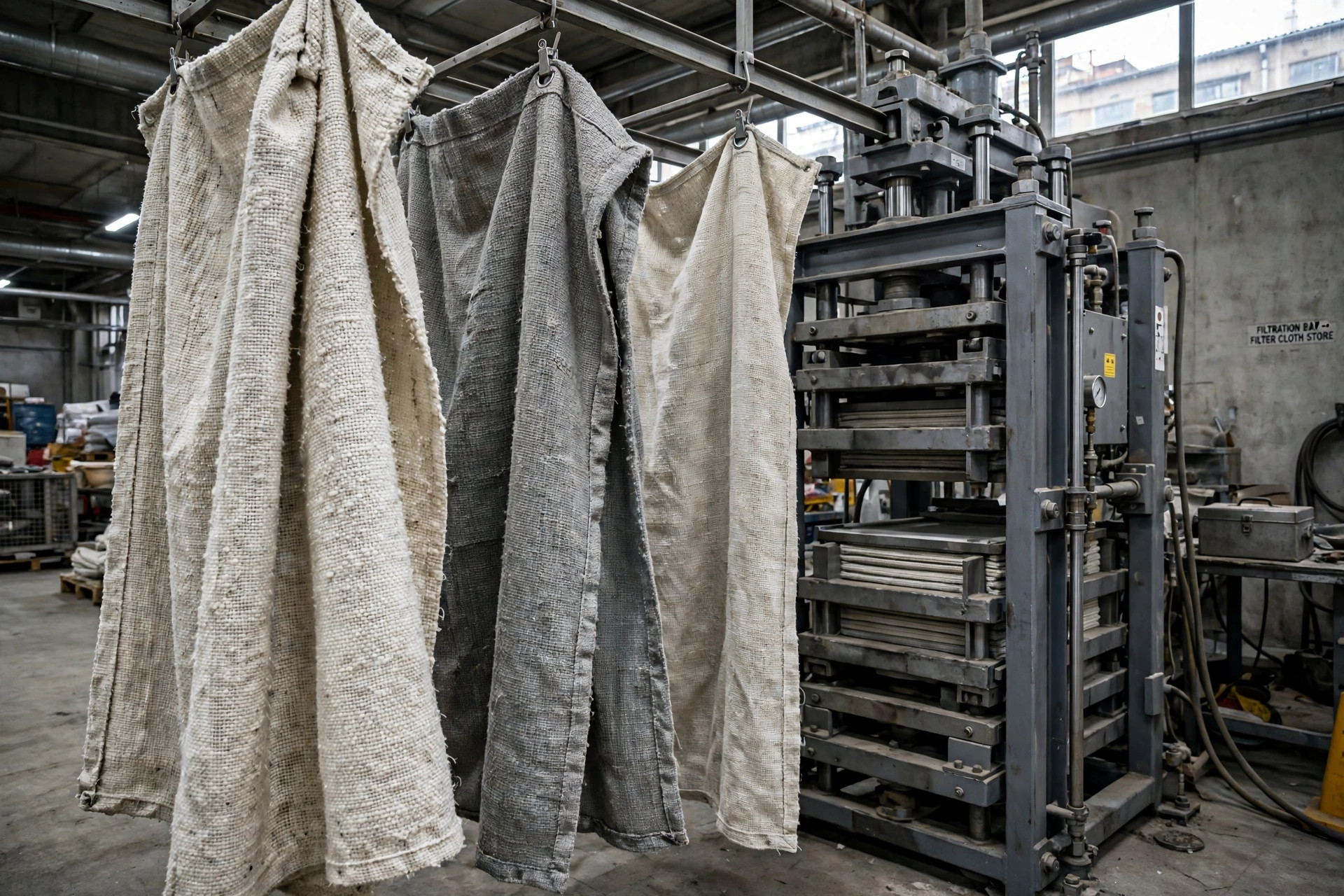
What Filter Cloth Does
Filtration is one of the oldest things cloth does - straining liquid through a woven barrier predates industry itself - and the modern filter cloth is that idea engineered. In a filter press, cloths line recessed plates; slurry is pumped in, liquid passes through the cloth, and solids build on its surface as a cake that is discharged when the press opens. The cloth decides the clarity of the filtrate, the dryness of the cake, how cleanly the cake releases and how many cycles the cloth survives before blinding - the gradual clogging of its pores - ends its life. The same family serves centrifuges, vacuum drum and belt filters, dust-collection bags and liquid polishing filters, across mining and mineral processing, chemicals, food and drink, pharmaceuticals, ceramics and wastewater treatment. It is a fabric category where the garment trade barely appears, yet the cloth is as much a textile, woven or felted to a specification, as anything in this directory.
Two constructions dominate. Woven filter cloths are made from monofilament yarns - single smooth strands that release cake cleanly and resist blinding - from multifilament yarns that catch finer particles, and from spun staple yarns that give the finest capture and the shortest life, with cloths often combining them: a multifilament face over a monofilament back, for example, balances capture against release. Needlefelts - fiber webs punched into a scrim - serve air filtration and some liquid duties where depth capture matters. Fiber choice follows chemistry and temperature: polypropylene for broad chemical resistance at moderate temperatures, polyester where strength and heat rise, nylon for abrasion and alkaline duty, and speciality fibers beyond them. Weave - plain, twill or satin - trades capture against flow and release, exactly as it does in apparel cloth, but here the numbers are measured in microns and cubic metres rather than in hand and drape.
Specifying Filter Cloth and Using This Directory
A filter cloth enquiry starts with the process, not the fabric: what is being filtered, the particle size, the chemistry and temperature, the machine the cloth must fit and the result that matters most - clarity, cake dryness, throughput or cloth life - because improving one usually costs another. The mill then works back to fiber, yarn, weave, weight and finish: calendering and singeing smooth a woven cloth's face for cleaner cake release, heat-setting stabilises dimensions against the press, and edge treatments and fittings - grommets, neck rings, centre-feed holes - marry the cloth to its machine. Buyers should expect to trial cloth on their own slurry before committing; reputable mills supply test pieces, since no laboratory figure substitutes for the behaviour of a real process stream across a few dozen cycles.
The listing below is the complete set Apparel Search carries for this category: one mill, the Tiantai South-West Filter-Cloth Factory of China - its name is carried exactly as the original directory recorded it - linked to its profile in the Fabric Mills by Name section. No listing has been added or removed. Around this page, the fabric section's other industrial cloths - Fiberglass Fabric and the nonwoven directories reached from the Fabric Directory hub - cover the neighbouring filtration and technical-textile ground. When you enquire, send the machine type, the cloth dimensions and the process details above; filter cloth is quoted as an engineered component, and a complete enquiry gets a complete answer. Thank you for using the Apparel Search Fabric Mill Directory.
Filter Cloth Mill Listed in This Directory
Tiantai South-West Filter-Cloth Fictory
Company listed in the Apparel Search fabric mill directory under its own profile in the Fabric Mills by Name section. Open the linked profile for the company's directory record and contact details.
Common Questions
What is filter cloth used for?
Separating solids from liquids (and dust from air) in industrial equipment: filter presses, centrifuges, vacuum and belt filters and dust collectors, across mining, chemicals, food, pharmaceuticals and wastewater treatment. The cloth sets filtrate clarity, cake dryness, cake release and its own working life.
What is the difference between monofilament and multifilament filter cloth?
Monofilament cloth is woven from single smooth strands: it releases filter cake cleanly and resists blinding. Multifilament and spun-yarn cloths capture finer particles but blind sooner. Many cloths combine them - a fine-capture face over a clean-release backing.
Which mill is listed for filter cloth?
One company: the Tiantai South-West Filter-Cloth Factory (China), linked to its profile in the Fabric Mills by Name section, its name carried exactly as the original directory recorded it.
More to Explore - The Full Fabric Directory A-Z
- Fabric Scents & Aromas
- Fabric Finishes
- Fabric Mills Directory Page 2
- Fabric Mills Directory Page 3
- Fabric Mills Directory Page 4
- Fabric Mills Directory Page 5
- Fiberglass Fabric
- Fil-a-Fils Fabric
- Filter Cloth Mills
- Flame Retardant Fabric
- Flannel Fabric Mills
- Fleece Fabric
- Flock
- French Terry Fabric Mills
- Electromagnetic Shielding Fabrics
- Embroidered Fabric
- Gabardine Fabric Mills
- Gauze Fabric Mills
- Georgette Fabric Mills
- Gingham Fabric
- Greige Fabric
- Fabric Mills - Fabric Section Hub
- Textile Machinery
- Embroidery Directory
- Printing Directory
- Tiantai South-West Filter-Cloth Fictory
- Clothing Industry Factories
- Yarn Factories
- Fabric Retail
- Fabric Wholesalers
- Fibers Directory
- Fabric Definitions
- Fashion Industry News
- Clothing Industry Employment
- Conversion Charts
- Antibacterial Fabric
- Bamboo
- Basalt
- Boucle
- Breathable
- Broadcloth
- Brocade
- Burlettes
- Canvas
- Carbon
- Chambray
- Chenille
- Chiffon
- Circular
- Corduroy
- Cotton
- Crepe
- Crochet
- Damask
- Denim
- Dobby
- Double Knit
- Drill
- Duck
- Dyed Fabric
- Herringbone
- Horse Hair
- Interlining
- Interlock
- Jacquard
- Jersey Fabric
- Lace
- Lacoste
- Linen
- Lining
- Long Fiber Reinforced Thermalplastics
- Metallic
- Mesh
- Muslin
- Narrow
- Net
- Non Woven Fabric
- Novelty
- Nylon
- Ottoman
- Oxford
- Percale
- Pile
- Pique
- Pointelle
- Polar Fleece
- Polyester
- Poplin
- Printed
- Quilted
- Raschel
- Reflective
- Rib
- Sateen
- Satin
- Seersucker
- Silk Fabric
- Single Jersey
- Smart Fabrics
- Stretch
- Suede
- Taffeta
- Tassars
- Terry
- Thermal
- Tricot
- Tulle
- Tweed
- Twill
- Velcro
- Velour
- Velvet
- Viole
- Vynil
- Waffle
- Waterproof
- Wool
- Yarn Dyed
Looking for Fabric Mills and Suppliers?
Return to the Fabric Directory hub for the full fabric section, or browse the Fabric Manufacturers Directory page for the wider mill trade.