Yarn Dyed Fabric Mills
Yarn dyed fabric gets its pattern from the yarn itself: the yarn is dyed before weaving or knitting, so checks, stripes and plaids are built into the cloth rather than printed or dyed onto it afterward. This page explains the method and lists the mills that use it.
Shop Yarn Dyed Fabric Now
Shop Yarn Dyed Fabric on Amazon Shop Yarn Dyed Fabric on eBayThese links open the Apparel Search shopping guides for Amazon and eBay, where the product links are kept in one place.
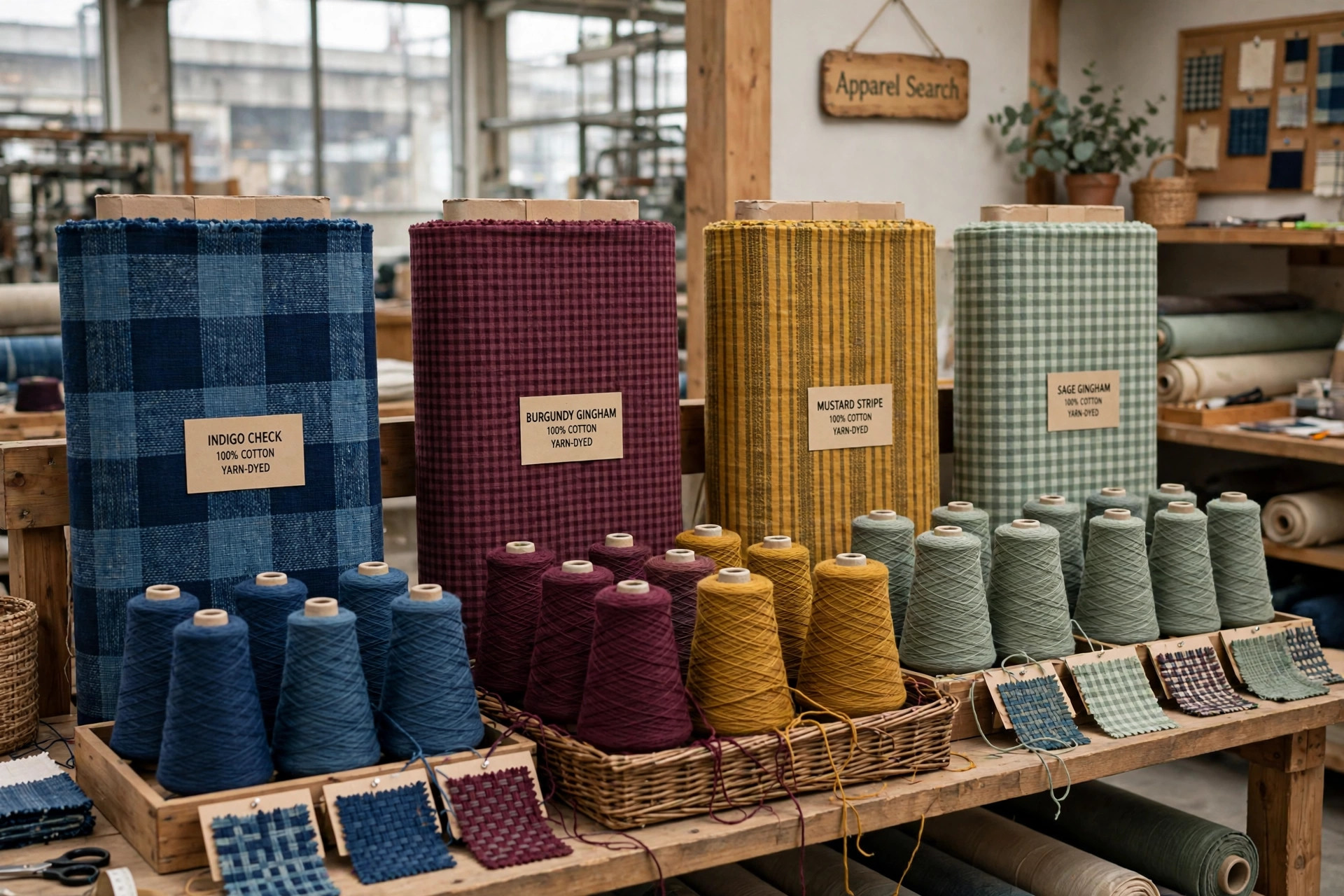
What Yarn Dyeing Is
Yarn dyeing colors the yarn before it becomes fabric. Yarn arrives at the dye house in skeins or on packages, is scoured, dyed, rinsed and dried, and only then goes to the loom or knitting machine, where yarns of different colors are combined into the finished pattern. A gingham check, for example, is not printed on white cloth: white and colored yarns cross in both directions, and the check, including the darker squares where the two colors overlap, emerges from the weaving itself.
That order of operations changes the cloth in ways a buyer can see and feel. The color runs through the whole yarn, so a yarn-dyed pattern looks essentially the same on both faces of the fabric, survives abrasion without showing a white ground underneath, and holds its color well in washing because the dye was applied to a small, easily penetrated package of fiber rather than to a dense finished cloth. It also costs more at every step: each color is dyed separately, looms are set up by pattern, and a weaving mistake in one colorway cannot be corrected by re-dyeing the piece.
Yarn Dyed, Piece Dyed and Printed
Piece dyeing takes the opposite route: fabric is woven or knitted in its natural, undyed state - greige goods - and dyed afterward in a single color. Piece dyeing is faster, cheaper and far more flexible, because one stock of greige cloth can become any color the season demands, but a piece-dyed cloth is a solid: any pattern must be added later by printing, or built from a textured weave. Printed fabric starts from finished cloth as well, applying color to the surface in a design, which allows photographic detail yarn dyeing can never achieve, at the price of a pattern that sits on one face and fades with surface wear.
The three methods are tools, not ranks. Shirting, school and work uniforms, and classic menswear rely on yarn-dyed cloth precisely because its checks and stripes stay crisp and double-faced through years of laundering. Fashion solids in fast-changing colors belong to piece dyeing. Fine floral and pictorial designs belong to print. A mill that yarn dyes, like the mills listed below, is therefore set up for patterned woven and knitted goods, and its minimums, lead times and pattern library should be read in those terms when comparing it with a piece dyer or printer.
Woven and Knitted Yarn-Dyed Fabrics
The famous yarn-dyed wovens are household names: gingham, chambray - where a colored warp crosses a white weft to give its soft, even tone - seersucker, whose striped puckers come from yarn tension as well as color, madras plaids, tartans, striped ticking, flannel shirtings and the small checks and hairline stripes of dress shirts. Because the pattern is structural, it cannot crack, peel or misregister, and cutting must match it at seams and pockets, which is why garments in bold yarn-dyed checks cost more to make as well as to weave.
Knitted yarn-dyed fabric follows the same principle on knitting machines: colored yarns are fed in sequence so stripes and simple patterns form in the knitting, the standard construction for striped T-shirts, polo shirts, interlock and jersey basics, and socks. Yarn-dyed knits keep their stripes through stretching and washing far better than printed stripes, and the pattern again shows on both sides. Whether woven or knitted, the buyer should ask whether a design is truly yarn dyed or a print made to look like one - the reverse side answers at a glance, since a true yarn-dyed pattern is woven or knitted in, not sitting on the surface.
Sourcing From the Mills in This Directory
Twenty-five listings follow - mills and factories in India, Pakistan, China, the USA, Turkey, Thailand, Taiwan, the United Kingdom and Honduras, plus Ceyteks Tekstil, for which no country is given. The spread is typical of this trade: South Asian mills are strong in cotton shirtings, checks and knits, and several names here appear elsewhere in this directory under velvet, viole, waterproof and other fabric headings, because a mill that dyes yarn usually sells several fabric families woven from it.
A buyer sourcing yarn-dyed cloth should specify fiber, weave or knit construction, pattern and colorway with yarn counts, finished width and weight, and should approve a loom-state or finished swatch under daylight before bulk, because yarn-dyed colors are set at the yarn stage and a shade agreed from a piece-dyed substitute will not match reliably. Ask also about colorfastness testing to washing, light and rubbing for each color in the pattern - in a multi-color check, the weakest dye, not the strongest, decides how the whole cloth performs.
Fabric Mills and Factories in This Directory
Each name below opens the company's profile in the Fabric Mills by Name directory, and each listing gives the company's country.
Antex Knitting Mills
Country: USA.
Best Textiles International Co.,Ltd
Country: China.
Birim Textile San Tic Ltd Sti
Country: Turkey.
Carolina Cotton Works, Inc.
Country: USA.
Ceyteks Tekstil
No country is given for this company.
Glacial Exports
Country: India.
G R Garments
Country: India.
G.S. Kankariya
Country: India.
Gulshan Weaving Mills
Country: Pakistan.
Hands On
Country: India.
Jong Stit Knitting Co. Ltd.
Country: Thailand.
Kuanging Industrial Co. Ltd.
Country: Taiwan.
Lotus Mills
Country: India.
Multan Industries
Country: Pakistan.
Rashid Textile Printing Ind. (Pvt.) Ltd.
Country: Pakistan.
SGS Interknits (p) ltd
Country: India.
Shahtex (Leicester) Limited
Country: United Kingdom.
Shamala Textiles
Country: India.
Shanghai Sanmao Textile Co., Ltd.
Country: China.
Sri Jaisri Export
Country: India.
Sriyansh Ispat Limited
Country: India.
Supreme Textile Industries (Pvt) Limited
Country: Pakistan.
Textiles Rio Lindo, S.A. de C.V.
Country: Honduras.
Vrijesh Corporation
Country: India.
Zibo Ermao Textile Co. Ltd.
Country: China.
Common Questions
What does yarn dyed fabric mean?
The yarn is dyed before weaving or knitting, and the pattern - checks, stripes, plaids - is formed by combining yarns of different colors in the fabric itself. The design runs through the cloth and shows on both faces, unlike a printed pattern, which sits on one surface.
What is the difference between yarn dyed and piece dyed fabric?
Yarn dyed cloth is dyed at the yarn stage, then woven or knitted into patterned fabric. Piece dyed cloth is made first in its natural state and dyed afterward as a whole piece, which suits solid colors, is cheaper and more flexible, but cannot create a woven-in pattern.
Which mills does this directory list for yarn dyed fabric?
Twenty-five, including Antex Knitting Mills and Carolina Cotton Works (USA), Best Textiles International, Shanghai Sanmao and Zibo Ermao (China), Gulshan Weaving Mills and Supreme Textile Industries (Pakistan), Shahtex (United Kingdom) and Textiles Rio Lindo (Honduras).
More to Explore
- Antex Knitting Mills
- Antibacterial Fabric
- Bamboo
- Basalt
- Best Textiles International Co.,Ltd
- Birim Textile San Tic Ltd Sti
- Boucle
- Breathable
- Broadcloth
- Brocade
- Burlettes
- Canvas
- Carbon
- Carolina Cotton Works, Inc.
- Ceyteks Tekstil
- Chambray
- Chenille
- Chiffon
- Circular
- Clothing Industry Employment
- Clothing Industry Factories
- Conversion Charts
- Corduroy
- Cotton
- Crepe
- Crochet
- Damask
- Denim
- Dobby
- Double Knit
- Drill
- Duck
- Dyed Fabric
- Embroidered
- Embroidery Directory
- Fabric
- Fabric Definitions
- Fabric Directory
- Fabric Retail
- Fabric Wholesalers
- Fashion Industry News
- Fiberglass
- Fibers Directory
- Fil-a-Fils
- Filter Cloth
- Flame Retardant
- Fleece
- French Terry
- G R Garments
- G.S. Kankariya
- Gabardine
- Gauze
- Georgettes
- Ginghams
- Glacial Exports
- Greige Fabric
- Gulshan Weaving Mills
- Hands On
- Herringbone
- Horse Hair
- Interlining
- Interlock
- Jacquard
- Jersey Fabric
- Jong Stit Knitting Co. Ltd.
- Kuanging Industrial Co. Ltd.
- Lace
- Lacoste
- Linen
- Lining
- Long Fiber Reinforced Thermalplastics
- Lotus Mills
- Mesh
- Metallic
- Multan Industries
- Muslin
- Narrow
- Net
- Non Woven Fabric
- Novelty
- Nylon
- Ottoman
- Oxford
- Percale
- Pile
- Pique
- Pointelle
- Polar Fleece
- Polyester
- Poplin
- Printed
- Printing Directory
- Quilted
- Raschel
- Rashid Textile Printing Ind. (Pvt.) Ltd.
- Reflective
- Rib
- Sateen
- Satin
- Seersucker
- SGS Interknits (p) ltd
- Shahtex (Leicester) Limited
- Shamala Textiles
- Shanghai Sanmao Textile Co., Ltd.
- Silk Fabric
- Single Jersey
- Smart Fabrics
- Sri Jaisri Export
- Sriyansh Ispat Limited
- Stretch
- Suede
- Supreme Textile Industries (Pvt) Limited
- Taffeta
- Tassars
- Terry
- Textile Machinery
- Textiles
- Textiles Rio Lindo, S.A. de C..V.
- Thermal
- Tricot
- Tulle
- Tweed
- Twill
- Velcro
- Velour
- Velvet
- Viole
- Vrijesh Corporation
- Vynil
- Waffle
- Waterproof
- Wool
- Yarn Dyed Fabric Search
- Yarn Factories
- Zibo Ermao Textile Co. Ltd.
Looking for Fabric Mills and Suppliers?
The wider directory behind this page is the Fabric section hub, which opens the whole Apparel Search fabric mill directory: fabric types from A to Z, the Fabric Mills by Name profiles, and the dyeing, printing and finishing directories that support them.