Novelty Fabric Directory
Novelty fabrics are the ones that refuse to be plain: cloth built from fancy yarns, slubs, bouclés, space-dyed effects, embroidery, burns-outs and mixed structures whose surface is the whole point. This directory explains how novelty cloth gets its character, and carries the two mills this section lists under novelty fabric factories — Antex Knitting Mills of the USA and Gideon Textiles Inc. of Canada.
Shop Novelty Fabric Now
Shop Novelty Fabric on Amazon Shop Novelty Fabric on eBayThe Amazon and eBay links on this page are affiliate links. If you make a purchase through them, Apparel Search may earn a commission.
What Makes a Fabric a Novelty
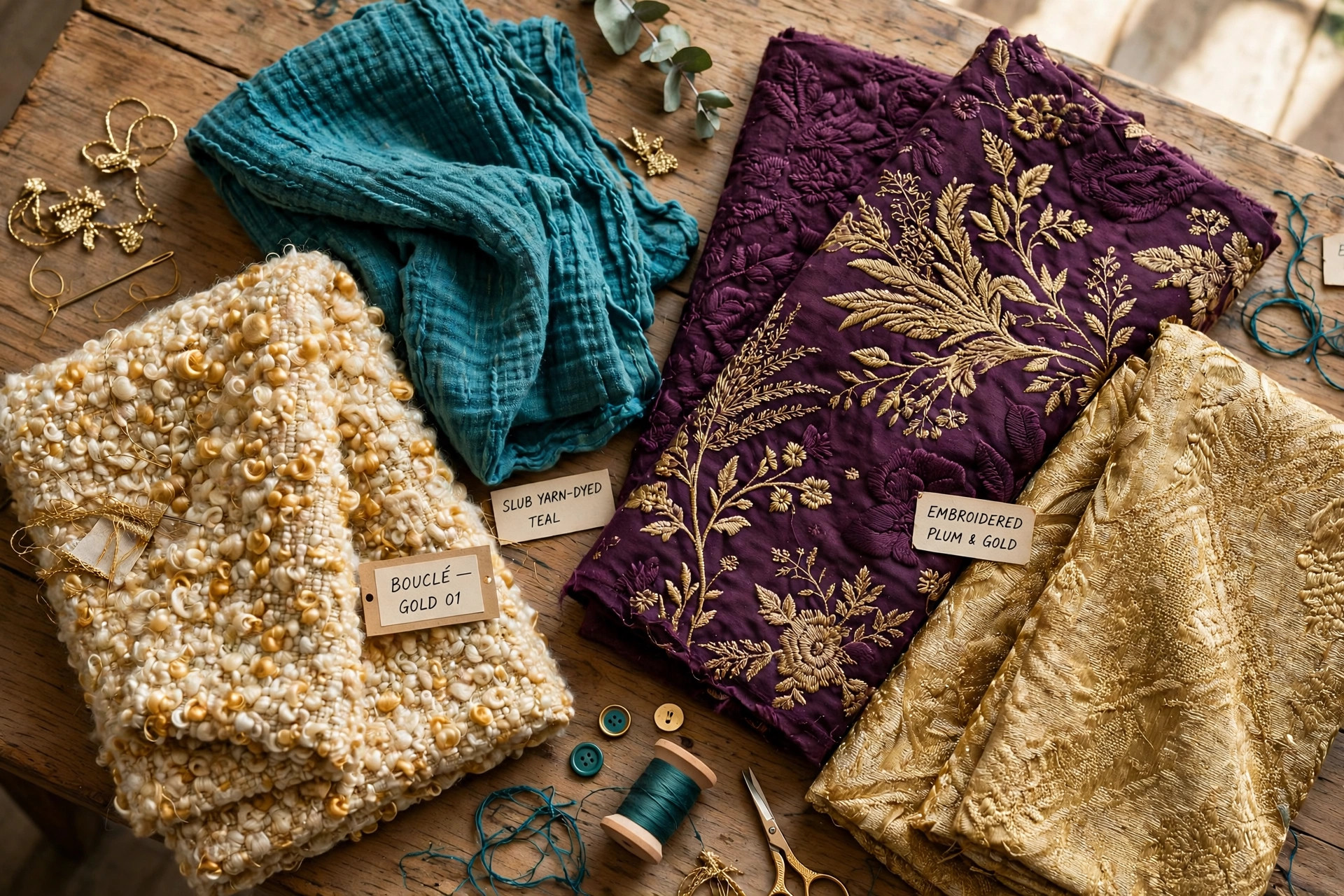
A novelty (or fancy) fabric is defined by deliberate irregularity. Where a standard cloth hides its construction, a novelty cloth displays it: fancy yarns with slubs, loops, knots, chenille tufts or metallic wraps are woven or knitted into a ground so the surface gains pattern and texture in a single process. The same family covers space-dyed and flame-dyed yarns that stripe the cloth as it forms, bouclé and ratiné surfaces, embroidered and appliquéd grounds, devoré (burn-out) patterns eaten into one fibre of a blend, and mixed constructions that combine knit and woven, sheer and opaque, or matte and shine in one length.
Because the effect is engineered at yarn stage, novelty fabrics are usually designed as a yarn-and-structure package rather than dyed or printed afterwards — a printer can imitate a slub, but only the real yarn gives the cloth its hand and depth. That also makes novelty production a specialist's game: fancy yarn spinning, careful loom or machine settings for irregular yarns, and finishing that protects loops and embroidery rather than flattening them. Fashion's cycle keeps the category permanently alive, since each season's textured jacket, statement knit or embellished dress cloth is, by definition, a novelty fabric.
Where Novelty Fabrics Are Used
Womenswear is the home territory — textured suiting and jacketing, novelty knits for tops and dresses, embroidered and burn-out fabrics for occasion wear — with menswear borrowing the quieter end in slub shirtings, textured ties and casual jacketing. Interiors take the heavier constructions: bouclé upholstery, embroidered drapery and mixed-fibre throws are novelty fabrics working at furniture scale. The two mills listed below are this directory's novelty specialists, and they sit on the knit side of the trade: Antex Knitting Mills of the USA and Gideon Textiles Inc. of Canada, both linked to their Fabric Mills by Name profiles. Knitting suits novelty production well, because fancy yarns that would struggle on a high-speed loom feed more forgivingly into knitting elements, and jacquard knitting adds pattern on pattern.
Buying novelty cloth well means accepting its nature. Irregular yarns make shade and texture vary along a length more than in standard cloth, cutting losses run higher because pattern and nap must be respected, and delicate effects — long loops, loose embroidery, burn-out sheers — set limits on garment care that must reach the label. None of that is a defect; it is the price of a surface no plain fabric can give. Thank you for using the Apparel Search Fabric Mill Directory.
Working With Novelty Fabrics
Test before committing. Cut and sew a sample garment or panel first: loops catch on machine feet, slubs shift seams, embroidered grounds need stabilising, and burn-out sheers fray at cut edges. Ask the mill for the fabric's repeat and usable width — fancy constructions often lose width to selvedge effects — and order a shade band of extra length, because re-ordering a novelty means re-making a fancy yarn, and the second batch will not match the first exactly. In garment care, follow the most delicate component: a cotton bouclé with a metallic wrap yarn is a metallic fabric for washing purposes, whatever the ground fibre says.
Storage matters more for novelty cloth than for standard lines. Loops and embroidery crush permanently under heavy stacking, burn-out sheers crease along folds, and metallic wraps tarnish faster in humid rooms. Mills ship novelty fabrics rolled for a reason; keeping them rolled, or at least loosely folded with tissue, preserves the very surface the buyer paid a premium to obtain.
Novelty Fabric Mills Listed Here
Antex Knitting Mills (USA)
Listed in this directory. Follow the company name to its Fabric Mills by Name profile, which carries its full directory record.
Gideon Textiles Inc. (Canada)
Listed in this directory. Follow the company name to its Fabric Mills by Name profile, which carries its full directory record.
Common Questions
What is a novelty fabric?
A fabric whose surface interest is built in during manufacture — from fancy yarns (slub, bouclé, chenille, metallic), space dyeing, embroidery, burn-out devoré or mixed knit/woven structures — rather than applied afterwards by printing or dyeing alone.
Why do novelty fabrics cost and vary more than standard cloth?
The effects come from specialist fancy yarns and slower, more careful production, and deliberate irregularity means shade and texture vary more along a length; cutting losses are higher because pattern, nap and texture must be matched. A sample garment before bulk cutting is standard practice.
Which mills does this directory list for novelty fabrics?
Antex Knitting Mills of the USA and Gideon Textiles Inc. of Canada, each linked to its Fabric Mills by Name profile on this site.
More to Explore - The Full Fabric Directory A-Z
- Narrow Fabric Mills
- Net Textiles
- Nonwovens
- Nylon Fabric Mills
- Mesh Fabric Mills
- Tulle Fabric
- Raschel Fabric
- Polyester Fabric Mills
- Fabric Mills - Fabric Section Hub
- Textile Machinery
- Embroidery Directory
- Printing Directory
- Antex Knitting Mills
- Gideon Textiles Inc.
- Clothing Industry Factories
- Yarn Factories
- Fabric Retail
- Fabric Wholesalers
- Fibers Directory
- Fabric Definitions
- Fashion Industry News
- Clothing Industry Employment
- Conversion Charts
- Textiles
- Fabric
Looking for Fabric Mills and Suppliers?
Return to the Fabric Directory hub for the full fabric section, or browse the Fabric Manufacturers Directory page for the wider mill trade.