Tassar Silk Fabrics
Tassar, better known as tussar or tasar, is wild silk: coarser, naturally golden and full of character beside smooth mulberry silk. This page explains the fiber and lists the mill that supplies it.
Shop Tussar Silk Fabric Now
Shop Tussar Silk Fabric on Amazon Shop Tussar Silk Fabric on eBayThese links open the Apparel Search shopping guides for Amazon and eBay, where the product links are kept in one place.
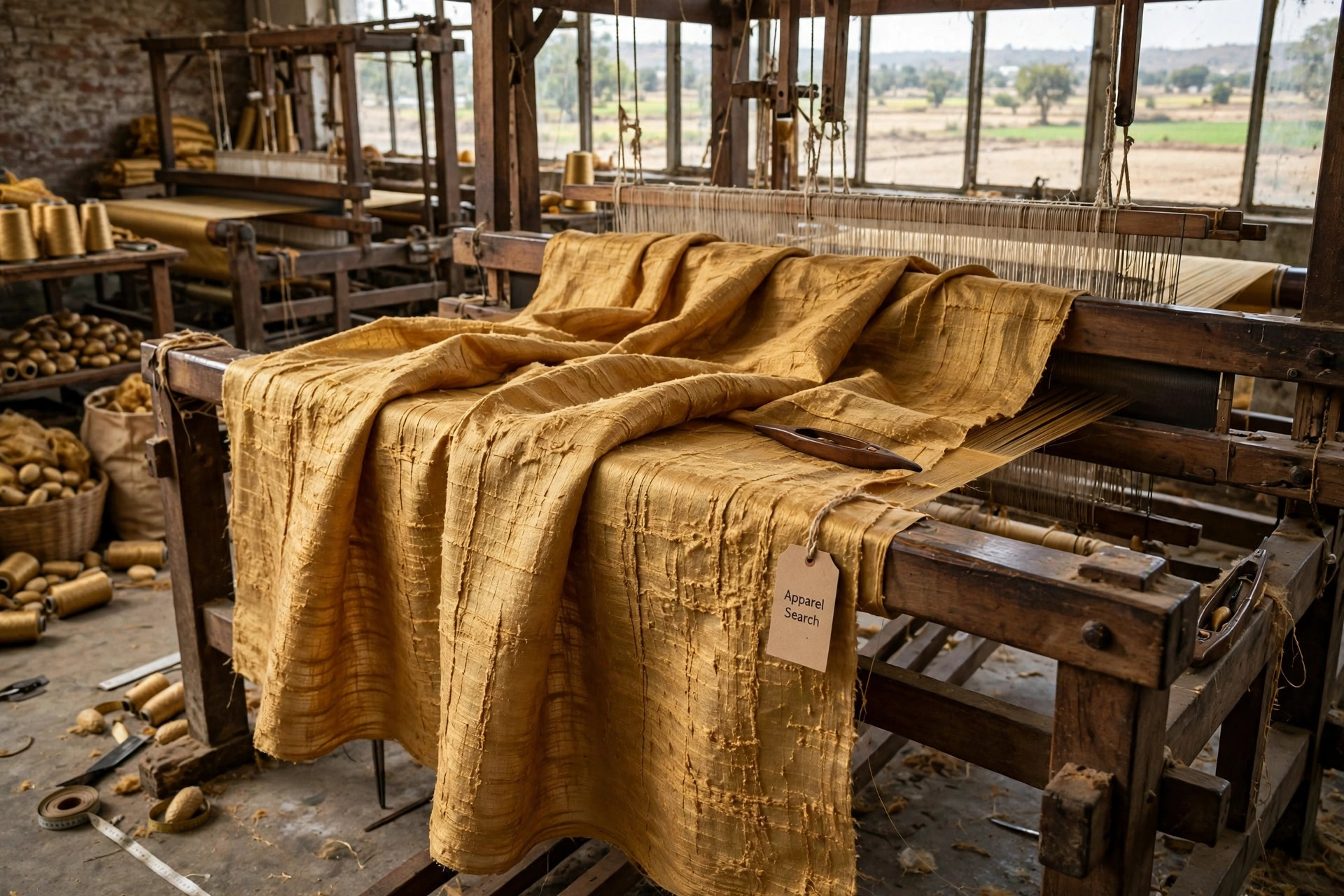
A Wild Silk, Not a Farmed One
Mulberry silk comes from the Bombyx mori silkworm, raised indoors for thousands of years on mulberry leaves. Tassar silk comes from wild and semi-wild moths of the Antheraea family, whose caterpillars feed outdoors on oak, arjun, asan and other forest trees. Because the cocoons are gathered from trees rather than harvested from trays, the filament is shorter, coarser and less uniform, and the silk keeps a natural tan-to-gold color that mulberry silk, naturally white, does not have. India is the great center of tasar production - the tropical tasar of the central Indian forest belt and the oak tasar of the northeast and the Himalayan foothills - with Bhagalpur in Bihar its best-known weaving and trading city.
This directory lists a single mill for tassar: Alok Textile Industries of India, below with its Fabric Mills by Name profile. A single listing reflects how specialized the trade is: tasar moves through regional weaving clusters and silk houses rather than through the big composite mills that dominate mulberry silk.
How Tassar Cloth Looks and Feels
Tassar fabric is unmistakable in the hand. The yarn carries natural slubs - soft thick-and-thin places where the wild filament varied - so the cloth has a textured, almost linen-like surface, a muted luster rather than a shine, and a warm honey, beige or grey-gold ground that takes dye into rich, slightly heathered colors. It is stiffer and more textured than mulberry silk charmeuse, drapes with body, and breathes well in hot climates, which is why it has been a sari, kurta and furnishing fabric in India for centuries.
The same irregularity that gives tassar its character sets the buyer's expectations: shade and slub vary a little from piece to piece and lot to lot, and Western quality standards written for uniform mulberry silk will reject good tassar if applied literally. Specifications should allow for the natural slub, define the acceptable shade band on a washed and finished sample, and state whether the cloth is reeled tasar, spun tasar (woven from shorter fibers, softer and cheaper) or a tasar blend with cotton, wool or mulberry silk.
Where Tassar Is Used
In India, tassar is woven into saris - often with woven borders, block prints or the hand embroidery of the Bhagalpur and tribal clusters - and into kurtas, jackets and stoles. Export markets take it for dresses, blouses and scarves that sell on natural texture, and for furnishings: cushion covers, curtains and upholstery-weight cloth where its durability and matte surface suit it better than shiny silk. Tasar yarn is also knitted and used in blends, and its waste silk goes into spun yarns and textured fabrics.
Care follows the fiber: tassar is a protein silk, so it washes gently in cool water with mild detergent or is dry cleaned, kept out of prolonged strong sunlight, and ironed on the reverse at a silk setting. Its wild origin is also its marketing story - a forest-linked, largely hand-processed fiber gathered by rural and tribal communities - and buyers who trade on that story should ask their supplier how the cocoons were collected and the yarn reeled, because hand-reeled and mill-reeled tasar differ visibly in evenness.
Sourcing Notes
Ask a tassar supplier three questions before price: is the yarn reeled or spun, what is the cocoon origin (tropical or oak tasar), and is the cloth handloom or powerloom woven. Handloom tassar carries the most texture and the widest variation; powerloom cloth is evener and cheaper per meter. Confirm the finished width after washing - tassar relaxes noticeably - and request a dye strike-off on the actual golden ground, because colors read warmer and deeper on tasar than the same dye on white mulberry silk.
Fabric Mills and Factories in This Directory
The mills below are listed in this directory. Each name opens the company's profile in the Fabric Mills by Name directory.
Alok Textile Industries
A fabric mill based in India, profiled in the Apparel Search Fabric Mills by Name directory and listed among the mills supplying this fabric type.
Common Questions
What is the difference between tassar and mulberry silk?
Mulberry silk is farmed from Bombyx mori worms fed on mulberry leaves, giving a fine, white, uniform filament. Tassar is wild silk from Antheraea moths feeding on forest trees - coarser, naturally golden, and slubbed in texture.
Why is tussar silk textured and golden?
Wild cocoons yield shorter, less even filaments with a natural tan pigment, so tussar yarn weaves into a slubbed, matte-lustrous cloth in warm honey and beige tones that dyers then deepen.
What is tassar silk used for?
Saris, kurtas, jackets, dresses, blouses and scarves in and from India, plus furnishing fabrics such as cushion covers and curtains that suit its durable, textured surface.
More to Explore
- Alok Textile Industries
- Antibacterial Fabric
- Bamboo
- Basalt
- Boucle
- Breathable
- Broadcloth
- Brocade
- Burlettes
- Canvas
- Carbon
- Chambray
- Chenille
- Chiffon
- Circular
- Clothing Industry Employment
- Clothing Industry Factories
- Conversion Charts
- Corduroy
- Cotton
- Crepe
- Crochet
- Damask
- Denim
- Dobby
- Double Knit
- Drill
- Duck
- Dyed Fabric
- Embroidered
- Embroidery Directory
- Fabric
- Fabric Definitions
- Fabric Directory
- Fabric Retail
- Fabric Wholesalers
- Fashion Industry News
- Fiberglass
- Fibers Directory
- Fil-a-Fils
- Filter Cloth
- Flame Retardant
- Fleece
- French Terry
- Gabardine
- Gauze
- Georgettes
- Ginghams
- Greige Fabric
- Herringbone
- Horse Hair
- Interlining
- Interlock
- Jacquard
- Jersey Fabric
- Lace
- Lacoste
- Linen
- Lining
- Long Fiber Reinforced Thermalplastics
- Mesh
- Metallic
- Muslin
- Narrow
- Net
- Non Woven Fabric
- Novelty
- Nylon
- Ottoman
- Oxford
- Percale
- Pile
- Pique
- Pointelle
- Polar Fleece
- Polyester
- Poplin
- Printed
- Printing Directory
- Quilted
- Raschel
- Reflective
- Rib
- Sateen
- Satin
- Seersucker
- Silk Fabric
- Single Jersey
- Smart Fabrics
- Stretch
- Suede
- Taffeta
- Terry
- Textile Machinery
- Textiles
- Thermal
- Tricot
- Tulle
- Tweed
- Twill
- Velcro
- Velour
- Velvet
- Viole
- Vynil
- Waffle
- Waterproof
- Wool
- Yarn Dyed
- Yarn Factories
Looking for Fabric Mills and Suppliers?
The wider directory behind these pages is the Fabric section hub, which opens the whole Apparel Search fabric mill directory: fabric types from A to Z, the Fabric Mills by Name profiles, and the dyeing, printing and finishing directories that support them.