Waffle Fabric Mills
Waffle fabric is the cloth woven or knitted with a recessed square pattern that looks like a breakfast waffle - a texture that traps air, absorbs water and dries fast. This page explains the construction and lists the mill in this directory.
Shop Waffle Fabric Now
Shop Waffle Fabric on Amazon Shop Waffle Fabric on eBayThese links open the Apparel Search shopping guides for Amazon and eBay, where the product links are kept in one place.
How Waffle Fabric Is Made
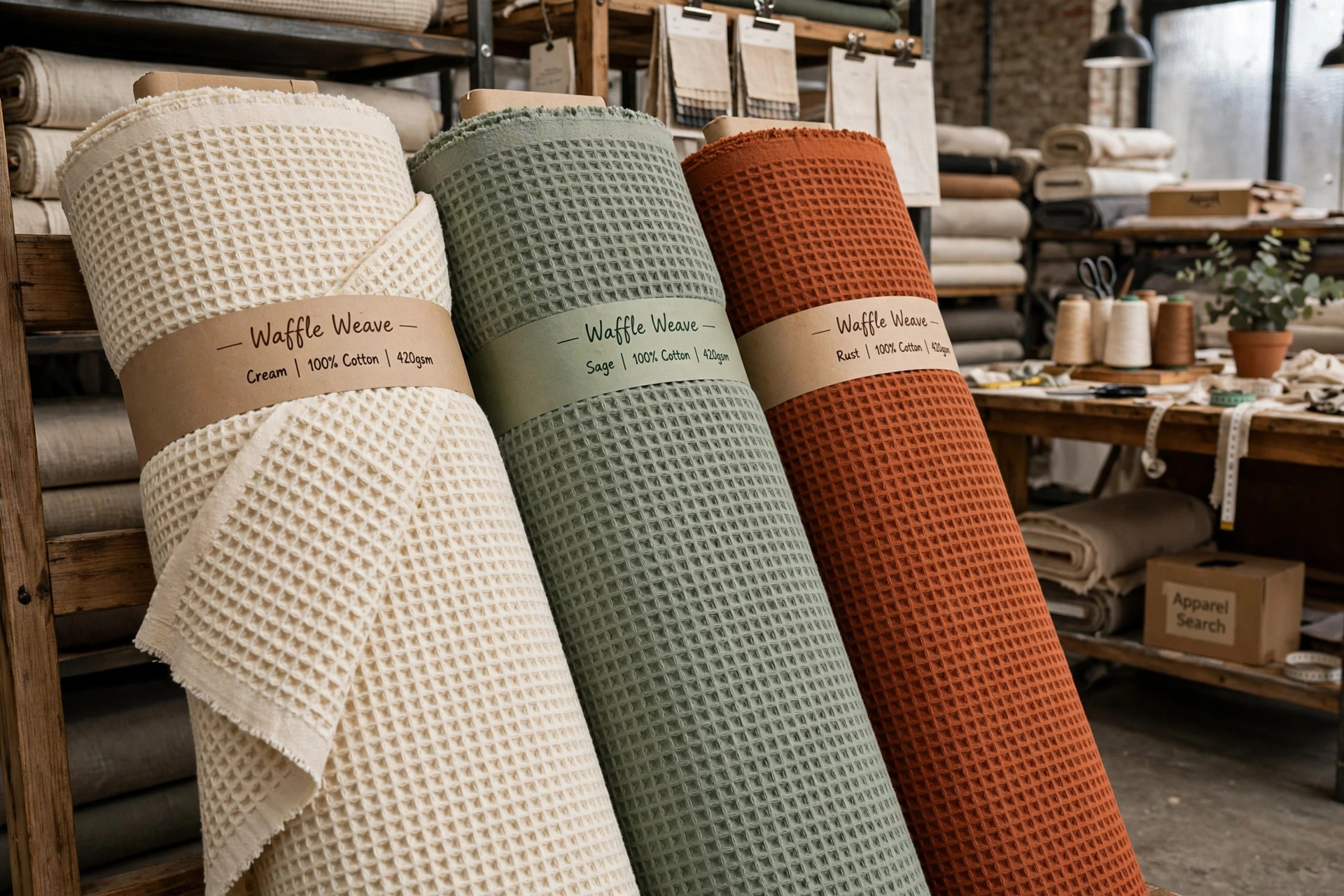
Waffle cloth - also called honeycomb weave - gets its texture from the weave itself, not from a print or a finish. Warp and weft yarns are floated and tightened in a pattern that pulls the surface into a regular grid of recessed squares with raised edges, so the finished fabric has pockets on both faces. Woven waffle is made on dobby looms in cotton or blends; knitted waffle, common in thermal clothing, builds a similar cellular surface on knitting machines and adds stretch the woven version does not have.
Those little pockets do real work. They trap still air against the skin, which is why waffle is warm for its weight in thermal underwear and robes, and they open a large surface area to water, which is why waffle towels, washcloths and bath mats absorb quickly and dry faster than a flat towel of the same weight. The raised grid also keeps the wettest part of the cloth off the skin, so a waffle robe feels less clammy than a smooth robe after a shower, and a waffle blanket breathes in summer while still covering.
Cotton, Microfiber and Thermal Waffle
Cotton waffle is the traditional form: absorbent, softening with every wash, and the standard for hotel and spa robes, towels and baby blankets. It shrinks noticeably on its first hot wash, so garments are cut generously or the cloth is pre-shrunk, and its squares relax slightly with age. Polyester microfiber waffle absorbs well for its weight, dries very quickly and holds its texture through commercial laundering, which is why gyms, spas and cleaning-cloth makers specify it where cotton's slower drying would be a problem.
In clothing, the knitted form dominates: waffle thermal tops and long johns are a cold-weather staple because the cellular knit insulates without bulk under work clothes and uniforms. Fashion borrows the texture for henleys, loungewear, pajamas and casual dresses, where the grid reads as a quiet pattern that needs no printing. Heavier woven waffle also serves for throws, cushion covers and upholstery accents, anywhere a maker wants visible texture in a plain, undyed or single-color cloth.
Working With and Caring for Waffle Fabric
Sewing waffle asks for a little care at the edges: the cellular structure can stretch and distort, woven grades fray at cut squares, and thick grid ridges resist a standard presser foot. A walking foot, a slightly longer stitch and finished or bound seams give the cleanest result, and pattern pieces should be laid so the grid runs square to the garment - a waffle texture cut off-grain shows its slant immediately. Knitted waffle needs ballpoint needles and the same seam allowances as other textured knits.
Care is easy, which is part of the fabric's appeal: most waffle washes warm, tumble dries without damage, and needs no ironing because the texture hides creasing. Fabric softener should be used sparingly on towels and absorbent goods, since softener coats fibers and slowly reduces the absorbency the squares were built to provide. Whites keep their brightness washed separately at first, because loose surface fibers shed in early laundering and can dull colors washed alongside them.
The Mill in This Directory
One listing follows: Carolina Apparel Group, Inc. of the USA, linked to its profile in the Fabric Mills by Name directory - the same mill also listed on this directory's raschel page. It is the only mill profiled here for waffle specifically; waffle cloth is also made on several continents by mills that list themselves under towels, thermals or knit goods instead.
A buyer sourcing waffle should specify woven or knitted construction, fiber content, weight in grams per square meter, square size, and finished width, and should wash-test a sample length before ordering - absorbency, shrinkage and texture retention after laundering are the three properties that separate a good waffle from a flat disappointment, and none of them can be judged from a dry swatch alone. For robes and towels, also agree the shrinkage allowance in writing, since cotton waffle's first-wash contraction is the commonest cause of size disputes.
Fabric Mills and Factories in This Directory
Each name below opens the company's profile in the Fabric Mills by Name directory, and each listing gives the company's country.
Carolina Apparel Group, Inc.
Country: USA.
Common Questions
What is waffle fabric?
A fabric woven or knitted with a recessed square, honeycomb-like texture resembling a breakfast waffle. The pockets trap air for insulation and open surface area for absorbency, so waffle serves in thermal clothing, robes, towels and blankets.
Is waffle fabric woven or knitted?
Both forms exist. Woven waffle, usually cotton, is made on dobby looms for towels, robes and blankets; knitted waffle adds stretch and is the standard construction for thermal tops and long underwear.
Which mill does this directory list for waffle fabric?
One: Carolina Apparel Group, Inc. (USA), linked to its Fabric Mills by Name profile.
More to Explore
- Antibacterial Fabric
- Bamboo
- Basalt
- Boucle
- Breathable
- Broadcloth
- Brocade
- Burlettes
- Canvas
- Carbon
- Carolina Apparel Group, Inc.
- Chambray
- Chenille
- Chiffon
- Circular
- Clothing Industry Employment
- Clothing Industry Factories
- Conversion Charts
- Corduroy
- Cotton
- Crepe
- Crochet
- Damask
- Denim
- Dobby
- Double Knit
- Drill
- Duck
- Dyed Fabric
- Embroidered
- Embroidery Directory
- Fabric
- Fabric Definitions
- Fabric Directory
- Fabric Retail
- Fabric Wholesalers
- Fashion Industry News
- Fiberglass
- Fibers Directory
- Fil-a-Fils
- Filter Cloth
- Flame Retardant
- Fleece
- French Terry
- Gabardine
- Gauze
- Georgettes
- Ginghams
- Greige Fabric
- Herringbone
- Horse Hair
- Interlining
- Interlock
- Jacquard
- Jersey Fabric
- Lace
- Lacoste
- Linen
- Lining
- Long Fiber Reinforced Thermalplastics
- Mesh
- Metallic
- Muslin
- Narrow
- Net
- Non Woven Fabric
- Novelty
- Nylon
- Ottoman
- Oxford
- Percale
- Pile
- Pique
- Pointelle
- Polar Fleece
- Polyester
- Poplin
- Printed
- Printing Directory
- Quilted
- Raschel
- Reflective
- Rib
- Sateen
- Satin
- Seersucker
- Silk Fabric
- Single Jersey
- Smart Fabrics
- Stretch
- Suede
- Taffeta
- Tassars
- Terry
- Textile Machinery
- Textiles
- Thermal
- Tricot
- Tulle
- Tweed
- Twill
- Velcro
- Velour
- Velvet
- Viole
- Vynil
- Waterproof
- Waterproof Systems for Fabric
- Wool
- Yarn Dyed
- Yarn Factories
Looking for Fabric Mills and Suppliers?
The wider directory behind this page is the Fabric section hub, which opens the whole Apparel Search fabric mill directory: fabric types from A to Z, the Fabric Mills by Name profiles, and the dyeing, printing and finishing directories that support them.