Terry Fabric Directory
Terry is the loop-pile fabric that drinks water: towels, robes and beachwear are woven terry, while sweatshirts are its knitted cousin, French terry. Here is how each is made, along with the mill listings.
Shop Terry Cloth Fabric Now
Shop Terry Cloth Fabric on Amazon Shop Terry Cloth Fabric on eBayThese links open the Apparel Search shopping guides for Amazon and eBay, where the product links are kept in one place.
Loops That Drink
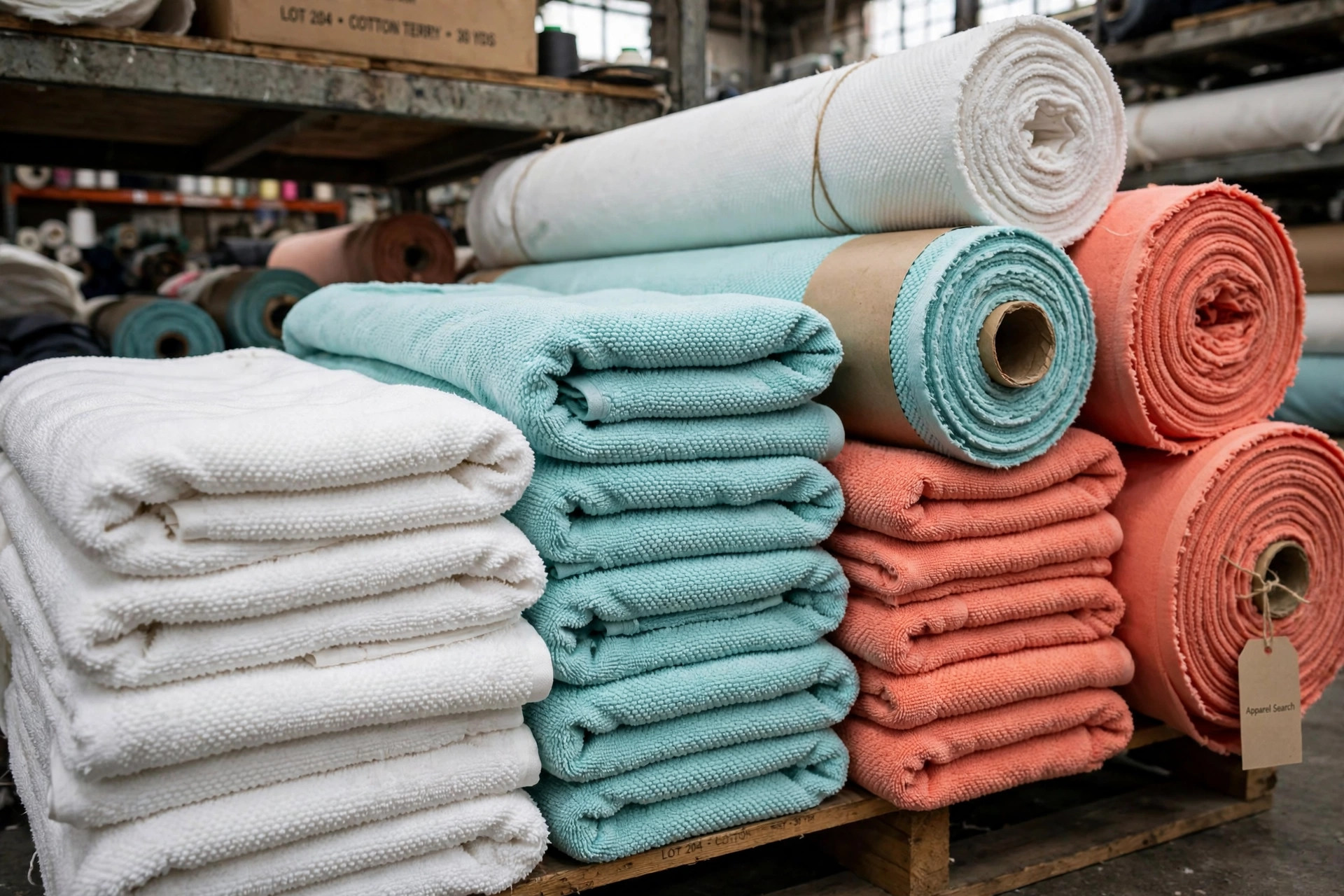
Terry cloth - terry towelling - is a woven fabric with an extra warp: alongside the ground warp and weft, a pile warp is woven slack and then beaten up so it stands away from the ground in loops on one or both faces. Those thousands of loops multiply the surface area of the cotton, which is why terry absorbs so much water and feels soft and warm doing it. Loop height, loop density and yarn quality set the grade: long, dense, even loops in long-staple cotton make the heavy hotel towel; short, sparse loops make the thin, hard-wearing institutional one.
This directory lists twelve terry mills across India, Turkey, Taiwan, Canada, the USA, Pakistan and China, each with its profile below. The Terry Search pages and the Terry Machinery directory are linked on this page. Towel production follows the cotton trade, and the listing map - South Asia, Turkey and China above all - is the map of the modern towel industry.
Woven Terry and French Terry Are Different Fabrics
Visitors often arrive on this page looking for French terry, so the distinction between the two fabrics matters. French terry is not woven at all: it is a weft knit - usually cotton or a cotton blend - with loops drawn through on the back face only, leaving a smooth face outside. That makes French terry a sweatshirt, hoodie, jogger and casual dress fabric, lighter and stretchier than woven terry and not made for towelling water. Woven terry has loops (or a sheared velour face) on a stable woven ground and no natural stretch. A purchase order that just says 'terry' will be quoted both ways by different mills, so specify woven terry towelling or French terry knit, the weight, and which faces carry the loops.
Velour is terry's dressed-up sibling: the loops on one face are sheared level, giving a velvet-like surface for fashion robes and beach towels, at some cost in absorbency, because cut loops drink less than closed ones. Microfiber terry, woven or knitted from split synthetic filaments, serves cleaning cloths and sport towels where absorbency per gram and fast drying matter more than cotton's soft hand.
Weights, Yarns and Quality Checks
Terry is sold by weight - grams per square meter - and by size and construction for made-up towels: hand towels, bath towels and bath sheets at weights from roughly 400 gsm for promotional quality to 700 gsm and above for luxury retail. Yarn matters as much as weight: ring-spun and combed cotton, Egyptian and Pima long staples, and zero-twist yarns (which need no twist because the filaments are held by a soluble core during weaving) all raise softness; open-end yarns and polyester blends lower cost and raise durability for institutional laundry. Buyers should wash-test samples for shrinkage, loop pull-out and linting - new terry always lints, but excessive lint after three washes signals short-staple yarn.
In the garment and robe trade, the same checks apply plus pattern ones: woven terry does not stretch, so robes and wraps are cut generously, and dobby borders and jacquard woven designs are specified at the loom, not added later. For French terry apparel, specify loopback or brushed back, elastane content for recovery, and the weight in the 280-380 gsm band typical of sweatshirting.
The Mills on This Page
The twelve listings below are: A K Dyeing, Alok Textile Industries, SGS Interknits and Sriyansh Ispat from India; Ceyteks Tekstil from Turkey; Dimple International from Taiwan; Gideon Textiles from Canada; Carolina Cotton Works, Lincoln Textile Sales and The West Coast Weaving Establishment from the American trade; Multan Industries from Pakistan; and Xiamen C and D from China. Between them they cover the towel, robe and French terry supply routes most buyers use, and each name opens its Fabric Mills by Name profile for the company-level detail.
Fabric Mills and Factories in This Directory
The mills below are listed in this directory. Each name opens the company's profile in the Fabric Mills by Name directory.
A K Dyeing
A fabric mill based in India, profiled in the Apparel Search Fabric Mills by Name directory and listed among the mills supplying this fabric type.
Alok Textile Industries
A fabric mill based in India, profiled in the Apparel Search Fabric Mills by Name directory and listed among the mills supplying this fabric type.
Carolina Cotton Works, Inc.
A fabric mill based in USA, profiled in the Apparel Search Fabric Mills by Name directory and listed among the mills supplying this fabric type.
Ceyteks Tekstil
A fabric mill based in Turkey, profiled in the Apparel Search Fabric Mills by Name directory and listed among the mills supplying this fabric type.
Dimple International Corporation
A fabric mill based in Taiwan, profiled in the Apparel Search Fabric Mills by Name directory and listed among the mills supplying this fabric type.
Gideon Textiles Inc.
A fabric mill based in Canada, profiled in the Apparel Search Fabric Mills by Name directory and listed among the mills supplying this fabric type.
Lincoln Textile Sales, Inc
A fabric mill based in USA, profiled in the Apparel Search Fabric Mills by Name directory and listed among the mills supplying this fabric type.
Multan Industries
A fabric mill based in Pakistan, profiled in the Apparel Search Fabric Mills by Name directory and listed among the mills supplying this fabric type.
SGS Interknits (p) ltd
A fabric mill based in India, profiled in the Apparel Search Fabric Mills by Name directory and listed among the mills supplying this fabric type.
Sriyansh Ispat Limited
A fabric mill based in India, profiled in the Apparel Search Fabric Mills by Name directory and listed among the mills supplying this fabric type.
The West Coast Weaving Establishment
Profiled in the Apparel Search Fabric Mills by Name directory and listed among the mills supplying this fabric type.
Xiamen C and D Inc.
A fabric mill based in China, profiled in the Apparel Search Fabric Mills by Name directory and listed among the mills supplying this fabric type.
Common Questions
What is the difference between terry cloth and French terry?
Terry cloth is woven, with absorbent loops on one or both faces, and is the towel and robe fabric. French terry is a knit with loops only on the back, used for sweatshirts, hoodies and joggers.
Why is terry cloth so absorbent?
Its extra pile warp stands in thousands of loops, multiplying the cotton surface that can hold water. Longer, denser loops in good cotton absorb the most.
What weight of terry makes a good towel?
Around 400 gsm is promotional quality, 500-600 gsm is good retail weight, and 700 gsm and above is luxury hotel weight - balanced against drying time, since very heavy towels dry slowly.
More to Explore
- A K Dyeing
- Alok Textile Industries
- Antibacterial Fabric
- Bamboo
- Basalt
- Boucle
- Breathable
- Broadcloth
- Brocade
- Burlettes
- Canvas
- Carbon
- Carolina Cotton Works, Inc.
- Ceyteks Tekstil
- Chambray
- Chenille
- Chiffon
- Circular
- Clothing Industry Employment
- Clothing Industry Factories
- Conversion Charts
- Corduroy
- Cotton
- Crepe
- Crochet
- Damask
- Denim
- Dimple International Corporation
- Dobby
- Double Knit
- Drill
- Duck
- Dyed Fabric
- Embroidered
- Embroidery Directory
- Fabric
- Fabric Definitions
- Fabric Directory
- Fabric Retail
- Fabric Wholesalers
- Fashion Industry News
- Fiberglass
- Fibers Directory
- Fil-a-Fils
- Filter Cloth
- Flame Retardant
- Fleece
- French Terry
- Gabardine
- Gauze
- Georgettes
- Gideon Textiles Inc.
- Ginghams
- Greige Fabric
- Herringbone
- Horse Hair
- Interlining
- Interlock
- Jacquard
- Jersey Fabric
- Lace
- Lacoste
- Lincoln Textile Sales, Inc
- Linen
- Lining
- Long Fiber Reinforced Thermalplastics
- Mesh
- Metallic
- Multan Industries
- Muslin
- Narrow
- Net
- Non Woven Fabric
- Novelty
- Nylon
- Ottoman
- Oxford
- Percale
- Pile
- Pique
- Pointelle
- Polar Fleece
- Polyester
- Poplin
- Printed
- Printing Directory
- Quilted
- Raschel
- Reflective
- Rib
- Sateen
- Satin
- Seersucker
- SGS Interknits (p) ltd
- Silk Fabric
- Single Jersey
- Smart Fabrics
- Sriyansh Ispat Limited
- Stretch
- Suede
- Taffeta
- Tassars
- Terry Machinery
- Terry Search
- Textile Machinery
- Textiles
- The West Coast Weaving Establishment
- Thermal
- Tricot
- Tulle
- Tweed
- Twill
- Velcro
- Velour
- Velvet
- Viole
- Vynil
- Waffle
- Waterproof
- Wool
- Xiamen C and D Inc.
- Yarn Dyed
- Yarn Factories
Looking for Fabric Mills and Suppliers?
The wider directory behind these pages is the Fabric section hub, which opens the whole Apparel Search fabric mill directory: fabric types from A to Z, the Fabric Mills by Name profiles, and the dyeing, printing and finishing directories that support them.