Seersucker Fabric Mills
Seersucker's crinkled stripes are woven in, not pressed in: alternating slack and tight warp yarns pucker the cloth as it comes off the loom. Here is how mills make it, and the original directory listings.
Shop Seersucker Fabric Now
Shop Seersucker Fabric on Amazon Shop Seersucker Fabric on eBayThese links open the Apparel Search shopping guides for Amazon and eBay, where the product links are kept in one place.
How the Pucker Forms
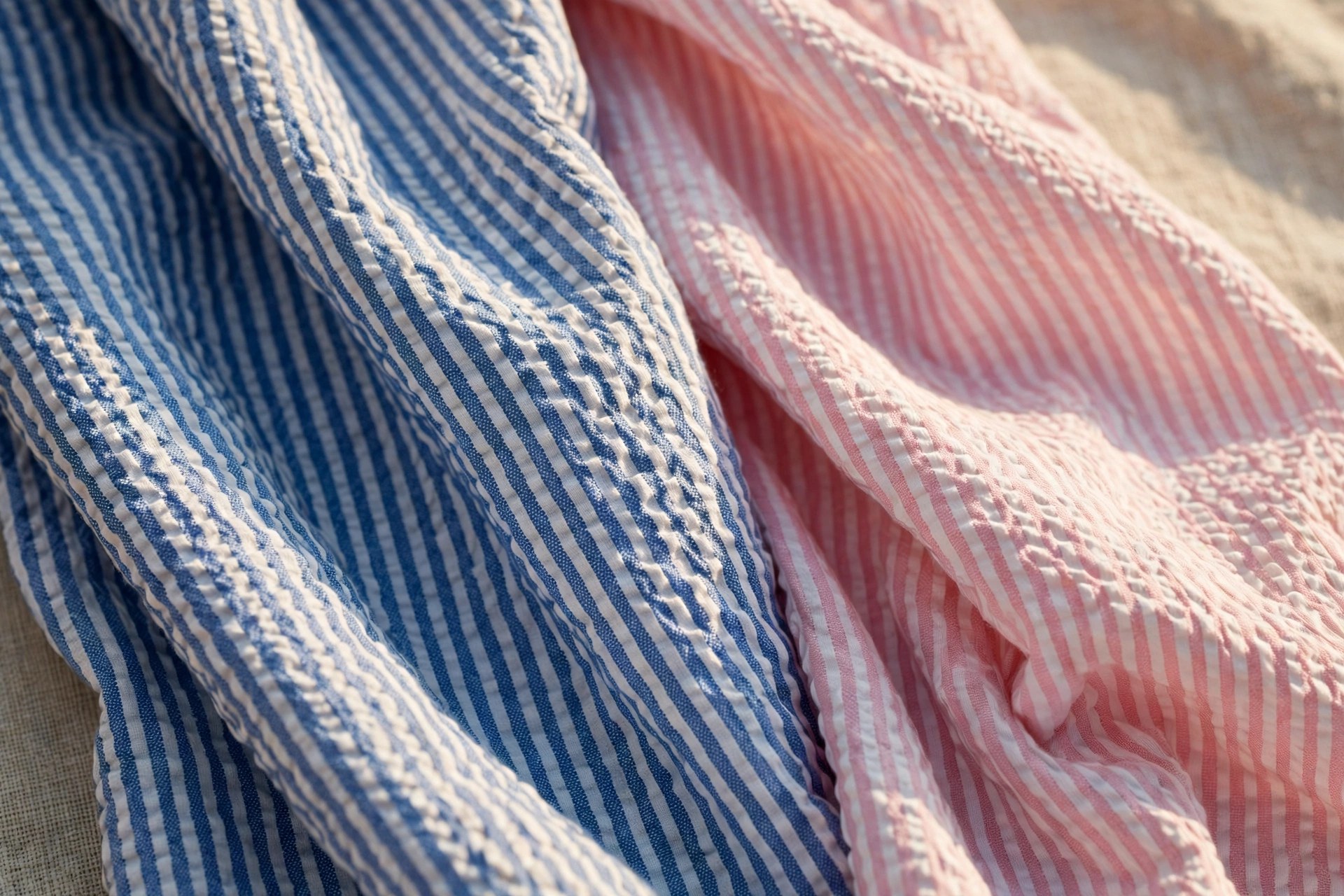
True seersucker is a slack-tension weave. On the loom, groups of warp yarns are fed from two warp beams at different tensions: the tight yarns weave flat while the slack yarns, released with extra length, buckle into soft ridges once the cloth leaves the loom. The result is the familiar puckered stripe, usually paired with flat stripes in a contrasting color, and the texture is permanent because it is part of the structure - no finish is needed to create it and no ironing can remove it. The name is usually traced to a Persian phrase for milk and sugar, a nod to the cloth's alternating smooth and rough stripes.
A cheaper imitation exists: plain cotton cloth treated with caustic soda in stripes, which shrinks the treated bands and puckers the rest. This chemical seersucker looks similar at first but relaxes with wear and washing, so buyers sourcing genuine seersucker should confirm with the mill that the pucker is woven, and check a washed sample before committing to a program.
Why the Texture Performs
The puckers hold most of the fabric away from the skin, so air circulates and only the raised stripes make contact - which is why seersucker became the classic summer suiting of the American South and of colonial India before it. It is almost always cotton, sometimes with polyester blended in for crease resistance, and it needs no ironing because the texture is supposed to look crinkled. Suits, sport coats, shirts, dresses, children's wear and bedding are its main markets, and the classic colorways are blue on white, grey on white and soft multi-stripes, though solid-dyed seersucker is also woven.
For mills, the skill lies in tension control: uneven let-off shows up as irregular puckers or stripes that wander, defects that are obvious in a finished suit. Buyers should check stripe regularity across the width, confirm the fabric's shrinkage after washing, and note that seersucker is normally woven narrower than suiting flannel because the two-beam set-up limits loom width on older equipment.
The Mills on This Page
The original Apparel Search seersucker page listed three mills, and all three listings are kept below with their profiles: Beximco Group of Bangladesh, one of that country's largest composite textile groups; Multan Industries of Pakistan, from the historic weaving city of Multan; and The West Coast Weaving Establishment. Seersucker production follows the cotton shirting and suiting trade, so South Asian mills feature strongly in this category, exporting greige and finished cloth to garment makers in Europe and North America.
Seersucker also has a workwear and hospitality life beyond summer tailoring: its texture hides soil and creasing, so hotels, airlines and warm-climate uniform programs use it for shirts, dresses and bedding that must look fresh without pressing. Mills weaving for those contracts emphasize wash durability - the pucker must survive industrial laundering - and offer polyester-cotton versions that dry faster than all-cotton cloth. When comparing quotations, buyers should ask whether the price is for loom-state, sanforized or fully finished cloth, since seersucker's relaxed texture makes width and length yields vary more between finishing routes than they do for a flat fabric, and a cheap greige price can disappear in finishing losses.
In the garment, seersucker's forgiving texture is a pattern maker's friend: it needs no matching of the pucker itself, only of the stripe, and small fitting wrinkles vanish into the crinkle. That is one reason the fabric cycles back into fashion whenever warm-weather tailoring returns.
Fabric Mills and Factories in This Directory
The mills below are the listings the original Apparel Search directory carried on this page. Each name opens that company's profile in the Fabric Mills by Name directory.
Beximco Group
A fabric mill based in Bangladesh, profiled in the Apparel Search Fabric Mills by Name directory and listed among the mills supplying this fabric type.
Multan Industries
A fabric mill based in Pakistan, profiled in the Apparel Search Fabric Mills by Name directory and listed among the mills supplying this fabric type.
The West Coast Weaving Establishment
Profiled in the Apparel Search Fabric Mills by Name directory and listed among the mills supplying this fabric type.
Common Questions
Is seersucker's pucker permanent?
On true woven seersucker, yes - the texture is built into the weave by slack-tension warps and survives washing. Chemically treated imitations gradually relax and flatten.
Why is seersucker comfortable in hot weather?
The raised stripes hold the cloth off the skin so air can circulate, and the cotton construction breathes. The crinkled surface also hides wrinkles, so it needs no ironing.
What is seersucker mainly used for?
Summer suits and sport coats are the classic use, along with shirts, dresses, children's clothing, robes and lightweight bedding.
More to Explore
- Antibacterial Fabric
- Bamboo
- Basalt
- Beximco Group
- Boucle
- Breathable
- Broadcloth
- Brocade
- Burlettes
- Canvas
- Carbon
- Chambray
- Chenille
- Chiffon
- Circular
- Clothing Industry Employment
- Clothing Industry Factories
- Conversion Charts
- Corduroy
- Cotton
- Crepe
- Crochet
- Damask
- Denim
- Dobby
- Double Knit
- Drill
- Duck
- Dyed Fabric
- Embroidered
- Embroidery Directory
- Fabric
- Fabric Definitions
- Fabric Directory
- Fabric Retail
- Fabric Wholesalers
- Fashion Industry News
- Fiberglass
- Fibers Directory
- Fil-a-Fils
- Filter Cloth
- Flame Retardant
- Fleece
- French Terry
- Gabardine
- Gauze
- Georgettes
- Ginghams
- Greige Fabric
- Herringbone
- Horse Hair
- Interlining
- Interlock
- Jacquard
- Jersey Fabric
- Lace
- Lacoste
- Linen
- Lining
- Long Fiber Reinforced Thermalplastics
- Mesh
- Metallic
- Multan Industries
- Muslin
- Narrow
- Net
- Non Woven Fabric
- Novelty
- Nylon
- Ottoman
- Oxford
- Percale
- Pile
- Pique
- Pointelle
- Polar Fleece
- Polyester
- Poplin
- Printed
- Printing Directory
- Quilted
- Raschel
- Reflective
- Rib
- Sateen
- Satin
- Silk Fabric
- Single Jersey
- Smart Fabrics
- Stretch
- Suede
- Taffeta
- Tassars
- Terry
- Textile Machinery
- Textiles
- The West Coast Weaving Establishment
- Thermal
- Tricot
- Tulle
- Tweed
- Twill
- Velcro
- Velour
- Velvet
- Viole
- Vynil
- Waffle
- Waterproof
- Wool
- Yarn Dyed
- Yarn Factories
Looking for Fabric Mills and Suppliers?
The wider directory behind these pages is the Fabric section hub, which opens the whole Apparel Search fabric mill directory: fabric types from A to Z, the Fabric Mills by Name profiles, and the dyeing, printing and finishing directories that support them.