Gingham Fabric
Gingham is the checked cloth whose pattern is woven, not printed: white yarn crossed with a color gives the true gingham check, with its pale intersections where the two colors mix in the weave. This directory explains how the check is built and carries the gingham mill Apparel Search lists.
Shop Gingham Fabric Now
Shop Gingham Fabric on Amazon Shop Gingham Fabric on eBayThe Amazon and eBay links on this page are affiliate links. If you make a purchase through them, Apparel Search may earn a commission.
A Check Made by the Loom
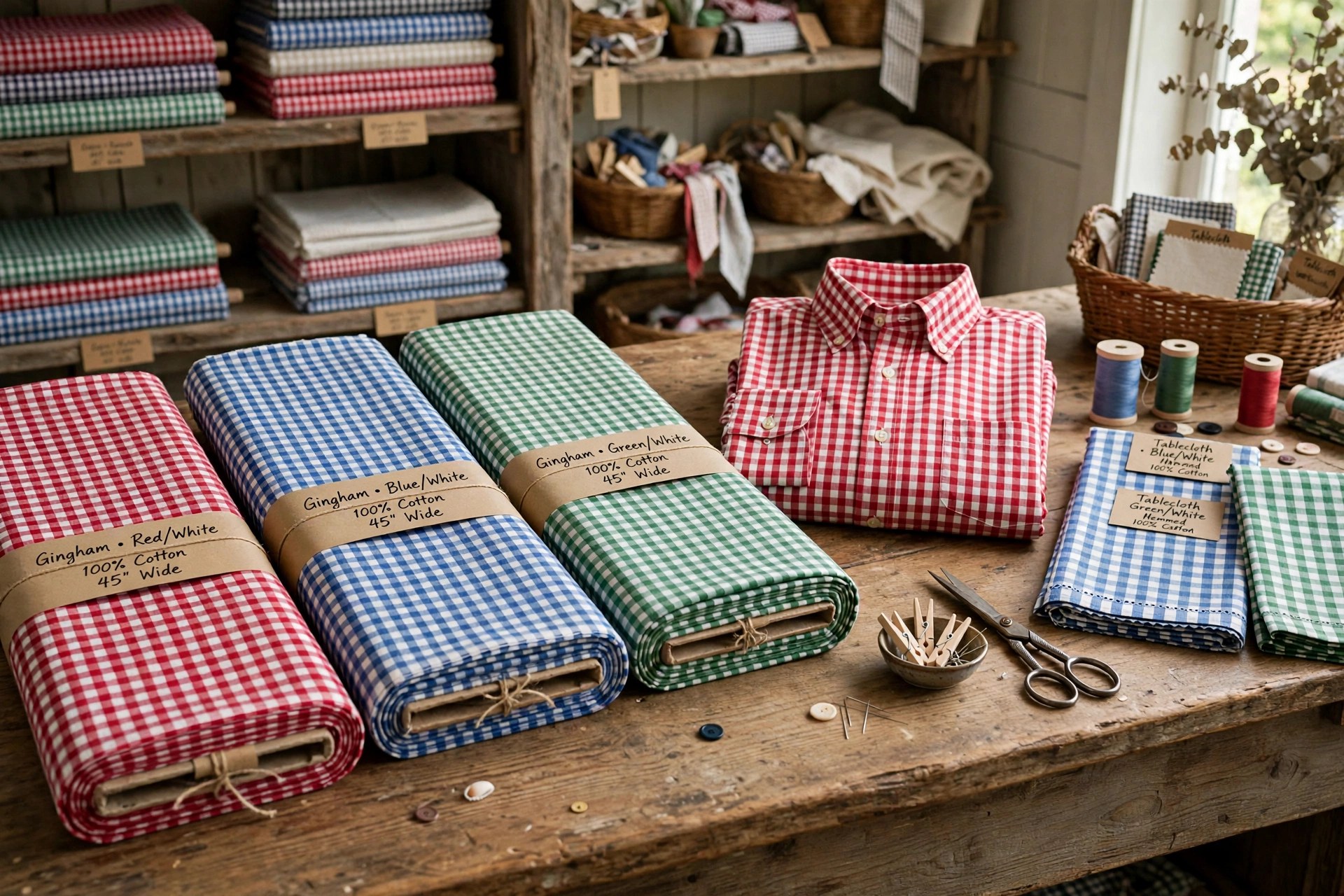
Gingham begins as yarn, not as cloth: the warp is set with alternating bands of white and a color, the weft is thrown with the same bands, and where color crosses color the check is full strength, where white crosses white it stays white, and where white crosses color it halves to a tint. That three-tone grid, woven in a balanced plain weave, is the unmistakable gingham pattern - and the test of the real thing, because a woven check looks the same on both faces, while a printed imitation is pale on the back. The name travelled from the Malay word genggang, meaning striped, through Dutch and French trade into English mills, and the cloth's meaning flipped from stripe to check on the way - a small lesson in how fabric names follow trade routes rather than logic.
Check size is the specification language: pin checks of a few threads, the classic mid-size checks of school dresses, picnic cloths and men's shirts, and wide windowpane-scale checks for fashion use. Traditional gingham is all cotton, crisp and washable; polyester-cotton versions keep the creases out of uniforms and table linen at the cost of cotton's hand. Seersucker gingham adds the family's one structural variation - slack-tension stripes woven into the check so the surface puckers in bands, a summer shirting that needs no ironing because its texture is deliberate. Whatever the size, a good gingham is square: the checks measure the same in warp and weft, the color is even band to band, and the cloth cuts without the pattern drifting off grain.
Uses and Buying Notes
Gingham's uses follow its character - clean, cheerful and unmistakably patterned. School and service uniforms wear it by the million metres; shirts, dresses, aprons and curtains carry it into homes; tablecloths and napkins are its hospitality staple; and fashion revives it in cycles, from mid-century shirtwaist dresses to contemporary prairie and picnic dressing. Because the pattern is structural, buyers specify check size in threads or millimetres, fiber, and whether the cloth must be yarn-dyed on both faces - the point on which cheap imitations fail inspection. Beside it in this section stand the other yarn-patterned staples of the Fabric Mill Directory, and Georgette offers the sheer, solid-color counterpoint for dress ranges planned across both cloths.
The listing below is the complete set Apparel Search carries for gingham: one mill, Alok Textile Industries of India, linked to its profile in the Fabric Mills by Name section, with no listing added or removed. One listed mill for a commodity check cloth is a starting point rather than a shortlist - gingham is woven wherever cotton shirting is woven - so an enquiry here should lead with the commercial facts a mill needs: check size and color, fiber, width, quantity and the delivery market's labeling rules for fiber content. A mill weaving gingham regularly will quote against that specification directly and will say plainly whether its checks are yarn-dyed in its own dye house or woven from bought dyed yarn. Thank you for using the Apparel Search Fabric Mill Directory.
Gingham also carries a cultural weight out of proportion to its simple weave. It is the cloth of school uniforms in much of the world, of the blue-and-white checked dress that became a screen icon in 1939, of French bistros' curtains and of the bistro check's close cousin in red and white on picnic blankets and trattoria tables. That familiarity is commercially useful: a gingham garment or table line reads instantly as clean, fresh and informal, which is why the check returns whenever fashion wants those associations - and why mills keep the standard colors, red, blue, green and black on white, in regular production rather than to order.
Gingham Mill Listed in This Directory
Alok Textile Industries (India)
Company listed in the Apparel Search fabric mill directory under its own profile in the Fabric Mills by Name section. Open the linked profile for the company's directory record and contact details.
Common Questions
How can you tell real gingham from a printed check?
Turn the cloth over. Gingham's check is woven from yarn-dyed warp and weft bands, so both faces look the same and the color-crossings show three tones - full color, white and a half-tint. A printed check is strong on one face and pale on the back.
What check sizes does gingham come in?
From pin checks of a few threads, through the classic mid-size checks of uniforms, shirts and table linen, to wide windowpane-scale checks for fashion. Check size, fiber and width are the core of any gingham specification.
Which mill is listed for gingham fabric?
One company: Alok Textile Industries (India), linked to its profile in the Fabric Mills by Name section.
More to Explore - The Full Fabric Directory A-Z
- Gabardine Fabric Mills
- Gauze Fabric Mills
- Georgette Fabric Mills
- Gingham Fabric
- Greige Fabric
- Flannel Fabric Mills
- Fleece Fabric
- French Terry Fabric Mills
- Herringbone Fabric Mills
- Horse Hair Fabric
- Fabric Mills - Fabric Section Hub
- Textile Machinery
- Embroidery Directory
- Printing Directory
- Alok Textile Industries
- Clothing Industry Factories
- Yarn Factories
- Fabric Retail
- Fabric Wholesalers
- Fibers Directory
- Fabric Definitions
- Fashion Industry News
- Clothing Industry Employment
- Conversion Charts
- Antibacterial Fabric
- Bamboo
- Basalt
- Boucle
- Breathable
- Broadcloth
- Brocade
- Burlettes
- Canvas
- Carbon
- Chambray
- Chenille
- Chiffon
- Circular
- Corduroy
- Cotton
- Crepe
- Crochet
- Damask
- Denim
- Dobby
- Double Knit
- Drill
- Duck
- Dyed Fabric
- Embroidered
- Fiberglass
- Fil-a-Fils
- Filter Cloth
- Flame Retardant
- Interlining
- Interlock
- Jacquard
- Jersey Fabric
- Lace
- Lacoste
- Linen
- Lining
- Long Fiber Reinforced Thermalplastics
- Metallic
- Mesh
- Muslin
- Narrow
- Net
- Non Woven Fabric
- Novelty
- Nylon
- Ottoman
- Oxford
- Percale
- Pile
- Pique
- Pointelle
- Polar Fleece
- Polyester
- Poplin
- Printed
- Quilted
- Raschel
- Reflective
- Rib
- Sateen
- Satin
- Seersucker
- Silk Fabric
- Single Jersey
- Smart Fabrics
- Stretch
- Suede
- Taffeta
- Tassars
- Terry
- Thermal
- Tricot
- Tulle
- Tweed
- Twill
- Velcro
- Velour
- Velvet
- Viole
- Vynil
- Waffle
- Waterproof
- Wool
- Yarn Dyed
- Textiles
- Fabric
Looking for Fabric Mills and Suppliers?
Return to the Fabric Directory hub for the full fabric section, or browse the Fabric Manufacturers Directory page for the wider mill trade.