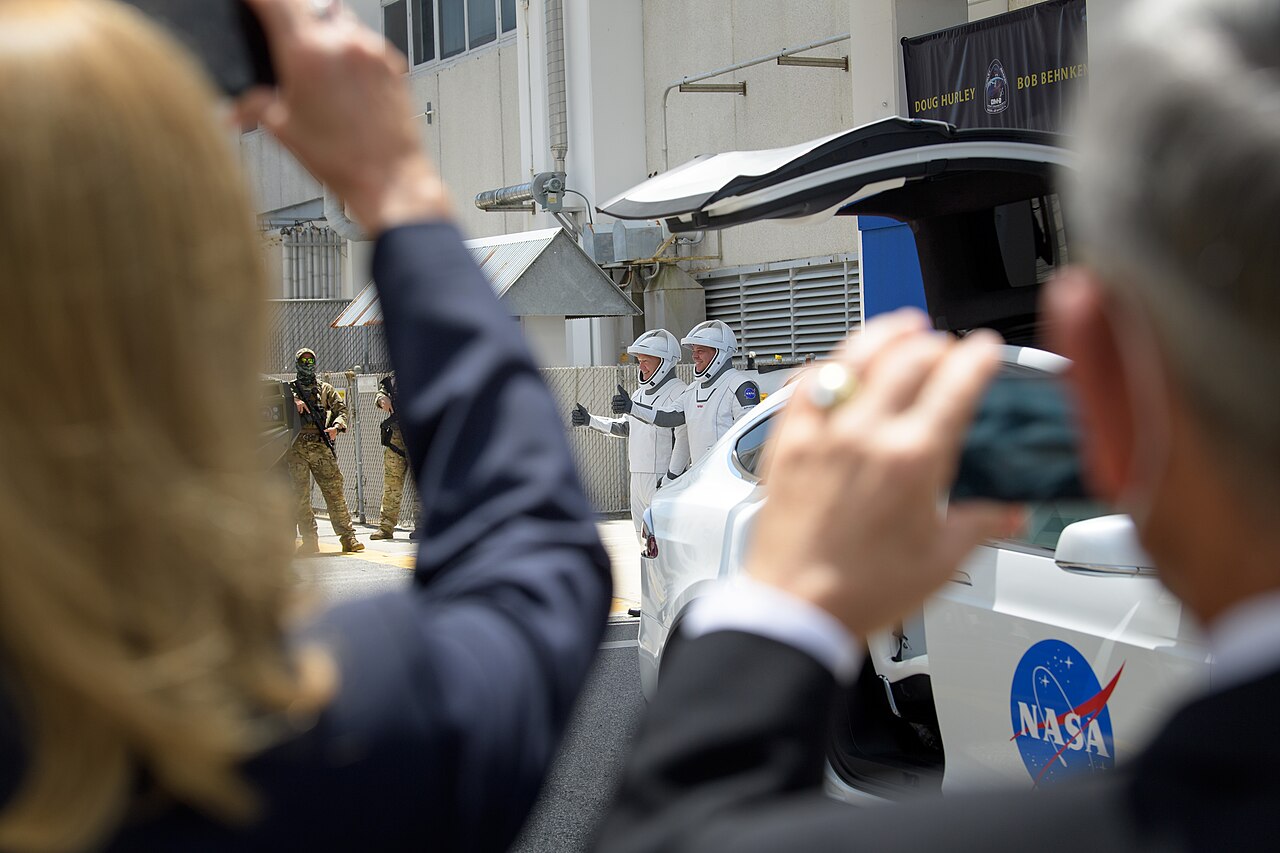
01 / The BasicsThe Suit at a Glance
The SpaceX garment is an IVA suit — IVA stands for intravehicular activity, meaning it is worn inside the vehicle. Its job begins where an ordinary flight suit's job ends: if the Crew Dragon capsule were to lose pressure on the way to or from the International Space Station, the suit would pressurize around its wearer, keep them breathing, keep them cool, and keep them in communication with the spacecraft and the ground. The rest of the time it is a close-fitting, flame-resistant garment with built-in communications, hearing protection for the noise of launch and re-entry, and gloves that work the capsule's touchscreen controls.
The contrast with what came before is the point. The Space Shuttle era's launch-and-entry suit — the bright orange ACES suit, nicknamed the “pumpkin suit” — was a bulky assembly of separate pieces. The SpaceX suit is a single tailored garment with integrated boots, closer in spirit to a racing driver's fire suit crossed with a bespoke suit of clothes than to the expedition gear of earlier programs. Our space suit definition explains how IVA and EVA suits differ and where each is used.
02 / The DesignerA Costume Designer Gets the Call
In 2016, SpaceX invited Jose Fernandez to compete for an unusual commission. Fernandez runs Ironhead Studio in Los Angeles, one of Hollywood's leading costume fabrication shops. His team's credits run through modern superhero cinema: Batman's suits for Batman v Superman, work on Captain America: Civil War, the helmets of Thor and Loki, Spider-Man's mask, and the iconic robot helmets of Daft Punk. Fernandez has told the story in interviews with Forbes and others: when SpaceX first called, he assumed the job was for a film. He did not know what SpaceX was.
What sealed the commission, by Fernandez's account, was the helmet. SpaceX's founder Elon Musk wanted a suit that looked heroic, and the helmet is where a costume designer earns that word — it is the piece that frames the face, the piece every camera finds. Fernandez brought a costumer's specific expertise to the problem: decades of solving how molded pieces join, flex and seal against a moving body, and how to let an actor wearing a rigid cowl still turn his head — a problem he had famously worked on for Ben Affleck's Batsuit.
Fernandez designed the suit's appearance and built the prototype over a development relationship he has described as lasting several years. Then the garment changed hands in the way a costume never does: SpaceX's in-house suit team in Hawthorne, California — working, as the company's lead space suit specialist Maria Sundeen put it, in the same building as the rockets and the capsule — took the design and engineered it into hardware that could be certified to keep people alive. Every production suit since has been made by SpaceX itself, in-house.
03 / Design Meets EngineeringDesigned Like a Tuxedo, Built Like Equipment
The “tux” brief explains the suit's most striking quality: it is tailored. Earlier American launch suits were assembled from sized components and adjusted with straps and laces; the SpaceX suit is patterned to one body. NASA's Commercial Crew press kit states it plainly: the suit “is custom-made for each passenger aboard Dragon.” SpaceX's suit team takes the individual crew member's measurements and builds the one-piece garment to fit, because a pressure suit is a garment whose fit is a safety system — a bladder that balloons unevenly, a joint that binds, a glove that is a size too large all become functional failures at the worst moment.
That is why the SpaceX suit belongs in a fashion guide as much as in an engineering one. The disciplines it draws on — measurement, pattern, fit, the behavior of flexible materials over joints — are the disciplines of tailoring, pushed to an extreme. It is the same logic our guide to custom-fit clothing technology follows into the consumer market, and the same measurement-first thinking behind modern body-scanning technology.
SpaceX also thinks of the suit as part of the vehicle. Chris Trigg, the company's spacesuits and crew equipment manager, has described it as a “suit-seat system”: the astronaut sits, plugs the suit into the seat's umbilical, and from that moment the capsule breathes for the suit. The garment, the seat and the spacecraft are one designed object — which is precisely how a costume designer thinks about a character, and precisely how a tailor thinks about a client.
04 / ConstructionAnatomy of the Suit
One piece, one wearer
The suit is a single-piece garment with integrated boots, entered and sealed as one unit rather than assembled from separates. Its outer layer is flame-resistant — Fernandez has described the construction drawing on Teflon- and Nomex-family technical fabrics of the kind used across aerospace and firefighting — and the white-and-black paneling is not decoration alone: the dark panels articulate the joints and torso the way a tailor's seams articulate a jacket, which is why the suit reads as fitted clothing rather than equipment even in photographs taken from across a launch pad.
The 3D-printed helmet
Each helmet is custom manufactured using 3D printing technology, per NASA's press materials, and it is a dense piece of engineering: integrated valves that regulate the suit's pressure, a mechanism for retracting and locking the visor, microphones and speakers built into the shell, and hearing protection for ascent and re-entry. A printed helmet can be produced to the individual's head measurements and reproduced exactly — the digital file is the pattern, an idea the apparel industry knows well from CAD/CAM pattern work.
Gloves that work a touchscreen
Crew Dragon is flown largely through three large touchscreen displays, so the suit's gloves are flexible and touchscreen-compatible — an astronaut in a pressurized suit, in an emergency, still has to be able to tap and swipe. Gloves are historically the hardest part of any pressure suit to get right, and making them fine enough for a touchscreen while strong enough to hold pressure is a pattern-and-materials problem any glove maker would recognize.
The single umbilical
There is no backpack. A single connection point on the suit's thigh attaches it to the seat umbilical, and through that one port flow everything the suit needs: air to cool the garment, gas to pressurize it if the cabin fails, and the electronics for communications. The tether is the suit's great limitation and its great elegance — it is why the garment can be slim, light and tailored instead of a wearable spacecraft in its own right.
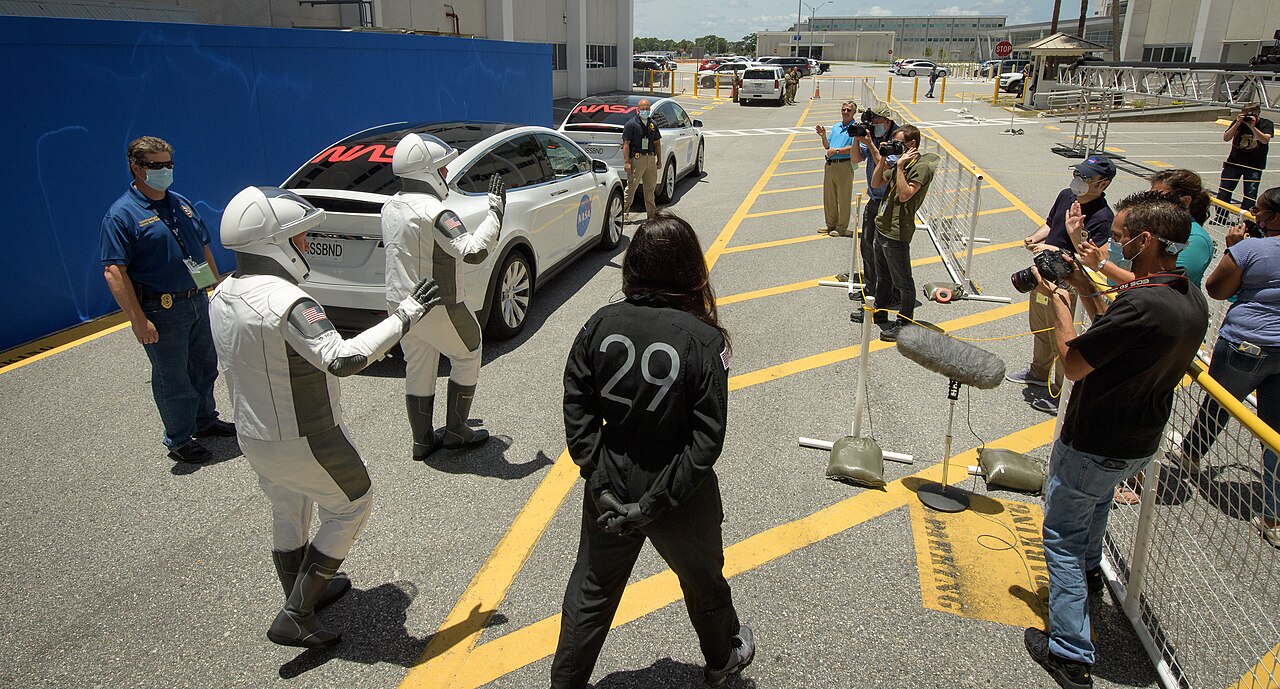
05 / First FlightDemo-2: The Suit Goes to Orbit
The design was first revealed to the public in 2017, when SpaceX published the first images of the suit, and it appeared again in February 2018 in an unexpected fitting: a mannequin nicknamed “Starman” wore one in the driver's seat of the Tesla Roadster launched on the first Falcon Heavy flight. But the garment's real debut came on May 30, 2020, when Behnken and Hurley rode Crew Dragon's Demo-2 mission to the International Space Station — the first crewed launch of a commercial spacecraft, and the first time astronauts had launched from American soil since the Shuttle retired in 2011.
Every crew that has flown on Dragon since — NASA astronauts, international partners and private crews — has worn a suit made the same way: measured, patterned and built for that one wearer in Hawthorne. In a decade of flights the suit has become the visual signature of the commercial space age, as recognizable as the orange Shuttle suit was of its era, and deliberately so.
06 / EvolutionFrom Flight Suit to Spacewalk Suit
The flight suit was never meant to leave the capsule — until a private mission asked it to. For Polaris Dawn, a private mission commanded by Jared Isaacman, SpaceX developed an EVA version of the suit, unveiled in May 2024: a true spacewalking garment evolved from the IVA design, with greater joint mobility, new materials and thermal management for open space, and a 3D-printed helmet carrying a heads-up display and camera. On September 12, 2024, Isaacman exited the Dragon capsule wearing it, completing the first spacewalk on a commercial mission.
The EVA suit matters to the design story because it proves the underlying garment architecture — the tailored one-piece pattern, the printed helmet, the umbilical philosophy (the EVA suit still tethers to the vehicle for life support) — could scale from cabin wear to the harshest clothing environment there is. Meanwhile, a very different design team has been building the suit astronauts will wear walking on the Moon: the Prada and Axiom Space lunar suit, where the fashion house's role is materials and the outer layer.
07 / The Bigger StoryWhy a Suit Like This Matters
For seventy years, spacesuit design was a closed engineering discipline, and it showed: the garments worked magnificently and looked like machinery. The SpaceX suit demonstrated that the two halves of garment-making — the engineering of survival and the craft of appearance, fit and identity — could be practiced on the same object by people from both worlds. A costume designer understood something the engineers had deprioritized: that how a suit looks changes how the public feels about the mission inside it, and that fit is not vanity but function.
It also quietly revived an older truth of spaceflight. The Apollo Moon suits were sewn by hand, by seamstresses from a brassiere and girdle company — clothing workers, not aerospace machinists. The SpaceX suit, tailored one body at a time, is their descendant as much as it is the engineers'. Our guide to spacesuits as clothing traces that whole lineage, from the cooling underwear worn against the skin to the white shell the world sees.