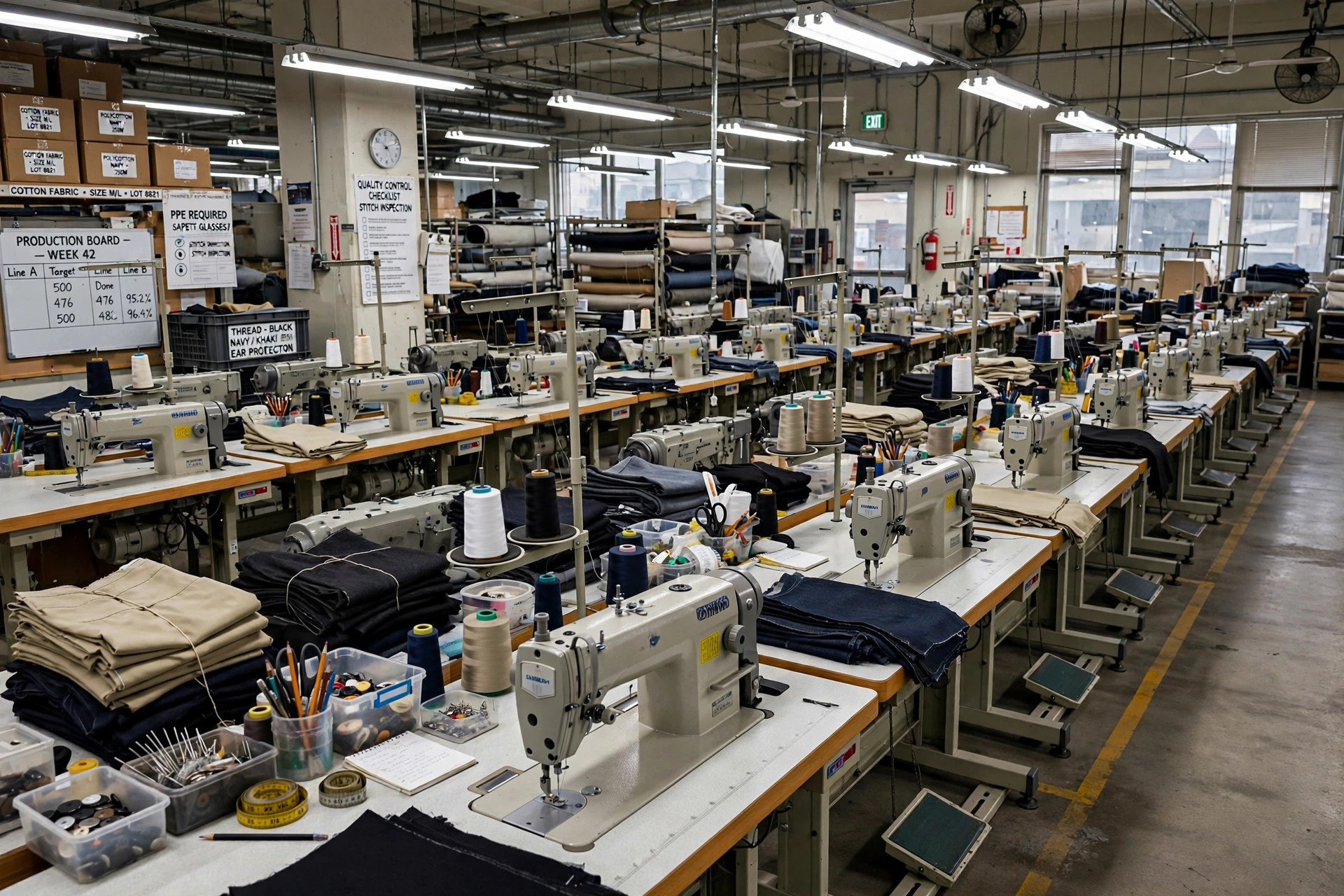
Production line design is how a garment factory arranges machines, operators, and workflow so each piece moves smoothly from cutting to packing. Good line design is the difference between a factory that ships on time and one drowning in work-in-progress.
Bundle vs. Unit Production Systems
In a bundle (progressive bundle) system, operators complete one operation on a bundle of pieces, then pass it on — simple to manage but slow, with bundles piling up between stations. In a unit production system (UPS), single garments travel on an overhead conveyor to the next free operator — faster throughput and less floor space, but it demands real-time tracking and disciplined maintenance.
Line Balancing Basics
Line balancing means assigning work so every operator finishes their task in roughly the same time — the line can only move as fast as its slowest station. Industrial engineers time each operation, then split or combine tasks to smooth the flow. An unbalanced line shows itself as piles of half-finished garments at one station while others wait idle.
Layout Principles That Matter
Keep the cutting room adjacent to the sewing floor to minimize material travel. Sequence machines in the order of operations, leave aisles wide enough for bundle trolleys, and place quality checkpoints at natural breaks (after sewing, after finishing). Good lighting and ventilation aren't comforts — they directly affect defect rates and operator output.
FAQs
- What is line balancing in garment manufacturing?
- Distributing sewing operations across operators so each workstation takes roughly equal time, preventing bottlenecks and idle time.
- Which is better: bundle or unit production?
- Bundle systems suit long runs of simple garments with lower investment. Unit production systems suit shorter runs and higher throughput but cost more to install and manage.
- What is work-in-progress (WIP)?
- Garments partially completed and sitting between operations. High WIP ties up cash and hides quality problems; lean lines keep it minimal.
- How do factories measure line efficiency?
- Typically as actual output versus the theoretical maximum at standard allowed minutes — most well-run lines target 60–80% efficiency.
Apparel Search: explore more production & sourcing resources for the fashion industry.