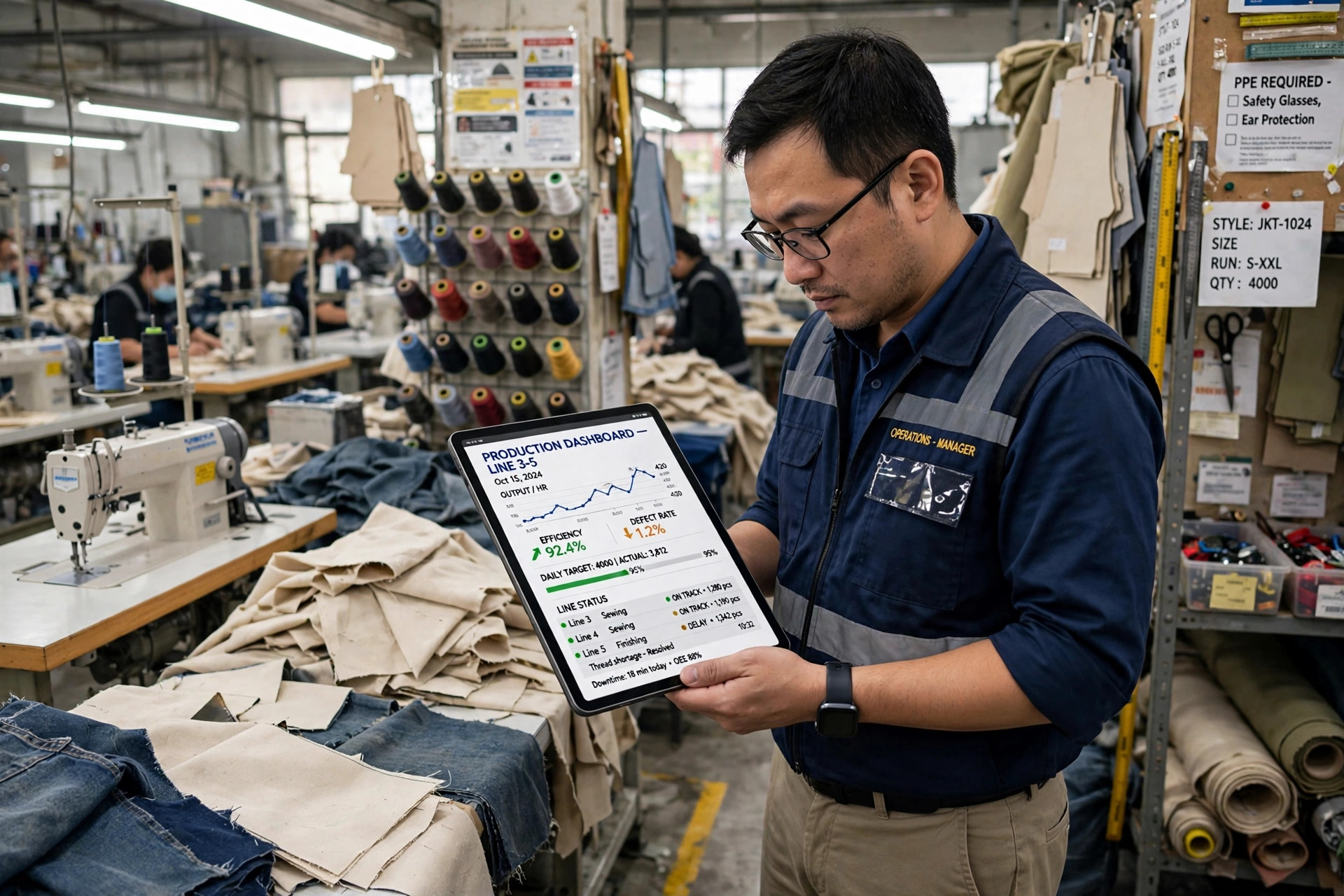
A production tracking system tells a factory — and its brand customers — exactly where every order is: how many pieces are cut, sewn, finished, and packed, updated in near real time. For brands, it's the difference between trusting a ship date and verifying it.
How Tracking Works on the Floor
Operators scan a barcode or RFID tag at each workstation, logging when a bundle starts and finishes an operation. Supervisors see live dashboards of output versus target by line, style, and operator. Problems surface in hours instead of at the end of the week — a stalled operation flags immediately rather than hiding inside a monthly report.
What Brands Should Ask For
Ask your factory for scheduled production reports: daily or weekly output by style, current completion percentage, and any revised ship dates with reasons. Factories with real tracking systems answer these questions in minutes; factories without them answer in days — or not at all. That difference tells you a lot about the operation.
From Clipboards to Cloud
Small factories still track with paper tickets and whiteboards, which works at low volumes. As orders scale, barcode and RFID systems pay for themselves through fewer lost bundles, accurate payroll (piece-rate wages need exact counts), and credible data for brand customers. Cloud-based systems let overseas brands watch production from home.
FAQs
- What is WIP tracking?
- Work-in-progress tracking follows partially finished garments between operations so nothing sits forgotten and bottlenecks are visible immediately.
- Do I need my factory to have a tracking system?
- For small test orders, no. For ongoing production or large orders, a factory with real tracking dramatically reduces the risk of surprise delays.
- What is an AQL inspection?
- Acceptable Quality Limit — a statistical sampling standard (often AQL 2.5 for major defects) used to accept or reject a shipment based on inspecting a sample of pieces.
- Can tracking systems prevent quality problems?
- They surface them faster — defect rates by operator and operation show up in the data, so retraining or repairs happen before thousands of bad pieces accumulate.
Apparel Search: explore more production & sourcing resources for the fashion industry.