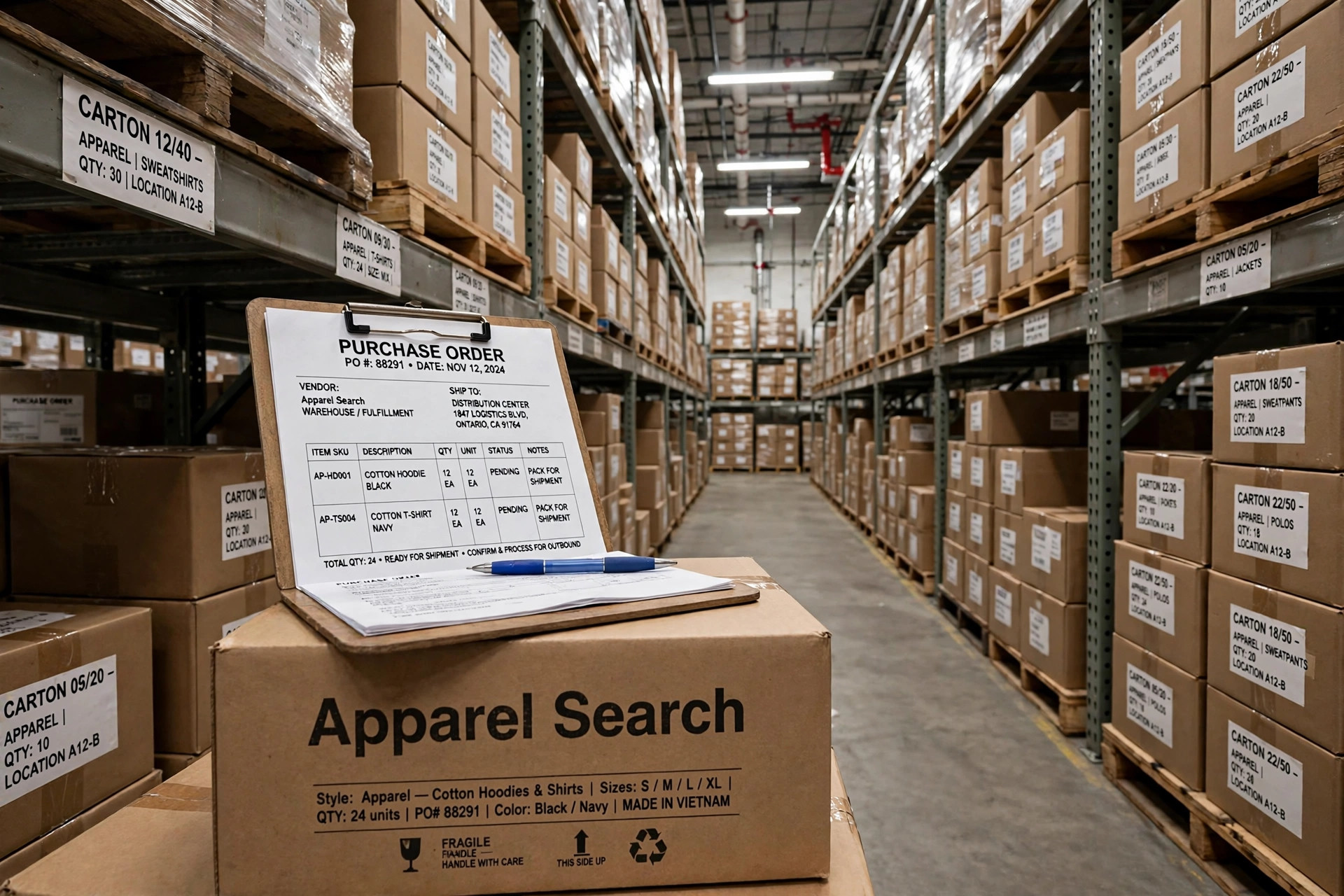
A purchase order from a real retailer is the best piece of paper a young clothing brand can hold — and it spends like nothing at all. The factory wants a deposit to start production and the balance around shipment. The retailer's payment is months away, on the far side of delivery. Between the order and the money sits the entire cost of making the goods, and a brand whose cash and credit line cannot carry that cost faces a miserable choice: decline the order and lose the account, or accept it and gamble the company on every step going right.
Purchase order financing exists for exactly that shape of problem. It funds the production of a confirmed order — paying the factory so the goods get made — and is repaid out of the retailer's payment when the order ships and the invoice comes due. This guide walks through how a deal flows, what it costs, who qualifies, and the risks that stay with the brand no matter who funds the order. It is the companion to our apparel factoring guide: factoring begins where this ends, at the moment the invoice exists.
Purchase order financing, in one paragraph
PO financing is transaction funding secured by a purchase order. A financier pays the factory to produce a confirmed order from a creditworthy retailer — usually by letter of credit or staged payments against documents — and is repaid, with its fees, from the retailer's payment for that order. Unlike factoring, which buys an invoice after shipment, PO financing works before production, and the asset it relies on is the order itself.
01 / The Problem
A Real Order You Can't Afford to Make
The gap is structural, not a sign of a badly run brand. Apparel production is paid for in the factory's currency of time: deposits at order placement, balances at shipment, freight on top — all before the retailer's terms clock even starts. The orders most worth having make the gap widest: a first program with a national chain can be several times larger than anything the brand has produced, with production costs to match, while the brand's bank line was sized for last year's business.
Lenders notice, too. A conventional loan underwrites the brand's past; a purchase order is a claim about the future — this retailer will accept these goods and pay this amount. PO financing is the tool built to underwrite that claim directly: the retailer's credit, the factory's competence and the order's margin, rather than the brand's balance sheet.
02 / The Mechanics
How a PO Financing Deal Flows
- The retailer issues the purchase order — styles, quantities, price, delivery window. This document is the foundation of everything that follows; its terms are the deal's terms.
- The brand takes the PO to a financier. Some apparel factors offer PO financing; other firms specialize in it. The financier underwrites three things: the retailer's credit (will the final payment be there?), the factory (can it produce this, on time, to spec?), and the margin (does the order make enough to pay for all of this?).
- The financier pays the factory. Commonly this is done by opening a letter of credit in the factory's favor, or by wired deposits and balances — often in stages tied to production milestones, inspections and shipping documents, so money follows verified progress.
- The goods ship. Frequently they move directly to the retailer, with the paperwork routed so the financier's interest in the transaction is protected end to end.
- The retailer pays the invoice at terms. The invoice is typically assigned to the financier — or factored with the same firm — so the payment lands with the financier first rather than passing through the brand.
- The settlement. The financier deducts the amount it funded plus its fees and remits the balance to the brand. That balance is the order's profit, and it arrives months after the work began — which is rather the point.
03 / The Cost
What It Costs — and Why Margins Decide
PO financing is priced like what it is: short-term money advanced against a single transaction the financier does not control, secured mainly by a promise from a third party. It costs more than factoring and much more than a bank line. Fees are commonly described as a percentage of the amount funded for each period the money is out — figures in the range of a few percent per month the funds are outstanding are commonly cited — and the meter runs on calendar time, so a production delay is also a financing charge. There may be additional costs for the letter of credit, inspections and document handling.
The test that decides whether a deal should happen at all is arithmetic. The order's gross margin must exceed the full financing cost with room left over for the deductions, freight surprises and small disasters that apparel production reliably produces. A purely illustrative example: on a $100,000 order that costs $60,000 to produce and deliver, the gross margin is $40,000 — an all-in financing cost of, say, $6,000 to $9,000 still leaves the order well worth doing. The same fee against an order with only $20,000 of margin would consume a third to nearly half of it, and a thinner order should not be financed at any price. Run your own numbers with your own quotes — the example is arithmetic, not an offer.
04 / Who Qualifies
Who Qualifies — and Who Doesn't
The strongest candidates share a shape: finished goods (not raw materials or services), a creditworthy end retailer whose payment anchors the whole structure, a factory with a verifiable record of shipping this kind of product, and margins that carry the cost with room to spare. Financiers also look hard at the humans: a brand — or a production team behind it — that has delivered programs like this before is a materially better risk than a first attempt, and underwriting prices that difference.
The weak candidates are equally recognizable: orders from retailers whose own credit is shaky (if the final payment is doubtful, there is no deal to fund), highly custom goods with no resale value if the buyer rejects them, razor-thin private-label margins that leave nothing for the fee, and production plans nobody experienced has reviewed. When a financier declines, treat it as information — a professional judgment that this order, this factory or this margin does not hold together — and not merely as a door closing.
05 / The Risks
Risks and Honest Limits
Production risk stays yours. The financier funds an order; it does not guarantee the outcome. Late delivery, quality failure or a rejected shipment can leave the brand owing the funded amount and the fees without the retailer's payment to cover them. The inspections and staged payments in a well-run deal exist precisely because this risk is real, and they reduce it — they do not remove it.
The fee clock runs on calendar time. Factory delays, port congestion, a failed inspection and a re-make all extend the period the money is out, and the charge grows with it. A deal that works at ten weeks can stop working at sixteen.
It is a bridge, not a foundation. A brand that needs PO financing for every order, every season, is usually looking at a margin problem or a capitalization problem that financing can mask but not cure. Used well, PO financing is for the step-up order — the program that changes the size of the company — and its success is part of how a brand graduates to cheaper money: factored receivables, then a bank line of its own.
06 / Choosing the Tool
PO Financing, Factoring or a Letter of Credit?
The three tools answer three different questions, and in a typical import program all three appear in sequence.
Purchase order financing — before production
Funds the making of the goods against the retailer's purchase order. Underwrites the retailer, the factory and the margin. This guide's subject.
Factoring — after shipment
Buys the invoice once the goods ship, advances most of its value, and collects from the retailer at term. Underwrites the retailer's credit. See the apparel factoring guide.
Letter of credit — the payment promise inside the deal
A bank's undertaking to pay the factory against conforming shipping documents. Importers open LCs through their own bank — or, inside a PO financing deal, the financier opens it. See the letters of credit section of the factoring guide and the definitions in the international trade terms glossary.
Read as one story: the PO financier funds production; a letter of credit carries the payment promise to the factory; the goods ship and become an invoice; factoring takes the invoice off the brand's hands; and the retailer's payment closes the loop for everyone.
Questions
Common Questions
Does purchase order financing depend on my own credit?
Less than a bank loan does. The underwriting centers on the retailer's creditworthiness, the factory's reliability and the transaction's margin — which is why younger brands can sometimes qualify for PO financing before they can borrow conventionally. Your own record of delivering programs still matters, and a financier will review your company as part of the deal.
Can PO financing pay an overseas factory?
Yes — paying an overseas factory is one of its most common uses. The financier typically pays by letter of credit or by staged wires against documents and inspections, which is why clean shipping and customs documentation matters to getting funded, not just to clearing the goods.
How long does a first PO financing deal take to arrange?
Longer than the repeats. The financier must underwrite your company, your factory and your customer, and document the transaction, before any money moves. Brands do best arranging the relationship when a big order is on the horizon — or already in hand — rather than after production deadlines are pressing. Exact timing varies by provider and by how organized the paperwork is.
What happens if the retailer doesn't pay?
The financing still has to be repaid — the funded amount and the fees do not disappear with the retailer's payment. That is precisely why financiers underwrite the retailer before anything else, take assignment of the invoice, and often pair PO financing with factoring or credit protection on the same transaction.
Please note: this guide explains how apparel trade finance generally works. It is general information, not financial advice. Fee, advance and pricing ranges vary widely by provider, transaction and credit, and the ranges mentioned here are commonly cited ranges, not quotes. Talk with your accountant, lender or factor about your own numbers before signing any agreement.