Apparel Search · Labeling & Law
RN Numbers & Textile Labels
That small “RN” number on a garment's label is a lookup key into a federal database. Here is what RN and WPL numbers are, how to search one, and what United States law requires clothing labels to say.
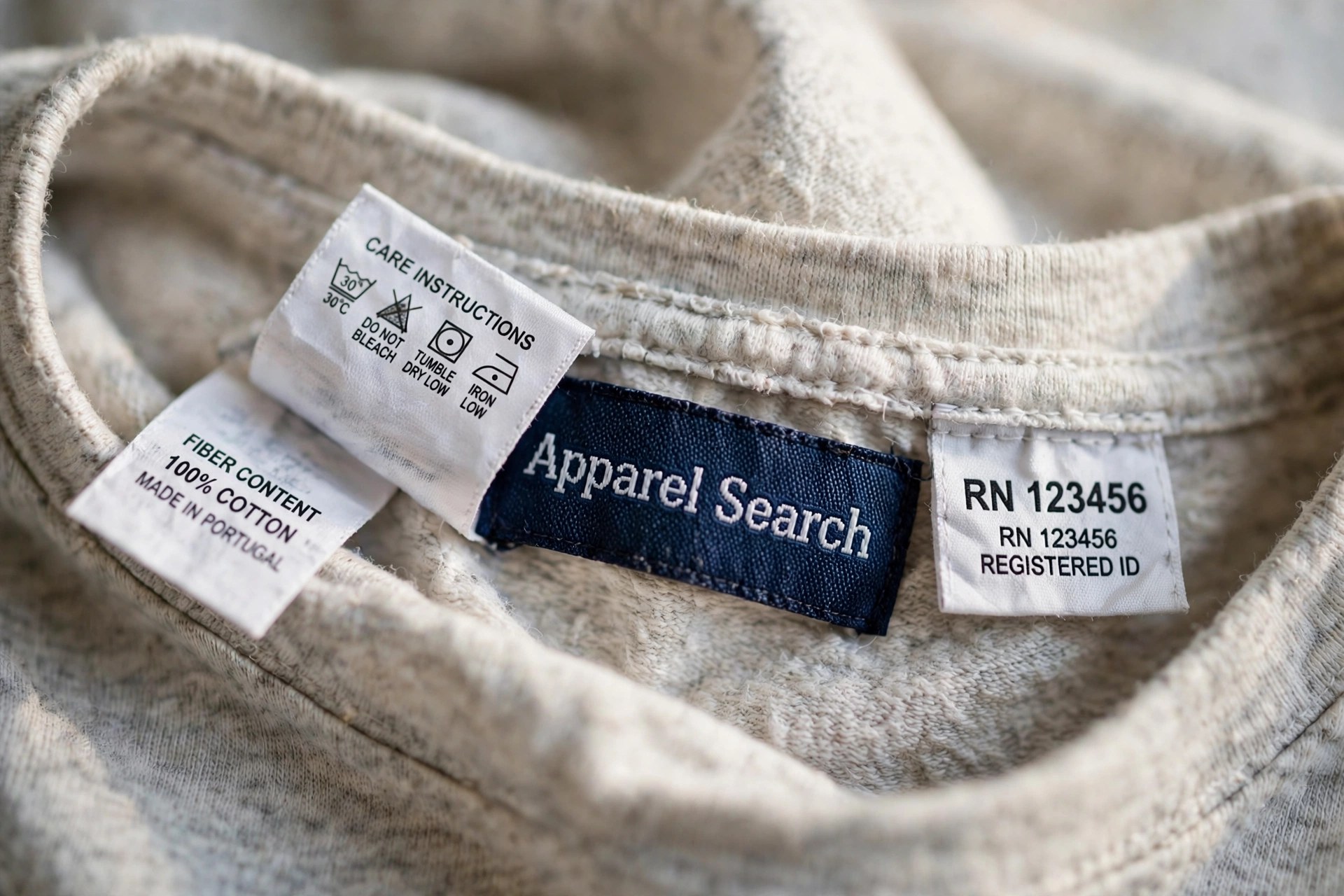
Turn a garment inside out and you will usually find a cluster of small print: fiber percentages, a country name, washing instructions — and, on many American garments, a short number beginning with RN. That number is one of the most useful research tools in the clothing business. It identifies the company behind the garment in a public database, and vintage clothing specialists use it every day to work out who made an unbranded or long-forgotten piece. This page explains the system and the labeling rules around it.
Labeling is one branch of the legal framework covered by the Fashion Law & Intellectual Property Guide: the same body of rules that governs trademarks and counterfeits also decides what a label must disclose before a garment can be sold.
RN Number, Defined
An RN is a Registered Identification Number issued by the US Federal Trade Commission (FTC) to a business that manufactures, imports, or sells textile, wool, or fur products. Printed on the label in place of the company's name, it satisfies the legal requirement that the responsible business be identified — and anyone can look the number up to learn which company it belongs to.
RN Numbers and WPL Numbers
The RN system lets a company use a short number instead of printing its full legal name on every label — practical for small labels, and for businesses that sell under several brand names while remaining one legal entity. Numbers are issued sequentially, so an early, low number belongs to a company that registered long ago. Older wool garments may carry a WPL number instead: identification numbers issued under the Wool Products Labeling Act before the RN system became the standard method. Both numbers do the same job and both trace back to the FTC. Numbers beginning with CA, occasionally seen on garments sold across North America, are the Canadian equivalent.
How to Look Up an RN Number
- Find the number. Check the label cluster at the neck, waistband or side seam, and copy the digits exactly — the letters RN (or WPL) plus the number.
- Open the FTC database. The Federal Trade Commission maintains a free Registered Identification Number lookup on its website, ftc.gov.
- Search and read the result. The database returns the company name and address registered to that number — the manufacturer, importer or marketer legally responsible for the garment.
- Interpret it carefully. The result names a company, not a factory or a date. A brand may have used contractors to sew the garment, and the same RN can appear on clothing sold across many years.

What US Textile Labels Must Say
Three disclosures form the core of US garment labeling. First, fiber content: the Textile Fiber Products Identification Act requires labels to list the fibers in the garment by generic name and percentage, in descending order. Second, country of origin: where the product was made or processed. Third, identity of the responsible business: the manufacturer's name, or its RN or WPL number instead. On top of those, the FTC's Care Labeling Rule requires care instructions — a label or symbols telling the owner how to wash, dry, iron and bleach the garment safely; Apparel Search decodes those symbols on its care label symbols page. Fur and wool products carry their own additional labeling acts, and the Fashion Law Guide places all of these rules in context.
Why RN Numbers Matter for Vintage and Resale
For secondhand clothing, the label is often the only document a garment carries. An RN lookup can identify the maker of an unbranded piece, confirm that a label matches the company a seller claims, and anchor a date range when combined with label design, care symbols and construction clues. That detective work is a core skill in the Thrifting & Secondhand Fashion guide, where dating vintage clothing by its labels gets a full treatment.
Related Guides on Apparel Search
Common Questions
Is an RN number required on clothing labels?
No. US labeling law requires the label to identify the manufacturer or another business responsible for the product, but that identification can be the company's full name instead of a number. The RN is an optional, compact alternative that the FTC issues to businesses that apply for one — useful for small labels and for companies that market under several brand names.
Can an RN number tell me how old a garment is?
Not by itself. The RN identifies a company, not a date, and a company keeps the same number for decades while styles change around it. The number can still help date vintage clothing indirectly: lower numbers were issued earlier, and looking the company up tells you when it operated under that identity. Vintage daters combine the RN with label design, union tags and construction details for a fuller picture.
What is a WPL number on an old label?
WPL stands for Wool Products Labeling. Before the RN system became the standard identification method, companies selling wool products were issued WPL numbers under the Wool Products Labeling Act. You will find them on mid-twentieth-century wool garments. Like an RN, a WPL number identifies the business responsible for the product and can be researched through the FTC.
Where do I look up an RN number?
In the Registered Identification Number database maintained by the Federal Trade Commission on its website, ftc.gov. Enter the number exactly as it appears on the label, and the database returns the company name and address associated with it — the business that manufactured, imported or marketed the garment.
Labels Are Legal Documents in Miniature
Every line of small print on a garment label exists because a rule requires it. The fashion terms glossary defines the labeling vocabulary used across Apparel Search.