Apparel Search · Private Label Guide
Private Label Labels & Labeling Rules
What relabeling legally involves: the four required label elements, what can change, and what must stay exactly as true as it was.
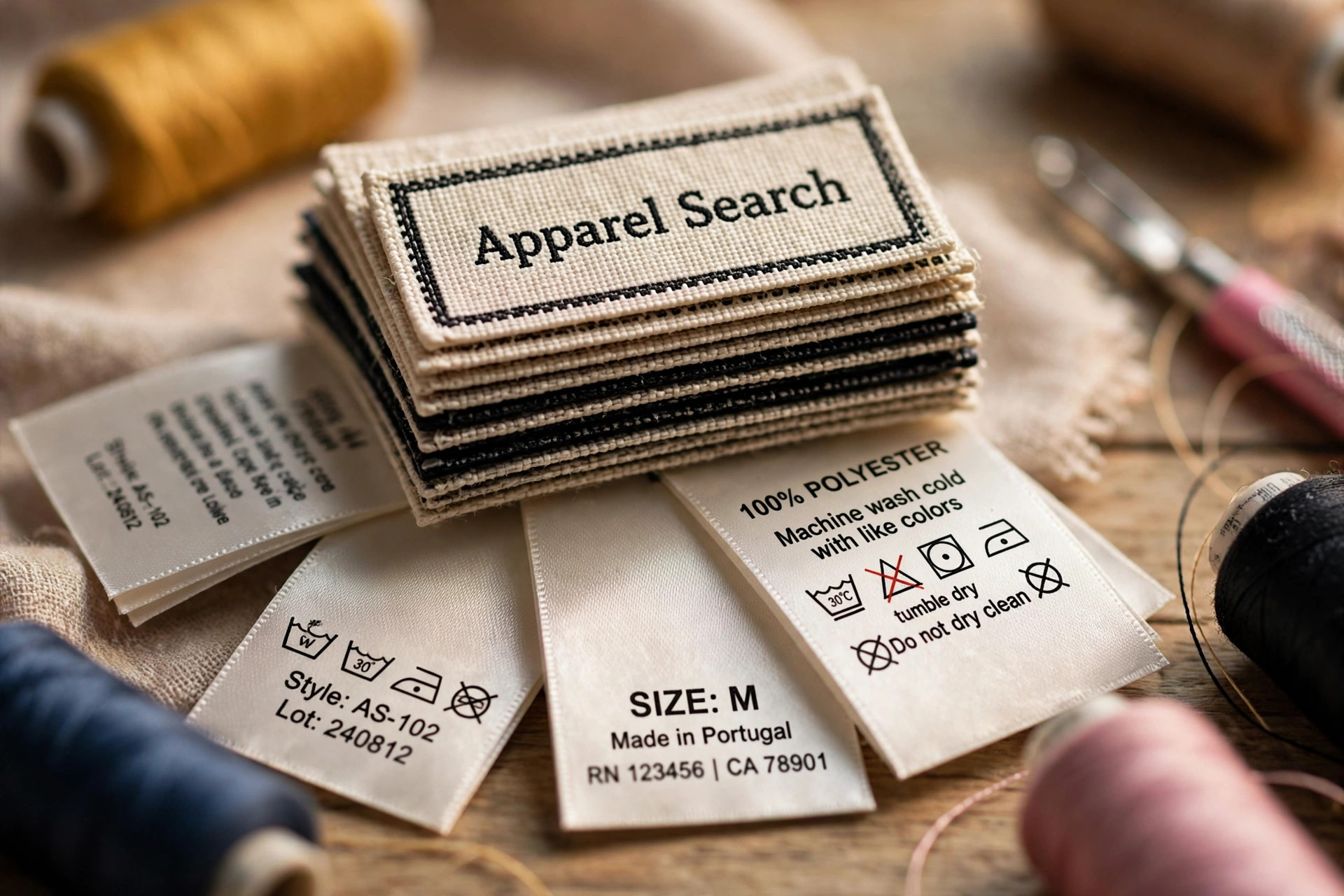
Putting your label into a garment is the defining act of private label — and the point where a branding exercise becomes a legal one. The short version: your brand label may go in; the garment's required information may not come out. In the United States, most clothing must carry fiber content, country of origin, the identity of a responsible company, and care instructions, and all of it must be true of the actual garment in the bag — whoever's name is on the neck label. This page explains the rules at the practical level a small brand works at. It is general information, not legal advice: for your own products, check the official guidance linked below or a labeling attorney.
The One Principle Behind Every Rule
Labeling law protects the buyer's information, not the maker's anonymity. A garment's label must let a customer learn what it is made of, where it was made, how to care for it, and which company stands behind it. Relabeling is legitimate exactly as far as that information survives the process — complete and unchanged in substance.
What May Be Relabeled
- The brand label is yours to add. Your woven or printed brand label at the neck or waistband is the point of private label, and suppliers' relabeling services exist to sew it in. Where a supplier's program provides for it, their house brand label can be removed in the process.
- Hangtags and packaging are yours entirely. Brand story, price, barcodes, size stickers — the outer layer carries no federal content rules of its own (though claims made on it, like fiber claims in advertising, must still be truthful).
- The responsible-company identity can be yours. A product's label must identify a company responsible for it — by company name or by the FTC-registered RN number. A private label brand that markets the garment can be that identity, using its own name or its own RN. Our RN numbers guide explains how RN numbers work and how to look one up.
What May Not Be Changed
- Fiber content must describe the actual garment. Under the Textile Fiber Products Identification Act, fiber content is stated by generic fiber name and percentage by weight, largest first; fibers at 5% or more are named individually, smaller amounts may be grouped as "other fiber," and a small manufacturing tolerance applies. You cannot upgrade a blend on paper, drop a fiber, or borrow the content line from a different garment.
- Country of origin must stay where the garment was made. Origin follows manufacture, not branding: a shirt sewn abroad and labeled in the United States is imported, and must say so. Qualified claims ("Made in USA with imported fabric") exist for genuinely mixed cases — the rules for them are specific.
- Care instructions must remain, and must work. The FTC Care Labeling Rule requires a permanent label with instructions for a safe cleaning method. If the stock garment's care label is on the same label you are replacing, the care information has to be carried onto yours — and it has to be right for the garment as sold, decorations included: a print that cannot take the base garment's wash cycle changes the care answer.
- Another company's RN is not yours to use. An RN identifies the company that registered it. Using the manufacturer's RN where the rules allow the manufacturer to remain the identified party is one thing; applying an unrelated number, or keeping a number for a company that has no role in the product, makes the label false.
- Trademarked names and designs are not decoration. Relabeling never transfers rights in the garment's protected designs, logos or prints. Our fashion trademarks guide covers what brand elements the law protects.
The Four Required Elements, One by One
Fiber content
Generic names (cotton, polyester, wool — not brand names) in descending order of weight, on a label the customer can find before purchase. If you modify a style — a new fabric on route 3 of the routes guide — the content line changes with the fabric, and your label order has to change with it. Wool products and fur carry their own additional acts and disclosures.
Country of origin
The country where the garment was made (cut and sewn, for apparel), stated conspicuously — for tops, conventionally at the neck. Imported garments name the country; US-made garments say so, with qualifications where materials were imported. Neither decoration nor relabeling done in the US converts an imported garment into a US one.
Identity: company name or RN
The label names the manufacturer, importer or another company responsible for marketing the product — or gives its RN, the number the FTC issues to US businesses in the trade. Private label brands commonly apply for their own RN once they are selling steadily; until then, the label carries the responsible company's name by arrangement with the supplier. Details and the lookup database are in our RN numbers & textile labels guide.
Care labeling
One safe cleaning method, permanently attached, in words or symbols — our care labels page and care label symbols guide decode both. Private label sellers inherit the base garment's instructions only if nothing they add changes them: embroidery thread, prints, trims and finishes can all lower the safe wash temperature or rule out a cleaning method.
Special Cases Worth Knowing
Children's products add a second regime: CPSIA requires tracking labels and safety compliance on top of textile labeling — start with our factory compliance guide. Chemical warnings: California's Proposition 65 can require warnings on some products sold into California — see our REACH and Prop 65 guide. Selling into the EU brings its own fiber and care conventions, and digital product passport requirements are arriving — the compliance guide maps that landscape too.
Where to Check: Official Sources
The FTC's business guidance, Threading Your Way Through the Labeling Requirements Under the Textile and Wool Acts, is the standard plain-language reference — read it at the FTC via the federal depository library (PDF). For design-level questions — label layout, hangtag design, what a good label program looks like — see our labels & hangtags design studio page and clothing labels resources. Rules summaries like this page orient you; they do not replace the guidance itself or legal advice for your products.
More to Explore
Back to the Private Label Guide
Labels settled, the remaining question is money — return to the Private Label Clothing Guide for the full sequence.
Common Questions
Can I legally sew my own label into clothing made by someone else?
Yes — that is the basis of private label, and suppliers run relabeling programs for exactly this purpose. The condition is that the garment's required information stays complete and truthful: fiber content for the actual garment, its real country of origin, working care instructions, and the name or RN of a company genuinely responsible for the product.
Whose RN number goes on a private label garment?
The label must identify a responsible company — the manufacturer, the importer, or the company marketing the product. A private label brand can apply for its own RN and be that identity, or the label can carry the manufacturer's identity by arrangement. What it cannot carry is an unrelated company's number.
Can I say 'Made in USA' if I add the labels and packaging in the US?
No. Country of origin for apparel follows where the garment was manufactured. Sewing labels into an imported garment, decorating it, or packaging it in the US does not change its origin; qualified wording exists for garments genuinely made in the US from imported fabric, under specific rules.
Do I need care labels if the garments already have them?
The requirement is that the garment as sold carries a permanent care label with a safe cleaning method. If the original care information remains attached and still describes the garment as you sell it — decorations and trims included — it can serve. If your additions change what cleaning is safe, the care instructions must change too.