The Palette
Why Safari Dressing Is a Color System
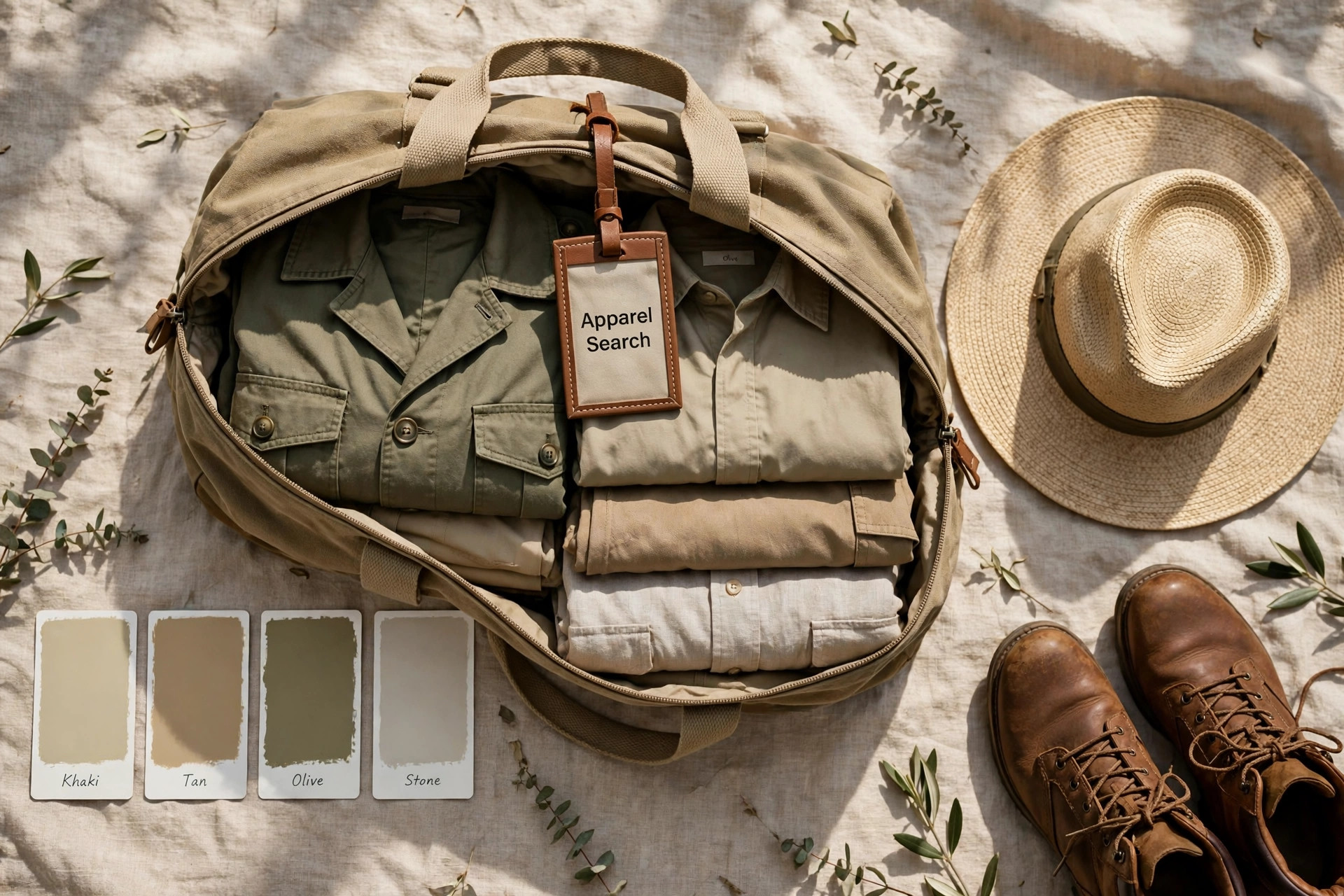
Safari colors are not a taste preference; they are field equipment that happens to be cloth. Khaki, tan, olive and stone match dry grass, dust and bush, reflect heat better than dark colors, hide the dust that coats everything on a drive, and — quietly, their greatest packing virtue — all match each other, so a tiny wardrobe produces a new outfit every day.
This page is the packing spoke of the safari family: the hub Safari Outfits Guide sets the rules, and the Women’s Safari Outfits and Men’s Safari Outfits guides turn them into outfits. Here we settle the palette, the luggage rules, and a complete worked list.
The Neutrals
Khaki, Tan, Olive, Stone
Each color earns its place. Khaki is the original — as the khaki definition records, the word itself means dust. Tan, explored across the tan color family pages, is the palette’s light end and its best mixer. Olive carries the green of dry bush and works as the palette’s one “color” outfit. Stone bridges tan and grey and hides dust nearly as well. Soft brown anchors footwear and leather. What to leave out follows the guidance operators commonly give: brights that announce you, white that dust defeats in an hour, and very dark blue or black where biting flies are a concern; camouflage patterns are restricted for civilians in some countries, so plain neutrals do the same job safely.
Luggage Rules
Soft Bags, Hard Limits
Safari luggage is where packing stops being a preference and becomes a rule. Many safaris reach camp by small aircraft, and operators commonly require soft-sided bags only — a duffel that squashes into a small hold and a vehicle rack — with total luggage limits often around 15 to 20 kilograms including hand luggage, and no hard cases, frames or wheels. Limits vary by operator and aircraft, and your booking’s figure always wins over any guide’s. The discipline this forces is the same one behind the carry-on packing guide, this page’s packing-system cousin: a tight palette, multi-use pieces and layers instead of bulk. Pack for the limit, weigh the bag at home, and leave the “just in case” outfit behind — camps do laundry; aircraft holds do not stretch.
The Worked List
A Seven-Day Packing List That Fits
- Shirts: 3–4 long-sleeve safari shirts in khaki, olive and stone, plus 1–2 T-shirts or polos for camp.
- Bottoms: 2 long trousers (one khaki, one stone or olive), 1 shorts, or 1 zip-off pair in place of a trouser and the shorts.
- Warmth: 1 fleece or insulated jacket for dawn drives, 1 lightweight outer layer for wind — the safari jacket can serve as that layer.
- Dinner: 1 change that dresses up — a midi dress, or a clean shirt with the better trousers.
- Feet: broken-in walking boots or sturdy closed shoes, 1 lighter closed shoe, socks for each walking day.
- Head & sun: 1 wide-brim safari hat with a chin cord, a cap as backup, sunglasses on a cord, a buff or scarf for dust.
- Small things: daypack, laundry bag, and everything soft rolled, not folded, to fill the duffel’s corners.
Count it: roughly a dozen core pieces, every one neutral, every top matching every bottom — a week of distinct outfits from one soft bag, with room left for the camera. That is the palette doing packing work.
Questions
Common Questions
Why do safari clothes come in khaki, tan and olive?
Those colors match dry grass, dust and bush, reflect heat better than dark colors, and hide the dust that covers everything on a game drive. The palette is functional first — it also happens to mix and match easily, so a small wardrobe in neutrals produces many outfits.
How much luggage can you bring on safari?
Often less than you expect. Many safaris use small aircraft and soft-sided luggage rules — commonly a soft duffel around 15 to 20 kilograms total, with no hard cases or wheels — because bags must fit into small holds and vehicle racks. Always check your operator’s limit, because it overrides any general guide.
What is the one packing mistake safari travelers make most?
Packing for the photograph instead of the temperature swing. Days can be hot, but dawn drives in an open vehicle are genuinely cold, and first-time travelers who skip the warm layer and the hat are uncomfortable on day one. Pack layers, sun cover and one warm piece before anything decorative.
More to Explore
Search Apparel Search