Stirrup Pants
Fashion Terms — the Apparel Search fashion terminology directory
Stirrup pants (or stirrup leggings) are a type of close-fitting ladies' pant that tapers at the ankle, similar to leggings, except that the material extends to a band, or strap, worn under the arch of the foot to hold the pant leg in place. The band is often elasticized to keep the material around the foot from tearing. Stirrup pants were originally sportswear for women and remain sportswear for horse riding and skiing, but they have come in and out of fashion through the 20th and early 21st centuries, peaking as street fashion during the 1980s.
What are stirrup pants?
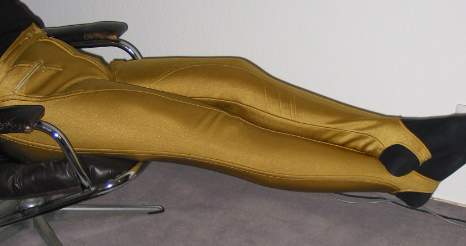
Stirrup pants (or stirrup leggings) are a type close-fitting ladies' pant that tapers at the ankle, similar to leggings, except that the material extends to a band, or strap, that is worn under the arch of the foot to hold the pant leg in place. The band of material is often elasticized to prevent the material around the foot from tearing.
Stirrup pants were originally sportswear for women, and remain sportswear for horse riding and skiing. However, they have come in and out of fashion during the 20th and early 21st centuries, peaking in popularity as street fashion during the 1980s.
Stirrup pants became a popular casual fashion for women in Europe and America from the mid-1980s to the early 1990s. Leggings in general became fashionable streetwear during the 1980s, as did sweatshirts, leg warmers, and other items that originated in sports and dance studios.
Stirrup pants were originally worn as breeches for horse riders. The purpose of the strap under the foot was to hold the pant legs in place in the boots of the rider. Stirrup pants for skiing were introduced at the 1936 Winter Olympic Games in Germany.
Do you think that this is a fashion trend that will return in the near future?
Learn about other pant styles.
Thank you for using the Apparel Search website.
A Functional Strap Becomes a Fashion Detail
The stirrup is a piece of engineering before it is a style. A close-fitting pant leg worn inside a boot or during sport tends to ride up; the strap under the arch anchors it, which is why the design began with riders and was adopted for skiing, where stirrup pants appeared at the 1936 Winter Olympics in Germany. The elasticized band matters as much as the strap itself: the fabric at the foot is under constant tension and movement, and elastic keeps that stress point from tearing.
The 1980s Streetwear Wave
When stirrup pants crossed into fashion, they arrived as part of a group. Leggings in general became fashionable streetwear during the 1980s, alongside sweatshirts, leg warmers and other pieces borrowed from sports and dance studios, and the stirrup version offered a slightly more finished line — the strap kept the leg smooth and anchored over shoes in a way a plain legging did not. The style peaked from the mid-1980s into the early 1990s, then receded, as it had before: few garments illustrate the in-and-out rhythm of fashion better, since the same practical pant has cycled between pure sportswear and street fashion repeatedly across the 20th and early 21st centuries. Whether it returns again is the open question the style leaves behind — the construction has never stopped being useful, even when it has stopped being fashionable.
Common Questions
What makes stirrup pants different from leggings?
The strap. Both are close-fitting and taper at the ankle, but stirrup pants extend into a band worn under the arch of the foot, which holds the pant leg in place. The band is often elasticized so the material around the foot does not tear.
Where did stirrup pants come from?
From the saddle. They were originally worn as breeches for horse riders, where the strap under the foot kept the pant legs in place inside the rider's boots. Stirrup pants for skiing were introduced at the 1936 Winter Olympic Games in Germany.
When were stirrup pants fashionable as streetwear?
From the mid-1980s to the early 1990s in Europe and America. Stirrup pants rode the same wave as leggings, sweatshirts, leg warmers and other garments that originated in sports and dance studios and became fashionable streetwear during the 1980s.