Plackets
Fashion Terms — the Apparel Search fashion terminology directory
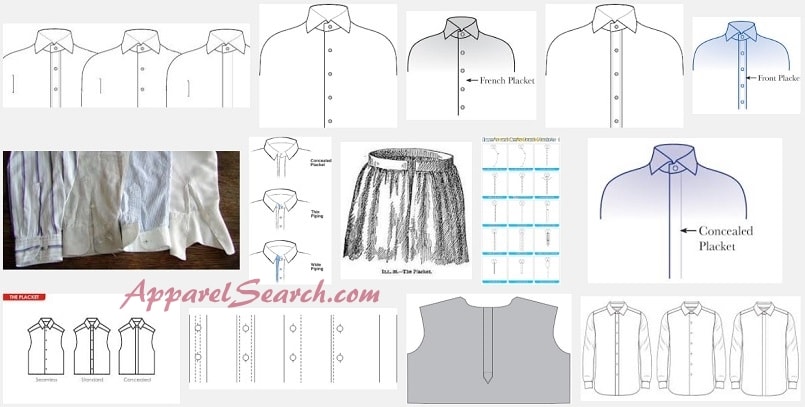
A placket (sometimes spelled placquet) is an opening in the upper part of trousers or skirts, or at the neck or sleeve of a garment. Plackets are almost always used to let clothing be put on or removed easily, though they are sometimes purely a design element. Modern plackets usually contain fabric facings or attached bands to surround and reinforce fasteners such as buttons, snaps or zippers, are made of more than one layer of fabric — often with interfacing between the layers — and the two sides usually overlap to protect the wearer's skin and hide what is underneath.
What are plackets? A placket is an opening in the upper part of trousers or skirts, or at the neck or sleeve of a garment. The word is sometimes spelled 'Placquet'.
Plackets are almost always used to allow clothing
to be put on or removed easily, but are sometimes used purely as a
design element. Modern plackets often contain fabric facings or
attached bands to surround and reinforce fasteners such as
buttons, snaps, or
zippers.
Plackets are almost always made of more than one
layer of fabric, and often have interfacing in between the fabric
layers. This is done to give support and strength to the placket fabric
because the placket and the fasteners on it are often subjected to
stress when the garment is worn. The two sides of the placket often
overlap. This is done to protect the wearer from fasteners rubbing
against their skin and to hide underlying clothing or undergarments.
A button front
shirt without a separate pieced placket is called a "French
placket." The fabric is simply folded over and the buttonhole stitching
secures the two layers (or three layers if there is an interlining).
This method affords a very clean finish, especially if heavily patterned
fabrics are being used. This method is normally only used in
stiff-fronted formal evening ("white-tie") shirts. However, the normal,
separate placket on a shirt gives a more symmetrical appearance.
If the buttons are concealed by a separate flange
or flap of the shirting fabric running the length of the placket, it is
called a "fly front." The inner placket of a fly front shirt can be made
as a less constructed French placket or as a fully constructed regular
placket.
Historically speaking a placket may also be:
A decorative front-panel used to fill in the
opening of a doublet or gown (later called a stomacher). Also spelled
placard.
A decorative panel or "forepart" attached to a
woman's
petticoat.
An opening or slit in a skirt or petticoat to
access a separate hanging pocket.
A petticoat or skirt pocket.
The clothing relevant term placket often refers to the double layers of fabric that hold the buttons and buttonholes in a shirt. Plackets can also be found at the neckline of a shirt, the cuff of a sleeve, or at the waist of a skirt or pair of trousers.
You may also want to learn about dress shirts which generally have plackets.
Thank you for using the Apparel Search website.
Built to Take Stress
A placket works hard: every buttoning and unbuttoning pulls at the same strip of fabric, so the construction is engineered for it. Multiple fabric layers, interfacing between them, and facings or attached bands around the fasteners give the opening support and strength. The overlap of the two sides is functional as well as neat — it shields the skin from the fasteners and conceals underlying clothing or undergarments from view.
Separate Placket or French Placket
The normal separate placket on a shirt gives a more symmetrical appearance and is the standard construction for dress shirts. The French placket trades that structure for a smooth, uninterrupted front, which suits both formal evening shirts and heavily patterned shirting where a separate band would break the design. The fly front goes further, hiding the buttons entirely under a flap. Choosing among them is a design decision about how visible the closure should be — the placket itself, in every version, remains the double layer of fabric that holds the buttons and buttonholes.
Common Questions
What is a French placket?
A button-front shirt without a separate pieced placket: the fabric is simply folded over and the buttonhole stitching secures the two layers (or three, if there is an interlining). It gives a very clean finish, especially with heavily patterned fabrics, and is normally used in stiff-fronted formal evening white-tie shirts.
What is a fly front?
A shirt front where the buttons are concealed by a separate flange or flap of the shirting fabric running the length of the placket. The inner placket of a fly-front shirt can be built as a less constructed French placket or as a fully constructed regular placket.
Where are plackets found besides shirt fronts?
At the neckline of a shirt, the cuff of a sleeve, and the waist of a skirt or pair of trousers — anywhere a garment needs a strong, reinforced opening. Historically, a placket could also be a decorative front panel filling the opening of a doublet or gown (a stomacher), a forepart on a petticoat, or an opening in a skirt giving access to a hanging pocket.