Button Fly Jeans
Fashion Terms — the Apparel Search fashion terminology directory
The button fly is an opening at the front of a pair of pants that fastens with buttons. A fly on clothing is a covering over an opening, concealing the mechanism — a zip, velcro or buttons — used to close it, and the term is most frequently applied to a short opening over the groin in trousers, shorts and other garments. This page explains the button fly, the placket it sits on, and the history of trouser flies.
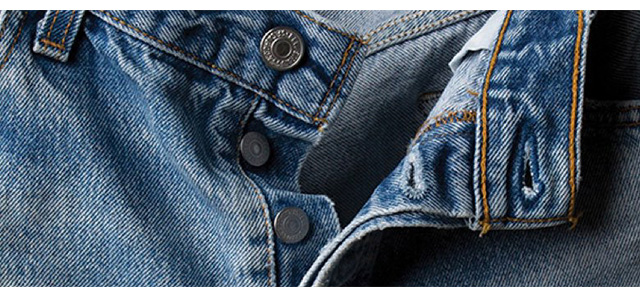
The button fly is an opening at the front of a pair of pants that fastens with buttons.
A fly on clothing is a covering over an opening concealing the mechanism, such as a zip, velcro, or buttons, used to close the opening. The term is most frequently applied to a short opening over the groin in trousers, shorts, and other garments.
The buttons are sewn on the placket. A placket is an opening in the upper part of trousers or skirts, or at the neck or sleeve of a garment. Plackets are almost always used to allow clothing to be put on or removed easily, but are sometimes used purely as a design element. Modern plackets often contain fabric facings or attached bands to surround and reinforce fasteners such as buttons, snaps, or zippers.
Trousers have varied historically in whether or not they have flies. Originally, trousers did not have flies or other openings, being pulled down for sanitary functions. The use of a codpiece, a separate covering attached to the trousers, became popular in 16th-century Europe, eventually evolving into an attached fall-front (or broad fall). The fly-front (split fall) emerged later. The panelled front returned as a sporting option, such as in riding breeches, but is now hardly used, flies being by far the most common fastening.
A button fly can be used on long pants, jeans shorts, and even denim skirts.
Designer jeans are also produced with this type of fly.
The first blue jeans out of the Levi's workshop in 1873 had a button fly. Zippers came later in the jeans history.
Levi's 501® Original Fit Jeans: since they invented it in 1873, the 501® Jean has been a blank canvas for self-expression. The iconic straight fit with signature button fly, the 501® Jean sits at the waist and is regular through the thigh with a straight leg. Slip into the comfy, on-trend style of Levi’s® 501 button-fly jeans. This classic look is sure to become a go-to in your everyday rotation.
Most flies now use a zip, though button flies continue in use. Traditionalists argue, buttons are just as easy to undo as zippers and one can acquire some grace and skill with a little practice.
The button fly method is not only used on denim jeans. This method is used on other type of trousers as well.
Thank you for using the Apparel Search website.
Buttons Versus Zippers
The zipper took over trousers in the 20th century because it is fast, but the button fly never disappeared, and denim brands keep it for reasons that are partly practical. Buttons do not break the way a zipper's teeth or slider can; a lost button can be sewn back by hand in minutes, while a failed zipper is a tailor's job. Buttons also flex with the fabric instead of forcing a stiff line down the front of the jean, which wearers describe as a more comfortable fit as raw denim softens and shrinks to the body. The trade-off is speed — though, as this page observes, button flies are just as easy to undo as zippers once a little practice gives the wearer some grace and skill.
That is why the button fly survives most visibly on heritage and premium jeans, where it signals the pre-zipper construction of the original 19th-century work trousers described in the blue jeans entry. Shoppers comparing a pair will find the choice listed as a specification alongside fit and denim weight. For care, the only special notes are to button the fly before washing — it keeps the placket flat and the buttons from chipping against the drum — and to check button stitching occasionally, since a fly button carries real strain.
Common Questions
What is a button fly?
A front opening on trousers or jeans that fastens with a row of buttons concealed under a fabric flap (the fly), instead of a zipper. The buttons are sewn on the placket — the reinforced opening that lets clothing be put on and removed easily.
Are button flies only on jeans?
No. As this page notes, the button fly method is not only used on denim jeans; it is used on other types of trousers as well. It is simply most associated with jeans because jeans carried it longest.
Did trousers always have flies?
No. Originally trousers had no flies or other openings; the codpiece, a separate covering attached to the trousers, became popular in 16th-century Europe and eventually evolved into the attached fall-front, the ancestor of the modern fly described on this page.