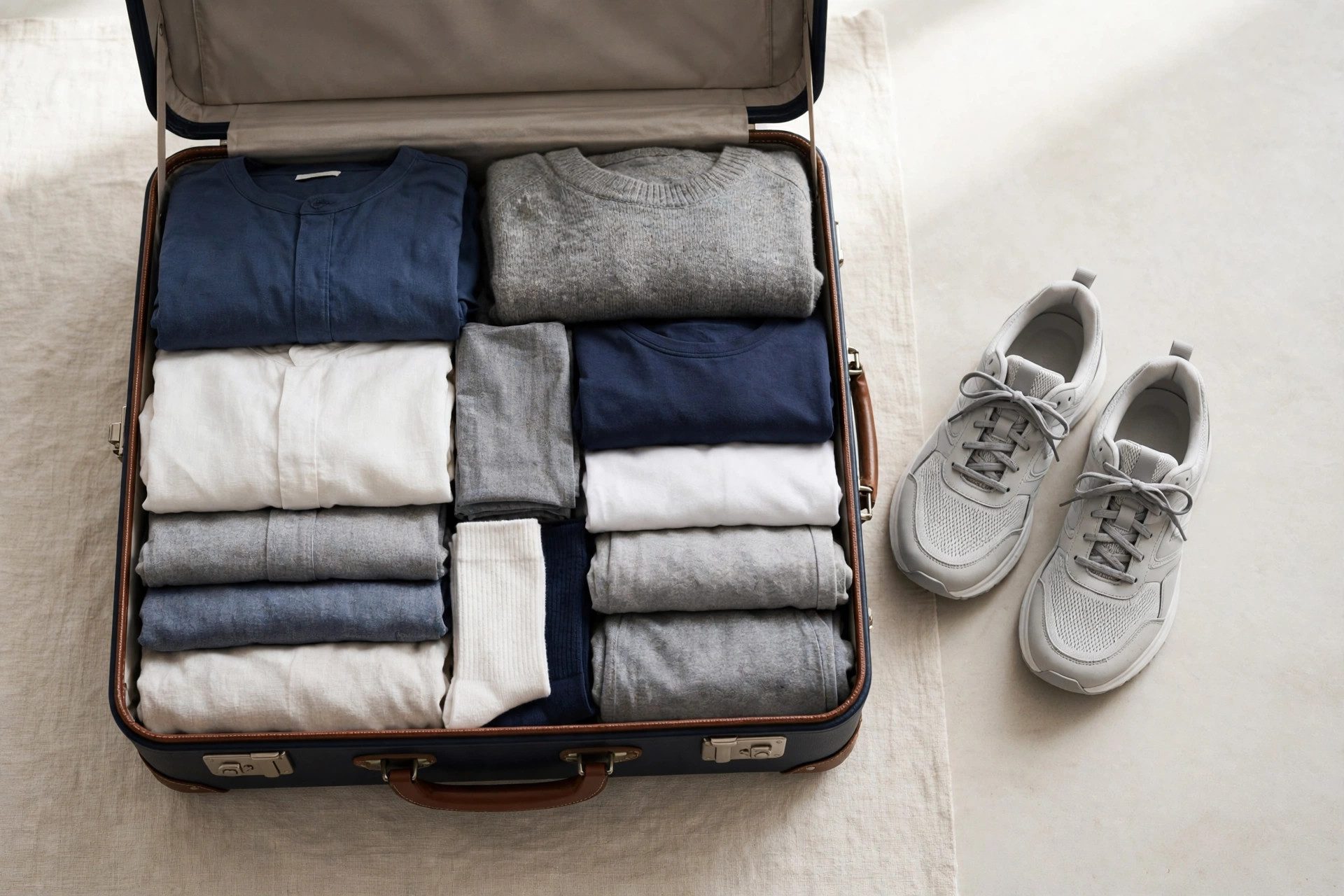
Travel outfits are the clothes you choose for a trip when everything has to fit in one bag and work in several combinations. A good travel outfit is built like a small capsule wardrobe: a limited colour palette in which every top works with every bottom, fabrics that resist wrinkles and wash easily, and layers that adjust to the weather at the destination instead of the weather at home. The mistake almost everyone makes once is packing outfits — seven complete, unrelated looks — and the fix is to pack components: fewer pieces, more combinations, and nothing that can only be worn one way.
Build Outfits, Not a Suitcase of Clothes
Start with the palette, not the pieces. Pick two neutrals (black and navy, or navy and stone) and one or two accent colours, and only pack things inside it. When every bottom works with every top, five tops and three bottoms give you fifteen outfits — more than a week — from eight pieces that fold small. This is the capsule principle applied at suitcase scale, and it is why seasoned travellers' bags look boring open and brilliant worn: the variety is in the combinations, not in any single loud piece.
Then plan by day-type rather than by day. Most trips need three kinds of outfit: a walking outfit for sightseeing (comfortable shoes, layers, a crossbody-friendly top half), a transit outfit built for planes and trains, and a smart outfit for dinners and occasions, which one dress or one tailored combination usually covers. Lay out components for those three jobs, check that pieces cross between them — the transit trousers should also serve sightseeing — and only then add the one or two things you simply want to bring.
Fabrics That Travel Well
Travel is hard on cloth: hours compressed in a bag, irregular washing, and weather you did not dress for. The fabrics that cope are merino wool (temperature-regulating, slow to smell, wrinkle-resistant — the single best travel fabric for tops), ponte and technical twills for trousers that keep a crease-free line, jersey knits that roll without marking, and textured weaves that disguise creasing entirely. Pure linen and stiff cotton shirting are the usual regrets: lovely on day one, exhausted by day three.
Layering is the fabric strategy's other half. Pack thin, stackable layers — a merino tee, a fine knit, a packable insulated or waterproof shell — rather than one heavy coat, unless the destination is truly arctic. Thin layers adjust in more combinations, dry faster if you wash them in a sink, and distribute through the bag. If washing en route, the rule is three of anything worn daily: one on, one drying, one ready.
Shoes Decide the Bag
Shoes are the bulkiest things you own, so the discipline is one pair worn, one pair packed — two if a formal occasion forces a third. The packed pair should earn its space by working with everything: a clean trainer that walks all day and does not disgrace a smart trouser, or a comfortable loafer. Wear the heaviest pair in transit. If neither pair can walk ten thousand steps, the trip will tell you about it daily, so comfort is not a preference here, it is the whole decision.
The transit outfit itself is a packing tool. Your bulkiest knit, your coat or jacket and your heaviest shoes worn onto the plane can save a third of your bag. Finish with one upgrade piece — a scarf, a piece of jewellery, a smarter top in your personal item — that converts the sightseeing uniform into the dinner outfit. Travel dressing done well looks effortless precisely because it was engineered before the bag was zipped.
Common Questions
- How many outfits should I pack for a week-long trip?
- For a week, the working rule is five tops, three bottoms, two layers and one dress or smart outfit if the trip needs it, in a palette where everything combines. That mix produces well over a week's distinct outfits. Wear your bulkiest pieces in transit and the count gets easier still.
- What are the best fabrics for travel clothes?
- Merino wool and wool blends for tops that resist odour and wrinkles, ponte and technical twill for trousers, and quality jersey that springs back. Linen is comfortable but creases dramatically — take it blended or accept the rumple. Darker colours and small prints hide travel marks between washes.
- How do I stop travel clothes wrinkling?
- Roll soft garments, hang what you can on arrival, and use the bathroom-steaming trick for the rest. Prevention matters more: choose knit and textured fabrics that do not show creases, avoid stiff shirting unless it travels in a folder, and do not leave clothes compressed in the bag longer than the journey requires.
- What should I wear on the travel day itself?
- Your most layered, bulkiest outfit: the heaviest shoes, the biggest layer, and anything that would eat suitcase space. Transit dressing is a packing strategy as much as an outfit — our airport outfits guide covers the full system, from security-friendly shoes to cabin layers.
Travel Outfit Guides
This page is part of our travel dressing series — what to wear when you are going somewhere.