Korea Textile Testing Labs
Apparel Search world clothing industry directory — textile and apparel testing institutes in Korea.
Korea Textile Testing Labs and Apparel Testing Labs: the institutes that test fabrics and clothing for the Korean textile industry.
Korea Testing Resources
Testing for the Korean Textile Industry
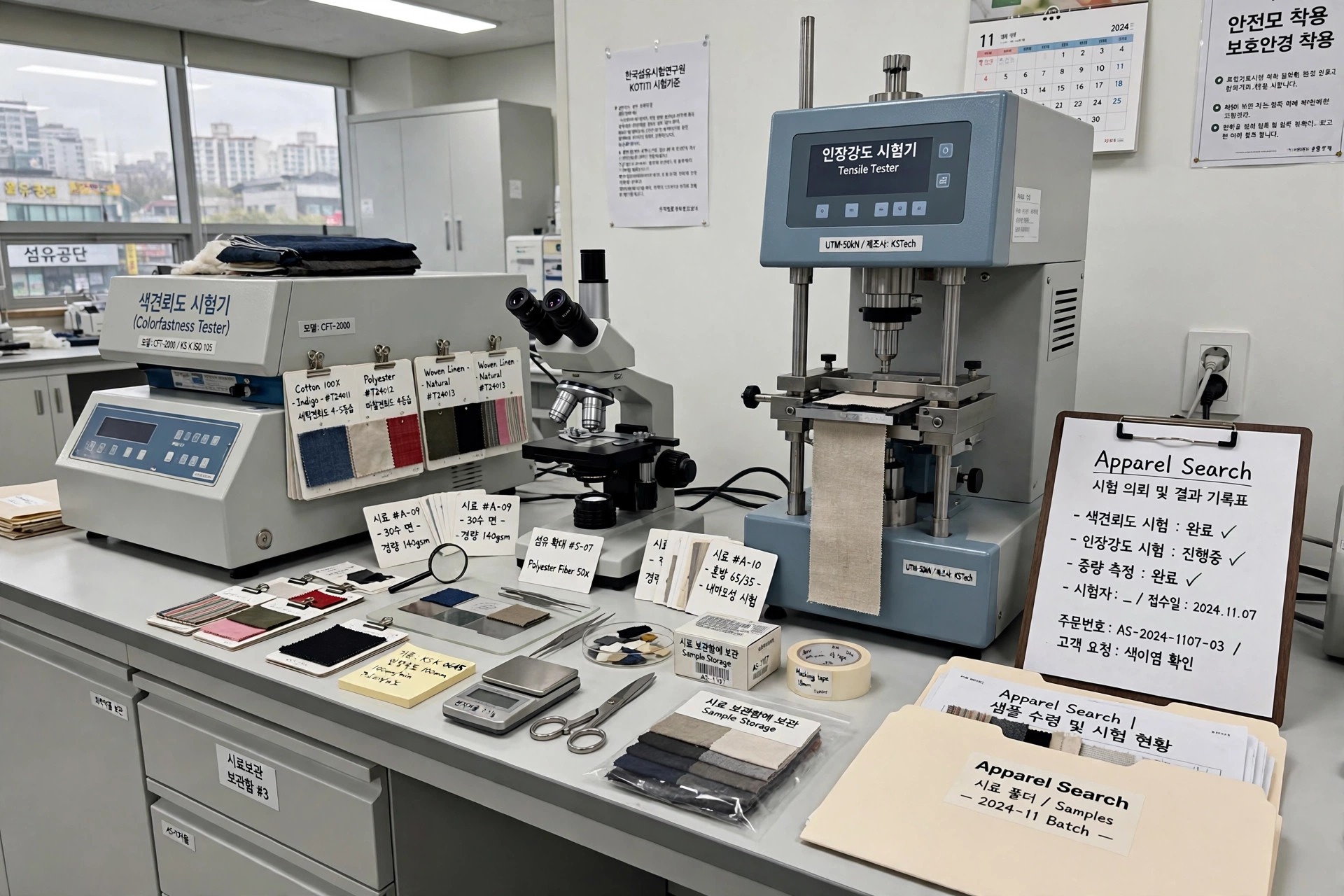
Export manufacturing runs on verified quality, and these four institutes are the testing backbone of the Korean clothing industry. Between them they cover the full testing menu a fabric or garment buyer needs: what a material is made of, whether its colour will hold, whether it will shrink, how it resists water, and whether it meets the specification written into an order. KEMTI's list states the shared core plainly — material compositions, dye fastness, shrinkage, water-resistance, water-repellence, hardness and permeability — applied to fabrics, non-woven cloths, sewing threads and finished goods from apparel and socks to tents, bags, hats and zippers.
The institutes are long-established. KOTITI was founded in 1961 by the Spinners & Weavers Association of Korea — the same association listed on page 3 of the Korea directory — explicitly to develop the Korean textile industry, and FITI's textile testing and inspection record runs from 1964. Their accreditations and memberships reach outward as Korean exports do: FITI lists approval as a foreign inspection body for Japan's JIS Marking System, recognition by the State of California and The Woolmark Company, and membership connected to ISO Technical Committee 38, AATCC and ASTM. For a buyer sourcing from the Korean companies in this directory, a test report from one of these institutes is the standard way to confirm that fabric or garments meet the order's specification before shipment. The wider Apparel Search quality testing pages linked above place these Korean labs alongside testing resources for other countries.
Korea Textile and Apparel Testing Institutes
Listings are given with the descriptions supplied for each institute.
FITI
On the basis of accumulated data from experience of textile testing and inspection since 1964, FITI is speedily and accurately providing testing and analysis services of polymeric products such as paper, leather, rubber, plastic, resin as well as textile, and performance evaluation services of consumer goods, industrial materials and high-performance advanced materials. Furthermore FITI is multi-field testing & research institute conducting analysis of environmental contaminants such as waste water and dust, toxic heavy metal content, pesticide content on food, hygienic evaluation of antimicrobial deodrant finish and Toxicity. FITI is an approved Laboratory by Japan Ministry of International Trade & Industry as Foreign Inspection Body of JIS Marking System, State of California and The Woolmark Company and a member of ISO Technical Committee 38 in Korea, AATCC, ASTM, AAMA, BTTG, CFI and LD for technical information, furthermore a cooperative laboratory of world leading testing & Inspection organizations such as Intertek testing Services in Hong Kong and Japan Spinners Inspecting Foundation (BOKEN) in Japan. They have been conducting the internationally accepted services of testing, inspection and consulting with worldwide network.
KEMTI (Korea Environment & Merchandise Testing Institute) (Korea)
Material compositions, dye fastness, shrinkage, water-resistance, water-repellence, hardness, permeability, etc. Textile fabrics, belts, non-woven cloths, sewing threads and apparel, socks, tents, bags, hats, zippers, etc. KEMTI is an official testing institute conducting testing, quality inspection, technical guidance, education and training and research of science and technologies for living goods such as fur and leather products etc.
Korea Apparel Testing and Research Institute (KATRI)
(Korea) Testing and research institute accredited by government; testing, inspection, analysis and research of textile and related products for the textile industry. They are a nationally and internationally accredited testing, inspection & research institute based on 40 years of experience. They are endeavoring to keep up to date with the demands of the 21st century and anticipated changes in the industry, and act accordingly. They aim to be in the forefront of any changes. Their company has the ability and capacity to diversify and increase its scope to be able to act in the best interest of the industry. Together with their partners they will be a world leading institute in the future and provide competitive and professional services to their clients. Services include description of quality and care instructions, confirmation of all specifications, evaluation of colorfastness, dimensional stability and physical characteristics, down and feather testing, specification test of harmful substances and processing catalysts, infection resistance tests, and analysis of defective factors for consumer protection.
KOTITI (Korea Textile Inspection & Testing Institute)
The Korean textile industry is facing many difficulties: developing countries in Asia drive the prices lower in the market, technology competition with advanced countries is very keen, and China, the biggest textile producer and exporter in the world, recently joined the WTO. The world textile market will be totally changed by the complete liberalization of textile trading. To overcome these difficulties, domestic textile industries have to promote international competitiveness by activating research and development service for high-functionality in products and efficiency in textile production, restructuring of textile industry, and transition to 21st century high-technology. KOTITI has been founded to be a Textile Inspection & Testing Institute by Spinners & Weavers Association of Korea in 1961, for the development of Korean textile industry. For over 40 years, based on the contributions of textile industry development, accumulated technology and high-tech test facilities, KOTITI has performed Testing & Analysis, Quality Inspection, Research & Development, Technology Assistance Services under the slogan of Accuracy, Swiftness and Kindness to strengthen the Korean textile industry at the international competitiveness. KOTITI's employees are doing their best to make KOTITI one of the world leading Testing & Research Institute in the 21st century.
Common Questions
What do Korean textile testing labs test?
The institutes in this directory test material compositions, dye fastness, shrinkage, water-resistance, water-repellence, hardness and permeability, across textile fabrics, belts, non-woven cloths, sewing threads and apparel, socks, tents, bags, hats and zippers. KATRI's services also include down and feather testing, specification tests of harmful substances and processing catalysts, infection resistance tests, and analysis of defective factors for consumer protection.
How long have Korea's textile testing institutes been operating?
KOTITI was founded in 1961 by the Spinners & Weavers Association of Korea, and FITI has provided textile testing and inspection since 1964. KATRI describes itself as a nationally and internationally accredited testing, inspection and research institute based on 40 years of experience.
Which Korean lab should a clothing buyer use?
The four institutes overlap in general textile testing, and each has its own emphasis: FITI also tests polymeric products such as paper, leather, rubber and plastic and evaluates environmental contaminants; KEMTI is an official institute for living goods including fur and leather products; KATRI focuses on apparel testing, care labelling and harmful-substance specifications; and KOTITI combines testing with research and development and technology assistance for the textile industry.