01 / The StageThe Biggest Kit Show Ever
The 2026 World Cup expanded the field to 48 teams playing in 16 cities — eleven in the United States, three in Mexico, two in Canada — and every team arrived with home, away and often third shirts: more than 105 kits in total, enough for ESPN to rank every single one. A tournament played in a North American summer also made the kits engineering projects. With extreme heat expected at several venues, the big makers built their shirts around cooling fabric systems — Adidas's Climacool+ and AEROREADY platforms among them — engineered mesh, and featherweight knits. The 2026 shirt had to perform like equipment and photograph like fashion, because the whole world was going to wear it.
02 / The HostsUSA, Mexico and Canada
United States — Nike
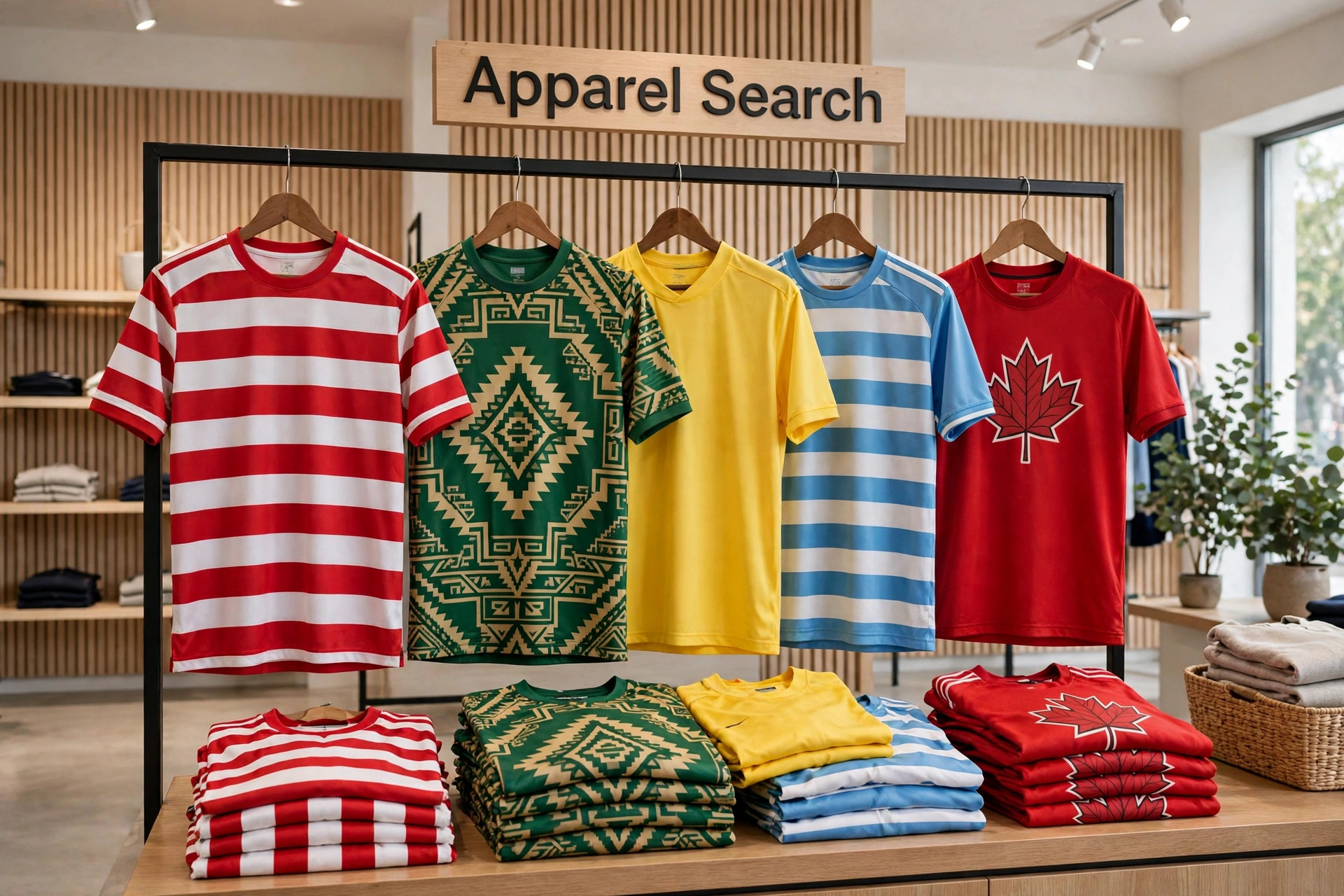
The home shirt reached back thirty-two years: clean white broken by horizontal red-and-white striping and a red, white and blue ribbed collar, in direct homage to the striped 1994 shirt from America's first World Cup — the shirt generations of fans call the “Waldo.” The away shirt went the other direction: a bold red-and-blue sash cut diagonally across deep navy. ESPN ranked the home shirt fifth of the entire tournament — nostalgia, tailored.
Mexico — Adidas
The strongest host set, by most verdicts. The home shirt wrapped Mexico's green in an Aztec-inspired motif explicitly honoring the beloved 1998 design; the away shirt revived the Trefoil on a clean, historic-patterned base; and the third kit was produced with Someone Somewhere, the Mexican social enterprise that works with artisan communities — a World Cup shirt with a supply chain story. Mexico finished with three shirts in the top sixteen of ESPN's ranking.
Canada — Nike
Canada's home shirt built a mosaic-style maple leaf across a two-tone red front; the away went dark — a black shirt with a cracked-ice “black ice” graphic and a hidden Lucky Loonie stamped inside the back collar, a nod to the loonie buried at center ice for Canada's 2002 Olympic hockey gold. The details were loved; the execution divided critics, and the away shirt landed near the bottom of ESPN's list. Host-nation kits carry impossible expectations, and Canada's showed both sides of the brief.
03 / The Critics' TableThe Shirts the Rankings Loved
ESPN's complete ranking of the tournament's 105-plus shirts put Uruguay's away shirt first — an indigo Nike design with a shimmering blue-and-orange mantle honoring the 1930 champions. Japan's away shirt was second and reportedly sold out on release: off-white, lined with twelve rainbow pinstripes. France's away took third with the tournament's cleverest idea — a verdigris green taken from the Statue of Liberty, with metallic copper logos, a French shirt about New York. Argentina's away shirt, black with Fileteado Porteño folk-art foliage, carried Buenos Aires' sign-painting tradition into the top ten. The pattern in the praise: the loved shirts were the ones with a story specific enough to be told in one sentence.
04 / TrendsThe Design Trends of 2026
Retro is the brief. The USA's 1994 stripes and Mexico's 1998 homage led a field full of archive references; Adidas formalized it by restoring the Trefoil logo to its away shirts and thickening the three stripes on its home shirts into the bold Tiro 26 trim. Texture over templates. After years of criticism that big makers dressed every nation in the same shirt with different colors, 2026's kits were dense with nation-specific pattern: Aztec geometry, mosaic maple leaves, topographic and folk-art graphics. Heat as a design material. Cooling yarns, mapped mesh and ventilation zones were marketed as features, not fine print. And the third shirt as fashion drop: alternate kits — Mexico's artisan collaboration above all — were designed as limited streetwear pieces that happened to be legal to play in. The line between kit and collection effectively ended in 2026; our streetwear guide picks the story up from the sidewalk side.
05 / The MakersThe Makers' League Table
Nike, Adidas and Puma still dress most of the world between them, and the hosts wore the two giants. But 2026's supplier list was the most diverse in decades: Reebok returned to a World Cup for the first time since 1998, dressing Panama; Kelme, Umbro, Kappa, Jako, Capelli Sport, Marathon and Saeta all put shirts on the field. For the smaller makers, a World Cup shirt is the single most valuable garment in the company — a month of global television in one design. For the giants, the tournament is a technology showcase and a streetwear launch at once. Either way, the product is the same object our women's soccer shirts guide and men's sports jerseys guide cover from the player's side: a knitted polyester shirt, carrying a nation.