World Textiles & Traditional Crafts · Central Asia
Felt of the Steppe: Shyrdak & Nomad Felt
On the Central Asian steppe, wool was not woven into houses — it was felted into them. The Kyrgyz shyrdak, a carpet built by cutting two sheets of felt at once and swapping the pieces into a bold mosaic, is the masterpiece of that world, and its softer sibling ala-kiyiz carries its pattern inside the cloth itself. This guide works through both techniques step by step, the felt architecture of the yurt, the Kazakh syrmak that shares the shyrdak's cut, what UNESCO's urgent safeguarding inscription really says, and how to buy felt that will last a lifetime.
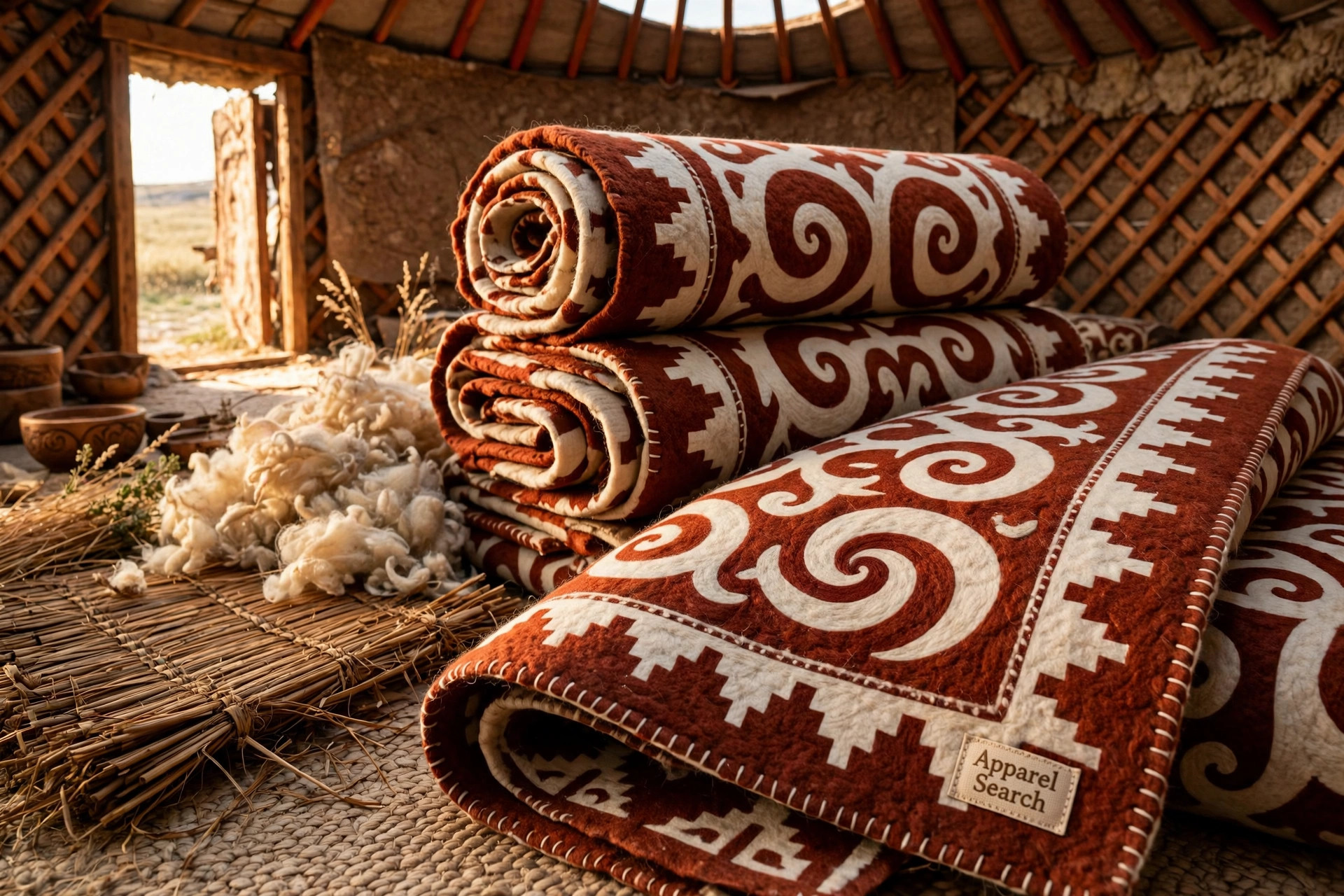
The Material
Felt: The Cloth That Built the Steppe Home
Felt needs no loom. As the Apparel Search felt definition explains in short-reference form, felt is a non-woven cloth made by matting, condensing and pressing fibres together: wool's microscopic scales lock under heat, moisture and pressure until loose fleece becomes a single sheet. That mechanism is the foundation of nomad material culture. A pastoral family with sheep, water and strong arms could produce its own architecture — no loom to transport, no yarn to spin, no warp to set up. Felt covered the yurt, floored it, blanketed its beds, and went under its saddles.
UNESCO calls traditional felt carpets "one of the foremost arts of the Kyrgyz people and an integral part of their cultural heritage," and their making was inseparable from nomad life: the carpets warmed and decorated the home at once. The knowledge was women's knowledge, held communally — felting a large sheet takes several women rolling and pressing in rhythm together — and UNESCO records that it passed, as a rule, from older women in rural and mountainous areas to younger women within the family. Carpets were also dowry and inheritance: a fine shyrdak demonstrated its maker's skill and passed down as an heirloom.
Two carpet techniques carry this heritage. The shyrdak is assembled from finished felt, cut and stitched. The ala-kiyiz — "motley felt" — is patterned in loose wool before felting begins. Everything else in this guide hangs on that distinction: crisp against soft, sewn against fused, heirloom against everyday.
The Process
Making a Shyrdak, Step by Step
A shyrdak begins long before the famous cut: first the felt itself must exist.
Sort, clean and lay the wool
Sheep's wool is sorted, cleaned and opened, then laid in even layers on a reed mat to the thickness the sheet requires — evenness here decides everything later.
Felt the sheets
The laid wool is moistened with hot, soapy water, rolled up in the mat and worked — rolled, pressed and turned, traditionally by a group working together — until the fibres lock into dense, even sheets. Sheets are made in the colours the design needs: a strong base felt and thinner coloured felts that will withstand cutting and stitching.
Pair two colours and draw
Two finished sheets in contrasting colours — classically a madder red against undyed cream, or black against white — are laid one over the other and the ornament is marked on the top sheet. Strong contrast is not decoration alone: it is what makes the two-sheet cut legible across a room.
Cut through both layers
The maker cuts the pattern through both layers at once, following the drawn line in one confident pass. Because both sheets are cut together, every shape exists twice — once in each colour — and each fits exactly into the space the other left behind.
Swap the pieces
The cut shapes are exchanged: the red motif drops into the cream field, the cream motif into the red. A single cutting therefore yields two complete compositions, each the colour reverse of the other — pattern and counter-pattern with almost nothing wasted.
Stitch, cord and quilt
The swapped pieces are sewn edge to edge, and the join is often covered with a twisted wool cord couched along the seam, which both protects the stitching and sharpens the design's outline. The finished mosaic is then laid over a plain felt backing, finished with a border and quilted through, so top, seams and backing become one thick, warm, structural carpet.
The result explains the shyrdak's reputation: dense felt, locked seams and a quilted backing make a carpet that shrugs off decades of use — the heirloom of the pair. Its designs set a strong central field inside concentric borders, and its recurring horn and scroll forms are a traditional ornamental vocabulary handed down between makers; confident one-line "meanings" offered at the point of sale deserve a polite discount.
The Sibling Technique
Ala-Kiyiz: The Pattern Inside the Cloth
An ala-kiyiz is never cut at all. The maker lays out the wool for the base, then draws the ornament on top with loose strands of coloured wool — at this stage a raised, imprecise sketch in fibre. The layout is moistened, rolled into its mat and worked for a long time, as a plain sheet is felted. As the fibres lock, the coloured wool fuses into the base until pattern and background are one cloth. There is no seam to find, because there was never a join: the design is in the felt, not on it.
| Shyrdak | Ala-kiyiz | |
|---|---|---|
| Technique | Cut mosaic: pattern cut through two finished felts, pieces swapped and stitched | Inlay: coloured loose wool laid on unfelted base, then felted into one cloth |
| Pattern edge | Crisp and geometric, outlined by seams and cord | Soft and blurred, the motif floating in the fibre |
| Build | Thick: mosaic top quilted to a plain felt backing | A single felted layer, thinner and lighter |
| Labour | Slow and highly skilled; the prestige carpet | Faster to make; the everyday household felt |
| Life | Decades of use; made to be inherited | Shorter-lived, and correspondingly less costly |
Neither technique is a failed version of the other: they are the two poles of one craft — the careful and the quick — and UNESCO inscribed them together for that reason. A buyer who can name which one they are looking at already knows more than most of the market.
A Craft on the Urgent List
In 2012, UNESCO inscribed "Ala-kiyiz and Shyrdak, art of Kyrgyz traditional felt carpets" — and the list matters. This was not the celebratory Representative List but the List of Intangible Cultural Heritage in Need of Urgent Safeguarding, the register reserved for living traditions at real risk of vanishing. UNESCO's own account of the element is unsentimental: the number of practitioners was diminishing and most were over forty years of age; younger people showed little interest in learning; inexpensive synthetic carpets dominated the market; raw materials were scarce and often poor; and government safeguarding was lacking. The verdict on the two carpets was starker still — ala-kiyiz had "practically disappeared from Kyrgyz homes," and shyrdaks were "under serious threat of being lost."
That inscription frames everything since. Safeguarding work — training, festivals celebrating master carpet-makers, women's cooperatives selling beyond the local market, workshops in felt centres such as Kochkor — answers the threats UNESCO named: an ageing maker base, cheap synthetic competition and poor wool. It also frames the buyer's responsibility: every genuine, fairly priced shyrdak from a named maker is a small counterweight to those threats; every printed imitation pushes the other way. The urgent list is not a marketing badge. It is a diagnosis, and the craft's survival is still being decided, purchase by purchase.
The Wider Felt World
Yurt Felt and the Kazakh Syrmak
Carpets were only the most decorated layer of a felt dwelling. The Kyrgyz yurt — boz üi, the "grey house" — is a portable round home of lattice walls (kerege), roof poles (uuk) and a crown ring (tündük), and felt makes it a house: large plain covers wrap the walls and roof, insulating against steppe winters and summer heat. Inside, felt did the furnishing — floor carpets, wall hangings, bags and saddle blankets — so a family's whole soft architecture could roll up and move with the herds between winter quarters and summer pastures.
Across the border in Kazakhstan, the same two-sheet cut produced the syrmak, the shyrdak's close kin. Kazakh sources describe the syrmak as the most valued felt carpet: where the plainer tekemet floor felt — patterned by laying dyed wool into a half-ready base, the ala-kiyiz method in Kazakh dress — covered the floor, syrmaks decorated the walls and served at celebrations. The mosaic syrmak is made exactly as a shyrdak is: pre-made dyed felts cut and stitched into a mosaic, a process that can take months, passed from mother to daughter. Its ornament balances foreground and background in mirrored rhythm — horn forms above all, including the "double horns" cross in diamond fields. Two peoples, one steppe, one knife-line: regional dialects of a single felt language.
Then and Now
Felt in Contemporary Hands
Felt never entirely left Central Asian life — yurts still rise for summer pastures and celebrations, and felt slippers, hats and bags remain everyday goods — but the carpet arts contracted hard when factory carpets arrived, exactly as UNESCO recorded. The revival since 2012 works on several fronts: cooperatives that pay women makers fairly and sign their work; design collaborations carrying shyrdak patterns onto scarves and home goods without pretending they are carpets; and a slow return of the full-size shyrdak as a conscious heirloom purchase. International fashion has noticed the mosaic's graphic power, and shyrdak-patterned pieces have appeared in designer collections — bringing income alongside the usual risk that the pattern travels faster than the credit. The honest version of that trade names the technique, the country and the makers. Anything less is just a print.
Acquiring
Buying Real Felt
Start with the essential check experienced sellers themselves recommend: ask the seller to name the technique, then unroll the whole carpet and inspect both sides. A shyrdak should show its construction — stitched seams you can feel, cord along the joins, quilting through a plain backing, slight irregularities of a hand-guided cut. An ala-kiyiz should show no seams at all, its pattern fused into a single sheet with blurred edges. Both should feel like what they are: dense, springy sheep's wool, never the flat uniformity of a printed synthetic rug.
Price follows labour honestly. A full-size shyrdak represents weeks to months of skilled group work; if the price looks like a machine-made rug's price, it is a machine-made rug. Kochkor, on the road south from Bishkek toward Song-Kul lake, has become the best-known centre for authentic felt, and cooperatives there and in Bishkek sell with makers' names attached — the best sign you are buying the real tradition rather than its image. Buy the best piece you can from a maker you can name, keep it aired, rolled and moth-guarded, and a shyrdak will warm a home for longer than you will remember the price.
Common Questions
Common Questions
What is a shyrdak?
A shyrdak is a Kyrgyz felt carpet made by a mosaic technique: two sheets of felt in contrasting colours are laid together, a pattern is cut through both at once, and the cut pieces are swapped so each sheet receives the other's shapes. The pieces are stitched edge to edge, the seams are often covered with twisted cord, and the mosaic is quilted onto a plain felt backing. One cutting produces two carpets, each the colour reverse of the other.
What is the difference between shyrdak and ala-kiyiz?
They are the two traditional Kyrgyz felt carpets, made in opposite ways. A shyrdak is assembled from pieces cut out of finished felt, so its patterns have crisp edges, visible seams and great durability. An ala-kiyiz is patterned before felting: coloured loose wool is laid on a base of unfelted wool and the whole is rolled and felted into a single cloth, so its motifs have soft, blurred edges and the carpet is thinner, faster to make and less durable.
What does the UNESCO listing for shyrdak actually say?
In 2012 UNESCO inscribed 'Ala-kiyiz and Shyrdak, art of Kyrgyz traditional felt carpets' on the List of Intangible Cultural Heritage in Need of Urgent Safeguarding — the list for traditions at risk of disappearing, not the celebratory Representative List. UNESCO recorded that most practitioners were over forty, younger people showed little interest, cheap synthetic carpets dominated the market, and ala-kiyiz had practically disappeared from Kyrgyz homes.
How long does a real shyrdak last, and how is it cared for?
A well-made shyrdak is an heirloom: densely felted, stitched and quilted, it can serve for decades and is traditionally passed down through families. Care is simple — shake and air it outdoors, vacuum gently without a beater bar, spot-clean spills promptly with cool water, and store it rolled rather than folded, with moth protection, since it is pure wool. Keep it out of prolonged direct sun to protect the dyes.
How can you tell a genuine handmade shyrdak from an imitation?
Unroll the whole carpet and look at both sides. A genuine shyrdak is wool felt through and through: you can feel the stitched mosaic seams under your fingers, see the quilting on the backing, and find small irregularities in the cutting that no machine repeats exactly. Ask the seller to name the technique — shyrdak or ala-kiyiz — and where and by whom it was made. Printed or synthetic 'shyrdak-style' rugs have a flat, uniform surface with no seams and no felted wool body.
Keep Exploring
More to Explore
Sibling Textile Guides
World Textiles & Traditional Crafts
The section hub — every world textile guide, from Mali's mudcloth to the tweeds of the Hebrides.
Visit the hub ↑Suzani: Central Asia's Dowry Embroidery
The settled towns' answer to the steppe: the great silk-embroidered dowry cloths of Uzbekistan and Tajikistan.
Read ↑Navajo Weaving
Another pastoral people's wool mastery — the upright-loom blankets and rugs of the American Southwest.
Read ↑Definitions & Fabric Partners
Search Apparel Search