World Textiles & Traditional Crafts · Central Asia
Suzani: Central Asia's Dowry Embroidery
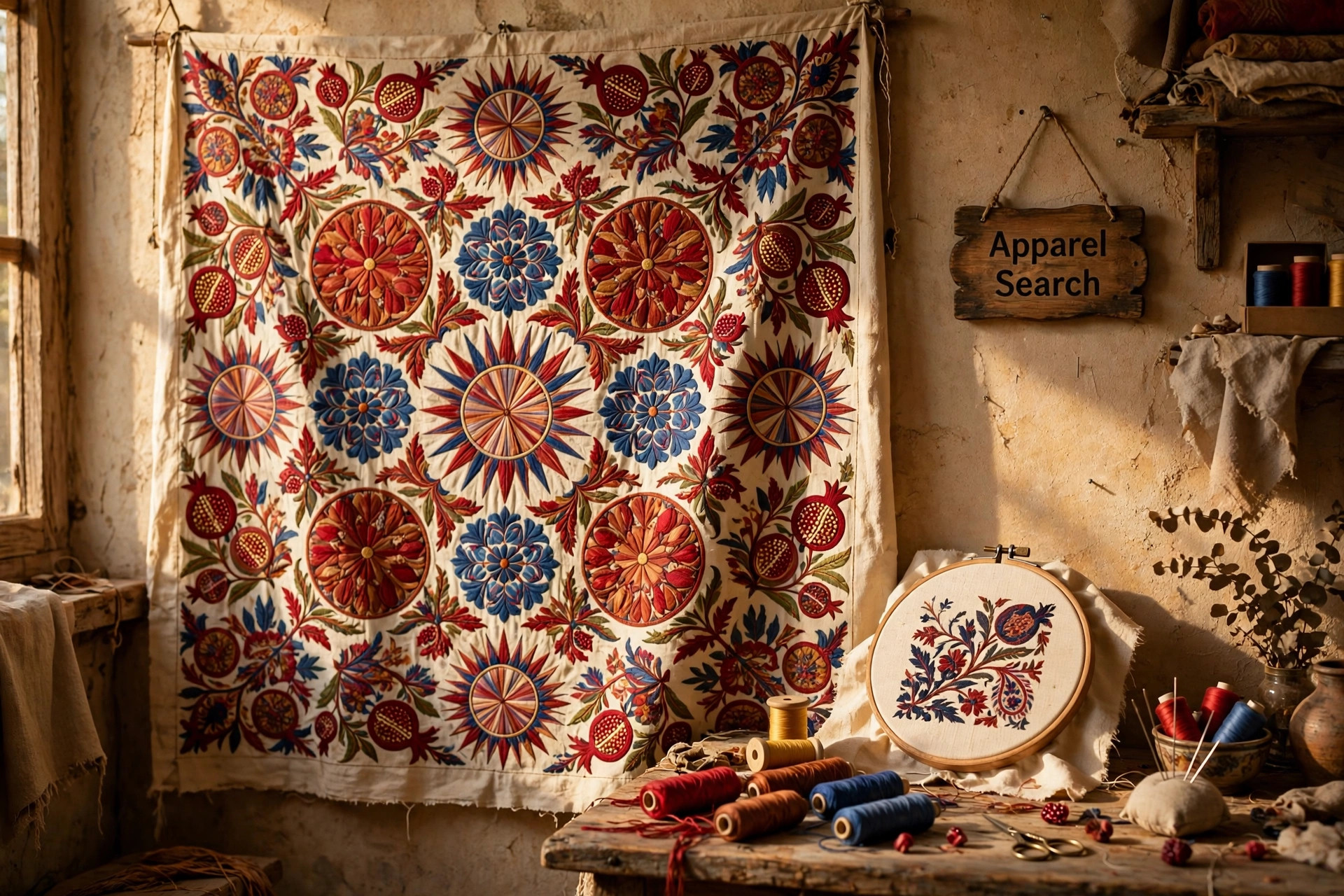
A suzani is a garden you can fold: a large cloth of hand-woven cotton covered, stitch by stitch in silk, with sun discs, pomegranates and flowering vines. For generations the women of Uzbekistan's and Tajikistan's oasis towns embroidered suzanis for a daughter's dowry — drawing the design together, dividing the cloth, and sewing it back into one blazing whole. This guide follows the cloth step by step, compares the town styles of Bukhara, Nurata, Tashkent and Shahrisabz, reads its medallions, and shows how to buy one honestly today.
The Cloth
Needlework on a Dowry Scale
Suzani comes from the Persian word suzan, needle — a suzani is, plainly, "needlework," and the name fits a cloth whose entire surface is made by the needle. The Apparel Search embroidery definitions cover the individual stitches as short references; what a definition cannot convey is the scale. A full dowry suzani is a wall-sized textile, commonly around two metres by a metre and a half or larger, embroidered in silk on a ground of narrow strips of hand-woven cotton. It was not a garment and not a furnishing in the modern sense. It was wealth made visible: a set of suzanis — a large hanging for the wall behind the bridal bed, a cover for the bed itself, covers for pillows and for the rolled bedding, and a prayer cloth with an arch — formed an important part of a bride's dowry and stood as a testament to her family's status and to the skill of its women.
The tradition belongs to the settled towns, not the steppe. Suzanis were produced by women in what is today Uzbekistan and Tajikistan — Bukhara, Samarkand, Nurata, Shahrisabz (Shakhrisabz), Tashkent, Khujand and Istaravshan — where a courtyard house, a garden and a loom framed daily life. The oldest surviving pieces date from the late eighteenth and early nineteenth centuries, and the suzani's great age is the nineteenth century, before factory cloth and Soviet-era workshops changed what was made and why. Because embroidery was a household art taught from mother to daughter, no two historic suzanis are alike: the drawing hand, the dye lots and the several stitchers all leave their evidence in the cloth.
A suzani's neighbour in the same bazaars was silk ikat, dyed in the yarn before weaving — the opposite direction of work, since suzani applies its pattern to finished cloth with a needle. Our ikat definition tells that story in full; this guide stays with the needle.
The Process
How a Suzani Is Made, Step by Step
The making of a suzani is a social process as much as a technical one — designed by one hand, embroidered by many, judged as a whole. Follow the steps and the famous quirks of old suzanis, the mismatched strips and wandering seams, stop looking like flaws and start reading as signatures.
Weave and join the ground
The ground is hand-woven cotton, woven in narrow strips because the household loom is narrow. Four to six strips are loosely basted together to form the full width of the cloth. At this stage the joins are temporary — the cloth is a working surface, not yet a finished textile.
Draw the design
A skilled draftswoman — the kalamkash (also spelled kalamkesh) — draws the whole composition freehand onto the joined strips, traditionally with a reed pen. She sets the medallions, the border and the flowering vines in one continuous plan, working from patterns carried in memory and family practice.
Divide the cloth
The basted strips are taken apart and shared out among the bride's kinswomen — mother, aunts, sisters, neighbours. Each woman embroiders her strip at home, at her own pace, with silk thread. This division of labour is why a suzani is a family document as well as a textile.
Stitch the garden
The embroidery is worked mainly in chain stitch, with couching — a thick thread laid on the surface and sewn down with a finer one, the basma technique — filling the large motifs, and buttonhole stitch for outlines and details. Silk on cotton is the classic pairing; the silk's sheen against the matte ground is the suzani's light.
Rejoin the strips
When every strip is finished, the pieces are sewn back together into one cloth. Because each was embroidered separately, the design rarely aligns perfectly at the seams, and adjoining strips often differ slightly in colour where dye lots or hands differed. Collectors prize these irregularities: they are proof of the process.
Finish and present
The completed suzani is backed or edged, checked as a whole, and folded into the dowry. At the wedding the set was displayed — the large hanging on the wall behind the bridal bed — before settling into household use, which is why most antique pieces show honest wear, a mended corner or a faded passage where the sun reached them.
The Towns
Reading the Regional Styles
Dealers and museums still sort suzanis by town. Attribution is never certain — designs travelled — but the classic profiles are distinct enough to learn, read as tendencies of layout, palette and stitch rather than passports.
| Centre | Layout and palette | Stitch and character |
|---|---|---|
| Bukhara | Large flowering plants and pomegranates, often arranged around a central medallion with a strongly worked border; rich reds and pinks on a cream ground | Fine chain stitch with strongly articulated rosettes and palmettes in the border and delicate stems in the field — the type most people picture |
| Nurata | Fine, airy compositions with plenty of pale ground showing; a central medallion or star with flowering branches and small sprigs, in soft colours | The most delicate work of the group; one traditional Nurata composition is called chor shokh u yak moh — "four branches and one moon" |
| Tashkent | The palak ("sky") and oy-palak ("moon sky") types: very large sun or moon discs covering almost the whole ground in deep reds | Bold, graphic and cosmic rather than floral; the discs dominate and the ground nearly disappears beneath them |
| Shahrisabz | Densely filled compositions with little ground visible, often on coloured grounds, with a big central medallion close in spirit to a carpet | Famous for iroqi, a very fine, even cross-stitch laid so close it can cover the cloth completely, and for the slanted couching stitch kanda-khayol |
| Samarkand | Very large circular motifs, few in number and widely spaced, drawn boldly, with round rosettes in raspberry tones framed by leaves | Mostly worked in basma couching; simpler and larger in scale than Bukhara, with a correspondingly bolder effect |
The Fergana Valley towns and the Tajik centres of Khujand and Istaravshan produced their own variants, and Lakai tribal embroideries sit alongside the urban tradition rather than inside it. When a seller assigns a town name, ask what supports it: layout, stitch and palette together are evidence; a name alone is marketing.
A Garden That Never Wilts
Read a suzani from the centre out and you are reading a courtyard garden translated into silk. The large discs are most often read as sun and moon medallions — in Tashkent pieces they give the cloth its "sky" names — standing for light, life and cosmic order. Around them grows the garden itself: flowering vines, tulips, carnations and irises for spring and renewal, leaves and scrolling stems for paradise and prosperity, and pomegranates, heavy with seeds, as the region's most persistent emblem of fertility and abundance. Small pepper shapes and amulet forms are traditionally read as protection against the evil eye, and the occasional bird as the soul or as good fortune.
Hold those readings with the right grip. Some are well established; others are repeated by sellers with more confidence than evidence, and embroiderers also copied a motif simply because it was beautiful and expected on a bridal cloth. What is certain is the intention: a suzani spread abundance over a new household — a wish worked in silk, sun overhead, garden in flower, fruit full of seed. That is why the cloth feels celebratory even in a museum case, and why its imagery travels so easily into contemporary interiors: it was designed, from the first drawn line, to bless a room.
Then and Now
Decline, Revival and the Fashion Afterlife
The suzani's world narrowed in the twentieth century. Factory-printed cloth undercut hand embroidery, dowries changed, and Soviet-era workshops reorganised needlework into standardised production with synthetic dyes and set patterns. The finest nineteenth-century pieces left for museums and collections abroad: the Metropolitan Museum's early nineteenth-century Bukhara cover, with its delicate field stems and rich chain stitching, is one benchmark of the type.
Since Uzbekistan's independence, the craft has revived as both heritage and livelihood. Women's cooperatives and family workshops in Bukhara, Nurata and elsewhere again embroider large suzanis by hand — now more often for walls, beds and tables in homes worldwide than for a dowry chest — and festivals and museum exhibitions have rebuilt pride in the town styles. International designers and interior brands periodically rediscover the cloth, and suzani motifs surface in fashion as jackets, cushions and upholstery. That afterlife is double-edged: demand sustains embroiderers, but it also floods markets with machine-embroidered imitations printed with the same medallions. One caution belongs here, because the internet gets it wrong: suzani has no suzani-specific UNESCO inscription. A multinational nomination for the traditional embroidery of Central Asia was examined by UNESCO's committee in 2022 and referred back for further information rather than inscribed, and revised embroidery nominations have followed. The craft's standing does not need an invented listing — the cloth itself is the credential.
Acquiring
Collecting and Buying Honestly
Suzanis are sold whole, by the piece and its measurements — never by the metre — because each is one composition with its border complete. Prices divide into three honest tiers. Antique pieces (nineteenth to very early twentieth century) are collectors' textiles: expect natural dyes, silk on hand-woven cotton, strip seams and colour shifts, and prices to match; very old pieces may face export restrictions, so buy documented pieces from reputable dealers. Mid-century workshop pieces cost less and can be beautiful, but should be sold as what they are. New hand-embroidered suzanis from living workshops are the ethical buy for most people: they keep the skill paid and alive.
Whatever the tier, turn the piece over before you pay. The reverse tells the truth: hand stitching is slightly uneven, knots appear, and the ground shows its joined strips; a mechanically perfect reverse on a single wide sheet of factory cloth means machine work. Check the ground (hand-woven cotton is softly irregular), the thread (silk's lustre is cool and uneven; rayon is uniformly shiny) and the dyes (natural colour is deep but slightly varied). Ask directly whether a piece is hand-embroidered, where, and by whom — good sellers answer precisely. Hang a suzani on a sleeve mount rather than pins, keep it out of direct sun, and it will outlast the wall it hangs on.
Common Questions
Common Questions
What is a suzani?
A suzani is a large hand-embroidered textile from the settled towns of Central Asia, in what is now Uzbekistan and Tajikistan. The word comes from the Persian suzan, needle. A classic suzani is silk thread embroidered on a ground of narrow strips of hand-woven cotton, worked by women as part of a bride's dowry and used as a wall hanging, bed cover or ceremonial cloth.
How can you tell a hand-embroidered suzani from a machine-made one?
Turn it over. Hand work is irregular in a living way: stitch lengths vary slightly, colours shift subtly where one strip was embroidered by a different hand, and the seams where the ground strips were rejoined rarely line up perfectly. Machine embroidery is mechanically even, often on a single wide piece of factory cloth, with a flat, uniform reverse. Genuine old pieces also show natural dyes and wear consistent with use.
What do suzani motifs mean?
The most widely repeated readings are of the large discs as sun or moon medallions, pomegranates as fertility and abundance, flowering vines as a garden of paradise and prosperity, and small pepper or amulet shapes as protection. Treat exact symbolism cautiously: designs were also copied because they were beautiful and traditional, and sellers often invent confident meanings. The garden reading — a suzani as an embroidered courtyard garden — is the safest overall frame.
Is suzani on a UNESCO heritage list?
Not as a suzani-specific inscription. A multinational nomination for Traditional embroidery in Central Asia, covering the region's embroidery arts, was examined by UNESCO's committee in 2022 and referred back to the submitting states for more information rather than inscribed, and a revised embroidery nomination has since been in preparation. Claims online that suzani itself was inscribed in 2022 or 2023 do not match UNESCO's own records.
How should a suzani be cared for?
Keep it out of direct sunlight, which fades silk quickly, and dust it with a soft brush or a vacuum through a mesh screen rather than washing it. Old pieces with natural dyes can bleed, so never wash an antique suzani at home; use a textile conservator. Store it rolled around an acid-free tube, face out, in a dark, dry place, and refold or re-roll it periodically so no crease becomes permanent.
Keep Exploring
More to Explore
Sibling Textile Guides
World Textiles & Traditional Crafts
The section hub — every world textile guide, from Mali's mudcloth to Japan's shibori.
Visit the hub ↑Felt of the Steppe: Shyrdak & Nomad Felt
The suzani's steppe counterpart: the mosaic felt carpets the nomads of Kyrgyzstan and Kazakhstan made for the yurt.
Read ↑Kantha: Bengal's Stitched Cloth
Another women's stitch tradition built on household cloth — Bengal's running-stitch quilts of recycled saris.
Read ↑Definitions & Fabric Partners
Embroidery Definitions
The short-reference library of embroidery techniques — chain stitch, couching and their kin, defined one by one.
Read ↑Ikat Definition
Central Asia's other great dowry cloth: the resist-dyed weaving whose pattern is made in the yarn before cloth exists.
Read ↑Silk Fabric Guide
What silk is, how its grades and weights work, and how to buy and care for it — the fibre behind the suzani's thread.
Read ↑Search Apparel Search