World Textiles & Traditional Crafts · Bengal
Kantha: Bengal’s Stitched Cloth
Kantha begins with cloth that has already lived a life. In Bengal — today divided between West Bengal in India and Bangladesh — women layered worn saris, dhotis and lungis that were too soft and thin to wear any longer, and stitched them together with the simplest stitch in sewing: a running stitch, in and out, row after row. The result was a new textile — a quilt, a wrap, a baby’s swaddling cloth — warmer and stronger than any of its layers, and, in the embroidered form called nakshi kantha, a surface on which a maker could draw her whole world in thread. This guide follows that cloth: how it is made, what its pictures mean, where its kinds differ, and how a thrift craft of rural households became one of South Asia’s most collected textiles.
The Craft
One Stitch, Layered Cloth
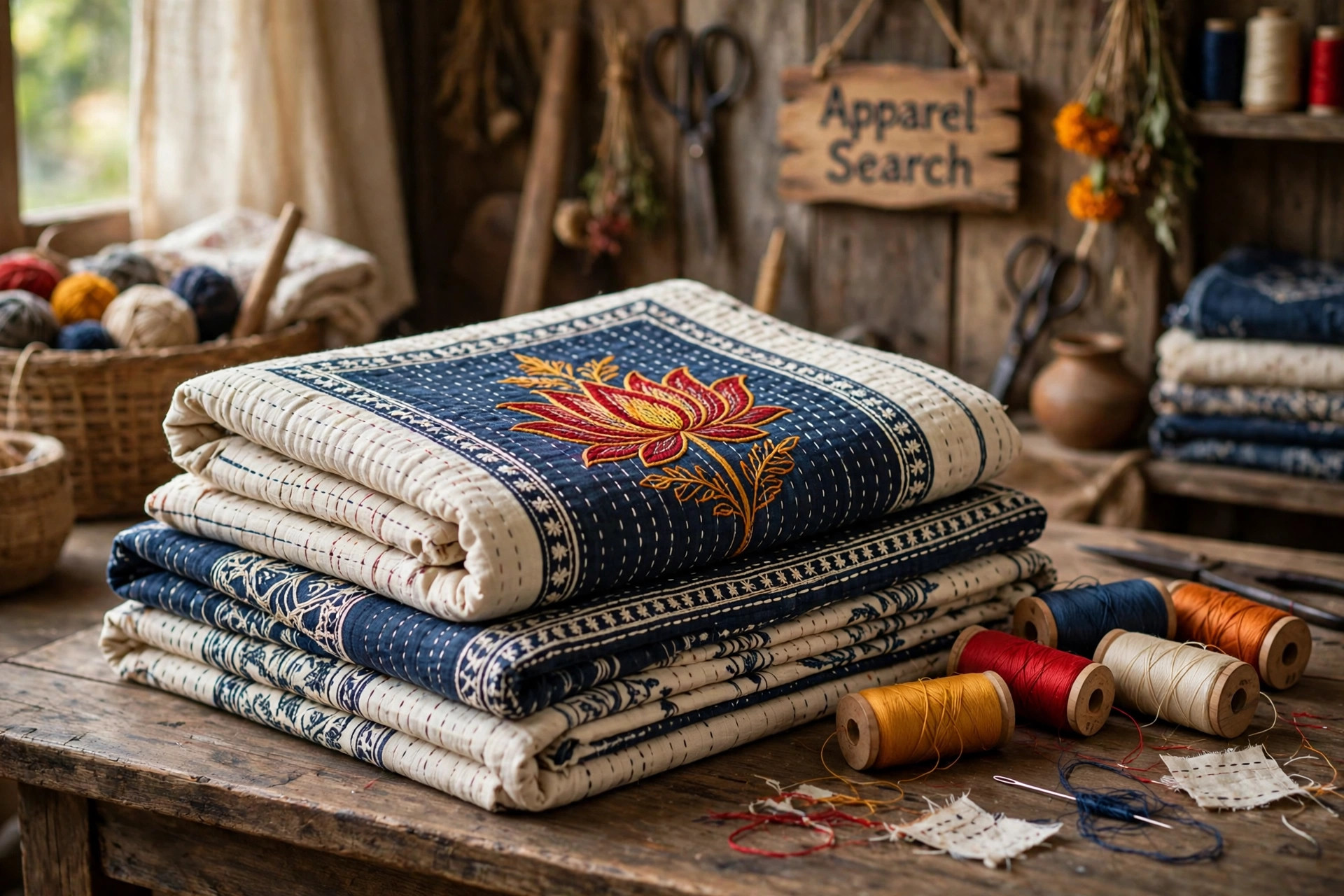
Kantha’s whole technique can be stated in a sentence, and then studied for a lifetime. Old cloths are stacked — three to seven saris is the traditional range, depending on the thickness wanted — smoothed flat on the ground, and quilted together with a running stitch: the needle dips in and out of the layers in a steady rhythm, leaving a dashed line on both faces. That quilting alone makes a kantha. It binds the layers so they cannot shift, traps air between them for warmth, and leaves the finished surface with the soft, watery ripple that is kantha’s fingerprint. Run a palm over an old kantha and you feel it at once: the cloth is not flat like a printed bedcover, but gently puckered everywhere the stitching has drawn the layers together.
The thread, traditionally, came from the cloth itself. Makers unpicked coloured yarn from the borders of the worn saris in the stack and used it for the embroidery, so a kantha’s palette was quite literally inherited from the garments it was made of. Borders mattered twice over: their patterns were also copied in stitch, and some kanthas — the par tola type — are worked almost entirely in concentric stitched borders that imitate woven sari borders so closely the result can look woven rather than sewn. Today most makers buy embroidery skeins, but the discipline is unchanged: everything on the surface, plain quilting and picture alike, is running stitch, varied in length, density and direction to make solid colour, outline, texture and shading.
Two named variations show how far one stitch can be pushed. The chatai or pati (mat) stitch fills areas with dense, even stitching that reads as a woven mat; the kaitya (bending) stitch curves the line so motifs can turn and flow. By crowding stitches, a maker builds up pointillist fields of colour; by spacing them, she lets the ground cloth breathe. There is no frame and, traditionally, no full-size cartoon: outlines might be marked, pin-pricked or block-printed for some types, but many makers worked the design out as they went, which is why no two historic kanthas — even two with the same central lotus — are ever quite alike.
Kinds of Kantha
From Winter Quilt to Picture Cloth
“Kantha” names a family, not a single object, and Bengali households gave each member its own name. Knowing the names is knowing what the cloth was for — because in the traditional household, kantha was not decoration first. It was equipment, made beautiful.
- Lep kantha — the winter quilt
- The original and plainest form: a thicker stack of old cloths quilted for warmth, used as a light winter covering and as bedding. Its stitching may be purely functional, in long even rows.
- Sujni (sujani) kantha — the spread
- A large coverlet or spread, often the ground for finer embroidery. In parts of Bihar and West Bengal the name sujni attaches to the kantha tradition itself. Sujni pieces frequently carry the undulating floral-and-vine work associated with the Rajshahi region.
- Nakshi kantha — the figured cloth
- The celebrated decorative form, covered in embroidered motifs and scenes. Nakshi comes from naksha, a pattern or design. A nakshi kantha is planned like a picture: a central motif, corner motifs answering it, borders framing the whole, and every remaining space filled.
- The small household kanthas
- The same stitching scaled down: asan, a spread to sit on for worship or for an honoured guest; arshilata, a wrap for a mirror or toilet articles; bostani or gatri, a wrapper for clothes and valuables; gilaf, an envelope-shaped cover for a book — including, in Muslim households, the Quran; jainamaz, a prayer rug; dastarkhan, a cloth spread on the floor for dining; and small soft kanthas used to swaddle babies, for which the worn, butter-soft old cloth was prized precisely because it was old.
Scale follows use, from a handkerchief-sized rumal to full bed-sized spreads. What unites them is thrift with intent: nothing in the stack was bought for the purpose, and the labour — evenings and rainy-season hours over months, sometimes years, shared between generations of women — was the real material.
Pictures in Thread
The Nakshi Kantha’s World
A classic nakshi kantha is composed like a garden seen from above. At its centre sits a large lotus, worked first, ringed by concentric circles of undulating vines or stitched sari-border patterns. In the four corners, tree-of-life motifs or kalka — the paisley form — point inward toward the lotus. Between centre and corners, the maker fills the field with everything she knows: flowers and creepers, elephants, tigers, horses and peacocks, boats and palanquins, kitchen utensils and ornaments, the chariot of Jagannath, scenes from Hindu mythology set down beside scenes of dancing, hunting and boating from the life around her. Many of these motifs are shared with alpana, the ritual floor-painting tradition of Bengal, and they carry wishes as well as decoration — for happiness, prosperity, marriage and fertility.
That is why nakshi kantha is so often described as women’s storytelling. In households where many makers could not write, the cloth could still speak — and sometimes literally: kanthas survive bearing proverbs, blessings and captions stitched beneath their scenes, and makers signed their work or stitched the recipient’s name. A kantha stitched for a son-in-law with the blessing Sukhe thako — be happy — is a letter as much as a blanket.
The belief woven through the craft is protective as well as expressive. Old cloth was thought to ward off the evil eye, so a kantha made from a family’s worn garments was believed to keep its user — above all a baby wrapped in one — safe from harm. Whether a modern reader shares the belief or not, it explains the material choice: the softness of old saris was practical, and their history was the point. A kantha quite literally wraps its sleeper in the family’s past.
History
Both Bengals, One Cloth
Kantha belongs to Bengal as a whole — the great delta region that is today split between the Indian state of West Bengal (with the craft also present in Tripura and parts of Assam) and Bangladesh. The earliest written mention usually cited is in the Chaitanya Charitamrita of Krishnadasa Kaviraja, written in the late sixteenth century, in which a homemade kantha is sent to Chaitanya — evidence that by then the stitched quilt was already an ordinary, affectionate household object. The finest surviving nineteenth-century kanthas come from districts such as Jessore, Faridpur and Khulna, in what is now Bangladesh near the West Bengal border, and from centres across the region including Mymensingh, Jamalpur, Rajshahi and Faridpur.
The craft’s modern fame owes much to a poem. Jasimuddin’s Nakshi Kanthar Math — “The Field of the Embroidered Quilt” — published in 1929, made the phrase nakshi kantha familiar far beyond the villages that made the cloth, fixing the embroidered quilt in Bengali literature as a symbol of rural women’s artistry and sorrow. In India, Nakshi Kantha received Geographical Indication (GI) registration for West Bengal in 2008 — a protection of the name and its place, which sits alongside, and does not erase, the equally deep Bangladeshi tradition across the border. The two Bengals share the stitch, the motifs and the household history; the modern border runs through the craft, not around it.
Richly embroidered kanthas declined in the early twentieth century, under pressure from manufactured goods, political upheaval and changing tastes — while the plain utilitarian quilt, made because a household needed one, never stopped being made at all. The revival of recent decades, driven by craft organisations, designers and collectors in both Bangladesh and West Bengal, has therefore taken two forms at once: support for the living household craft, and a new commercial kantha — stitched on new cotton or silk, for saris, jackets, stoles, bedcovers and wall hangings sold around the world.
Kinship
Kantha and Its Running-Stitch Cousin
Readers who know Japanese sashiko will recognise kantha at once — a kinship of logic, not of contact. Both build everything from the running stitch; both began as quilting together layered, worn cloth in households where textiles were too valuable to discard; in both, reinforcement became pattern. The differences are of place and palette: sashiko’s classic form is white thread on indigo cotton, in geometric patterns; kantha’s is coloured thread — traditionally pulled from sari borders — in pictorial, garden-like compositions. Our sashiko mending guide teaches the Japanese stitch as a repair craft; kantha shows what the same stitch becomes when it carries a household’s memory. For the garment that supplies kantha’s raw material, see the sari of India — this page leaves draping and occasions to that guide and stays with the cloth after its wearing life.
Buying Honestly
Collecting and Buying Kantha Today
Buy kantha with your hands first. A genuinely hand-stitched piece has a living surface: stitches that vary almost imperceptibly in length, a gentle all-over ripple, and a reverse side that reads nearly as clearly as the face, because running stitch shows on both. Motifs should be stitched, not printed — turn the piece over and check. In older-style work, look for the evidence of the stack: subtle changes of tone where one recycled cloth ends and another begins. Perfectly even stitching, a dead-flat surface and a motif that fades on the back point to machine work or print, which may still be attractive — but should be priced and described as what it is.
Ask what the ground cloth is. Traditional kantha is layered cotton; much contemporary fashion kantha is a single layer of cotton or silk carrying kantha-style embroidery — a legitimate product, but a different object from a quilted lep. Ask where it was made and by whom: the revival’s best organisations name their maker groups in Bengal and Bangladesh and pay for the months dense nakshi work takes. A large, densely figured nakshi kantha at a suspiciously low price is telling you something about someone’s wages.
Designers now carry kantha far beyond the quilt — jackets, scarves and dresses in kantha-stitched silk, bedcovers and cushions, and gallery hangings that treat the nineteenth-century picture cloths as the textile art they are. The best contemporary work honours the same grammar: centre, corners, borders and a filled, storytelling field.
Common Questions
Common Questions
What is kantha?
Kantha is Bengal’s stitched cloth: several layers of worn cotton cloth — traditionally old saris, dhotis and lungis — laid together and quilted with a simple running stitch. The word names both the stitch and the finished textile. Plain kanthas serve as quilts and wraps; embroidered nakshi kanthas carry pictorial designs worked entirely in running stitch.
What is the difference between kantha and nakshi kantha?
Kantha is the general craft. Nakshi kantha — from naksha, meaning a pattern or design — is its decorative form: a kantha whose surface is covered with embroidered motifs and scenes, usually organised around a central lotus with corner designs and a filled field. A simple lep kantha quilt may carry only quilting stitches, while a nakshi kantha can take months of pictorial stitching.
How many layers does a kantha have?
Traditionally three to seven old saris are layered, depending on the warmth and thickness wanted. The layers are smoothed flat, basted, and then quilted together with running stitch, which gives the finished cloth its characteristic gentle ripple. Thread was traditionally drawn from the coloured borders of the old saris themselves.
How can you tell a hand-stitched kantha from a machine-made one?
Look at the stitching and the cloth. Hand kantha shows slightly irregular running stitches, a soft rippled surface where the layers were quilted, and motifs whose reverse is nearly as legible as the face. Machine imitations have perfectly even stitches, a flatter surface, and often printed rather than stitched motifs. Genuine older-style pieces also show the joins and varied tones of the recycled cloths inside them.
How should a kantha be cared for?
Wash a cotton kantha gently in cool water with mild detergent and dry it in shade, because the coloured embroidery threads fade in strong sun. Store it folded with the folds changed from time to time, or rolled if it is heavily embroidered. Vintage and silk kanthas are more fragile: handle them as textiles, not bedding, and ask a textile-aware cleaner before washing.
Keep Exploring
More to Explore
Sibling Textile Guides
Bandhani: India’s Tied Dots
Thousands of pinch-tied dots from Kutch and Rajasthan — Bengal’s resist-dyed neighbour in this series.
Read ↑Jamdani: Bengal’s Woven Air
Bengal’s other great cloth: figured muslin woven, not stitched, around Dhaka.
Read ↑Suzani Embroidery
Central Asia’s large dowry embroideries — a distant cousin in spirit and scale.
Read ↑Traditional Dress Partner
India — The Sari
The garment that supplies kantha’s cloth: the sari’s drape, regions and wearing life, told in full.
Read ↑World Textiles Hub
Every guide in this series, plus the cloths Apparel Search already covers elsewhere.
Visit the hub ↑Definitions & Craft Partners
Search Apparel Search