World Textiles & Traditional Crafts · Dhaka, Bengal
Jamdani: Bengal’s Woven Air
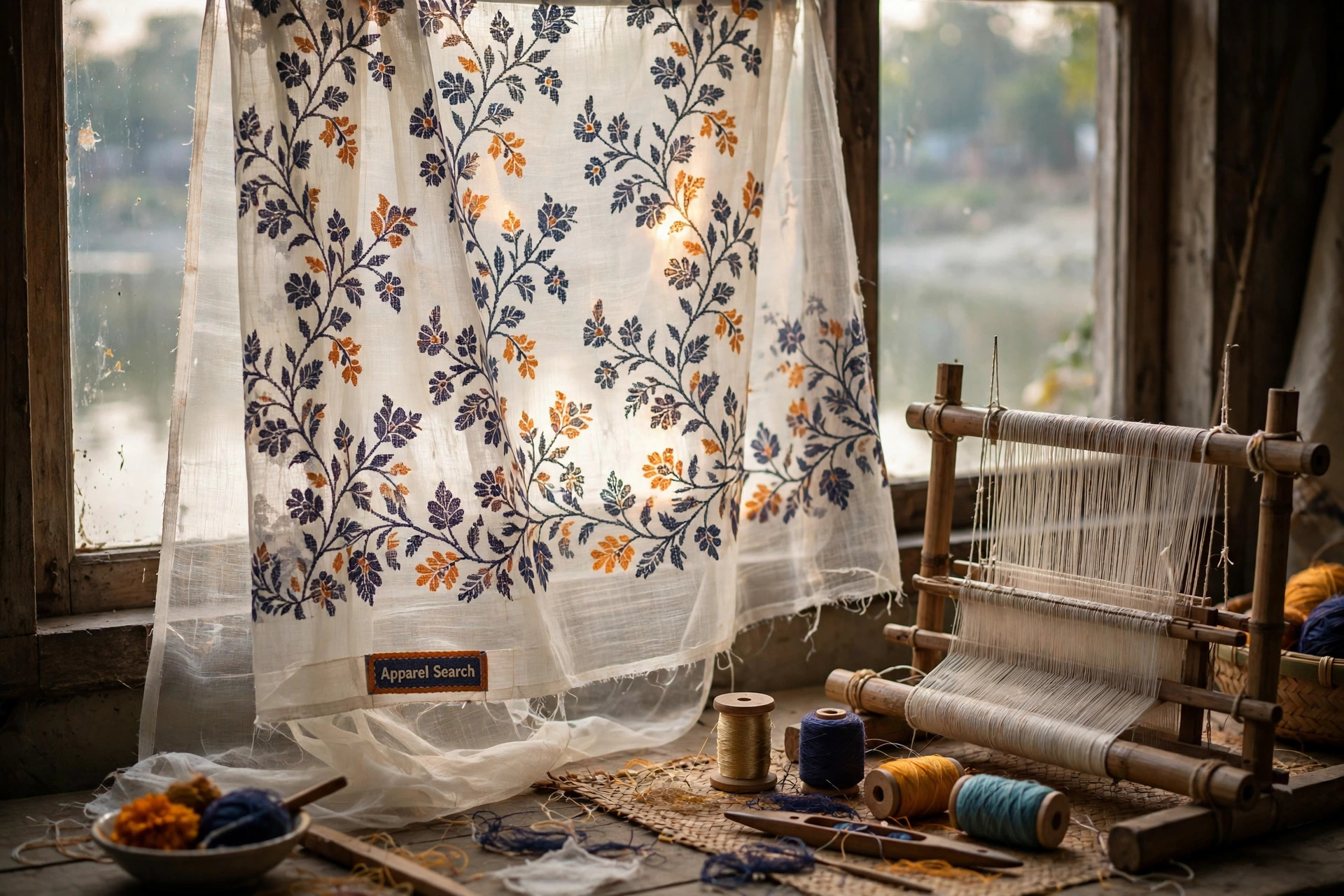
Hold a jamdani up to the light and the pattern seems to float. The flowers are not printed on the cloth, and they are not embroidered onto it afterwards. Each motif was placed there by hand, thread by thread, while the cloth itself was being woven — two weavers at a bamboo pit loom east of Dhaka, counting warp threads from memory and interlacing a thicker coloured yarn exactly where a flower should be, and nowhere else. Jamdani is the figured descendant of the Dhaka muslins the Mughals called baft-hawa, woven air: the most labour-intensive handloom cloth of Bengal, inscribed by UNESCO in 2013, and still woven today in the villages along the Shitalakshya River. This guide explains how the weaving works, how the finest muslin in the world rose, collapsed and was revived, and how to recognise the real cloth.
The Weave
Discontinuous Weft: A Motif That Goes Nowhere Else
Every woven cloth has a warp — the lengthwise threads held under tension on the loom — and a weft, the thread carried across them. Jamdani adds a third element. The ground is woven plainly and finely, warp and standard weft together making a sheer cotton gauze. Then, for each motif, the weaver takes a separate, slightly thicker thread — cotton, silk or zari — and interlaces it by hand through exactly the warp threads that motif needs, using a pointed bamboo or horn tool called a kandul. That supplementary thread appears only inside the motif and then stops. It does not travel to the next flower, and it never runs the width of the cloth. Textile language calls this the discontinuous supplementary-weft technique, and UNESCO’s own description of jamdani uses exactly those words: motifs “created directly on the loom using the discontinuous weft technique.”
The consequences are visible. Because the motif thread is locked into the weave, a true jamdani looks almost identical on both faces — no long floats trailing behind the pattern, no embroidery knots, nothing sitting on the surface. Unravel the cloth and the pattern unravels with it: the design is structural. It is also slow beyond easy imagining. Two weavers sit side by side at the pit loom, called a tant — traditionally a master weaver and an assistant, often his son or apprentice — and the design is carried in memory and counted out thread by thread rather than read from a full pattern draft, though graph-paper aids are used in some modern workshops. Before weaving, the fine yarn is washed and sized with rice starch to give it the strength to survive the loom. A plain sari may take about a week; a densely figured one can take months. Our short reference, the jamdani definition, gives the dictionary version of the weave; this guide is about everything around it — the river, the court, the collapse and the people.
The Patterns
Butidar, Tercha, Jhalar: A Counted Vocabulary
Jamdani’s design vocabulary is old, codified and held in the weavers’ memory as families of arrangement rather than as single pictures:
- Butidar — the scattered spray
- Small floral motifs — buti — sprinkled evenly across the field of the sari. The classic jamdani look: a translucent ground alive with tiny floating flowers.
- Tercha — the diagonal
- Motifs arranged in diagonal rows, giving the cloth a measured, rhythmic movement across its length.
- Jhalar — the net
- A continuous network of motifs covering the whole cloth, the most demanding of the standard arrangements, because the counting never rests.
- Panna hajar and the named motifs
- Named designs include panna hajar (“thousand emeralds”), kalka paisleys, fulwar flowers in straight rows, duria polka-like spots and charkona rectangular motifs — a shared language that lets a buyer in Dhaka and a weaver in Rupganj mean the same flower by the same name.
The name itself carries the flowers with it: jamdani is commonly derived from the Persian jam, a flower, and dani, a vase — a vase of flowers — a fitting name for a cloth whose whole purpose is to hold blossoms in air. Under the Mughals, Persian was the court language, and the name stuck to the figured muslin of Dhaka, which was also known simply as Dhakai, “of Dhaka.”
History
From Woven Air to Collapse — and Back
Jamdani is the surviving branch of a much older tree. Bengal’s fine cottons were praised in the ancient world — the first-century Periplus of the Erythraean Sea commended the muslins of the Ganges delta, and the Arthashastra, compiled around the third century BCE, is thought to describe the region’s fine fabrics. Those texts do not name jamdani — figured weaving under that name belongs to a later age — but they establish the ground it grew from: delta-grown cotton, spinners of legendary skill, and a trade already old when Rome was buying.
The golden age came under the Mughals, from the sixteenth to the eighteenth century, when imperial workshops and patronage around Dhaka produced muslins of a fineness never matched before or since. The yarn was spun from phuti karpas, a short-staple cotton that grew along the silty banks of the Meghna River and, by most accounts, nowhere else; its fibres were too delicate for machinery and were spun in humid morning air, sometimes over boats on the river, so the gossamer thread would not snap. Counts climbed to 300 and far beyond — against the roughly 40-to-120-count yarns of modern jamdani. The finest court cloth, mulmul khas, served emperors; the Mughal name for the best of it, baft-hawa — woven air — is the phrase this guide borrows for its title. Travellers’ tales belong to the same world: muslin that could be drawn through a finger ring, folded into a matchbox, or laid on grass and mistaken for dew. Treat the numbers as legend built on a real marvel — the cloth was astonishing, and astonishment embroiders.
The collapse, when it came, was structural rather than mysterious. Through the nineteenth century, cheap machine-spun yarn and finished cloth imported from industrial Britain undercut the Dhaka weavers, while the decline of Mughal power removed the court patronage that had sustained the finest work. Villages once famous for jamdani faded; the phuti karpas plant itself was lost as cultivation lapsed. What survived — and this is the essential point — was the figured weaving itself, carried in weaving families around Dhaka at coarser counts and narrower means. Jamdani is often called the only surviving variety of the traditional Dhaka muslins: the plain gauze is gone, but its flowered sister never entirely stopped.
The modern revival is therefore a rescue of a living craft, not a reconstruction of a dead one. After the Partition of Bengal in 1947, weaving communities were divided between Bangladesh and West Bengal in India, and jamdani continued on both sides of the new border — with its historic heartland, the villages of Rupganj and Sonargaon in Narayanganj district, on the bank of the Shitalakshya River near Dhaka. In Bangladesh, a Jamdani Palli — a weavers’ village-market established to connect buyers with weavers more directly — anchors the trade near the capital, and designers and craft organisations on both sides of the border commission new work in the old vocabulary.
Recognition
UNESCO 2013 and Bangladesh’s First GI
Two formal recognitions frame jamdani’s modern status, and both are matters of public record. In 2013, UNESCO inscribed the Traditional art of Jamdani weaving (Bangladesh) on the Representative List of the Intangible Cultural Heritage of Humanity — inscription 8.COM, element 00879, verified on UNESCO’s own Intangible Cultural Heritage site for this guide. UNESCO describes jamdani as “a vividly patterned, sheer cotton fabric, traditionally woven on a handloom by craftspeople and apprentices around Dhaka,” notes that the Jamdani sari is “a symbol of identity, dignity and self-recognition,” and records how the craft is transmitted: principally by parents to children in home workshops, with master weavers recognised as bearers of the traditional motifs. In 2016, the Jamdani Sari received Geographical Indication registration in Bangladesh — the first GI product in the country’s history. For the garment the cloth most famously becomes, see our partner guide to the sari of India, which owns the draping and wearing story; the fibre questions — what cotton and silk do, and how silk weights are measured — belong to our silk fabric guide and the fabric guides hub.
The Weavers’ Present
Buying Jamdani Honestly
UNESCO paper has not solved the loom’s economics. Jamdani weaving remains a closely knit community craft — weavers together with spinners, dyers and loom-dressers, in UNESCO’s words — in which a month of highly skilled, two-person loom work can still be undercut by a machine-made or embroidered imitation sold under the same name. Reports over the years have put master weavers’ earnings at levels that push their children toward the garment factories instead, and any honest buying guide has to say so plainly: the gap between a genuine jamdani’s price and an imitation’s price is the weavers’ wage, and it is the first thing a too-cheap “jamdani” has removed.
The recognition tests, fortunately, are in your hands. Light: hold the cloth up — a true jamdani is translucent, and its motifs float on the gauze rather than sitting on it. Reverse: turn it over — the pattern should read almost identically, with no long floats, knots or printed backing. Touch: the motif areas feel fractionally firmer than the ground, because extra thread lives there, but nothing feels applied. Ask: where it was woven, in what fibre — cotton is the classic ground, with half-silk and silk jamdanis also woven — and at what count; a seller who can answer is usually selling the real thing. Contemporary designers in Bangladesh and India now take jamdani beyond the sari into jackets, dresses and scarves, and festivals and exhibitions of wearable jamdani art keep the vocabulary in front of new buyers. Bought knowingly — from the weaving villages, the Palli, or a maker-led label — a jamdani is not just the finest cotton cloth most of us will ever handle. It is a counted, remembered pattern, carried in two pairs of hands, that has already survived an empire’s fall and an industry’s collapse. It deserves its price.
Common Questions
Common Questions
What is jamdani?
Jamdani is a fine, sheer cotton muslin, traditionally handwoven around Dhaka in Bangladesh, whose floral and geometric motifs are woven directly into the cloth on the loom by the discontinuous supplementary-weft technique. The motifs are neither printed nor embroidered: each one is interlaced by hand, thread by thread, as the ground cloth is woven.
Why is jamdani called woven air?
Jamdani descends from the legendary Dhaka muslins, cloths so fine that the finest Mughal court grade was called baft-hawa — woven air. A length of historic Dhaka muslin was said to pass through a finger ring and to be mistaken for dew on grass. Modern jamdani, woven in yarns of roughly 40 to 120 count, is fine but heavier than those lost muslins, which used yarns of 300 count and beyond.
Is jamdani UNESCO-listed?
Yes. The traditional art of Jamdani weaving (Bangladesh) was inscribed in 2013, at the eighth session of the Intergovernmental Committee (8.COM), on UNESCO’s Representative List of the Intangible Cultural Heritage of Humanity, as element 00879. UNESCO describes jamdani as a vividly patterned, sheer cotton fabric woven on handlooms around Dhaka, its motifs created directly on the loom by the discontinuous weft technique. In 2016 the Jamdani Sari also became Bangladesh’s first Geographical Indication product.
How can you tell a real handwoven jamdani from an imitation?
Hold it to the light and turn it over. In a true jamdani the motifs seem to float on a translucent ground and look almost identical on both faces, with no long loose floats or embroidery knots behind them, because each motif thread is interlaced into the weave itself. Machine and embroidered imitations show floats, knots or a printed surface, and their motifs sit on the cloth rather than in it.
How long does a jamdani sari take to weave?
Two weavers work side by side at the pit loom — a master weaver and an assistant or apprentice. A relatively plain jamdani sari can take about a week of loom time; a densely figured one, with motifs counted out from memory across the whole field, border and end-piece, can occupy both weavers for months. That labour is the main reason genuine jamdani costs what it does.
Keep Exploring
More to Explore
Sibling Textile Guides
Kantha: Bengal’s Stitched Cloth
Bengal’s other great cloth — stitched, not woven, from layered old saris.
Read ↑Bandhani: India’s Tied Dots
Pinch-tied resist dots from Kutch and Rajasthan, and the bridal gharchola.
Read ↑Chinese Brocades & Kesi
Figured weaving of another order: cloud brocade and carved-silk tapestry.
Read ↑Traditional Dress Partner
India — The Sari
The garment jamdani most famously becomes: drapes, regions and occasions.
Read ↑World Textiles Hub
Every guide in this series, plus the cloths Apparel Search already covers elsewhere.
Visit the hub ↑Definitions & Fabric Partners
Search Apparel Search