World Textiles & Traditional Crafts · China
Chinese Brocades & Kesi
In China, the most prestigious patterns were never printed or stitched onto silk — they were woven into it, thread by thread, on looms that needed two people and a hundred procedures to run. This guide covers the four famous brocades — Nanjing's cloud-like yunjin, Suzhou's Song brocade, Chengdu's Shu brocade and the Zhuang people's bold Zhuang brocade — and kesi, the tapestry weave whose cut wefts make silk look carved. For the garments these cloths serve, see the Traditional Dress partner guide below.
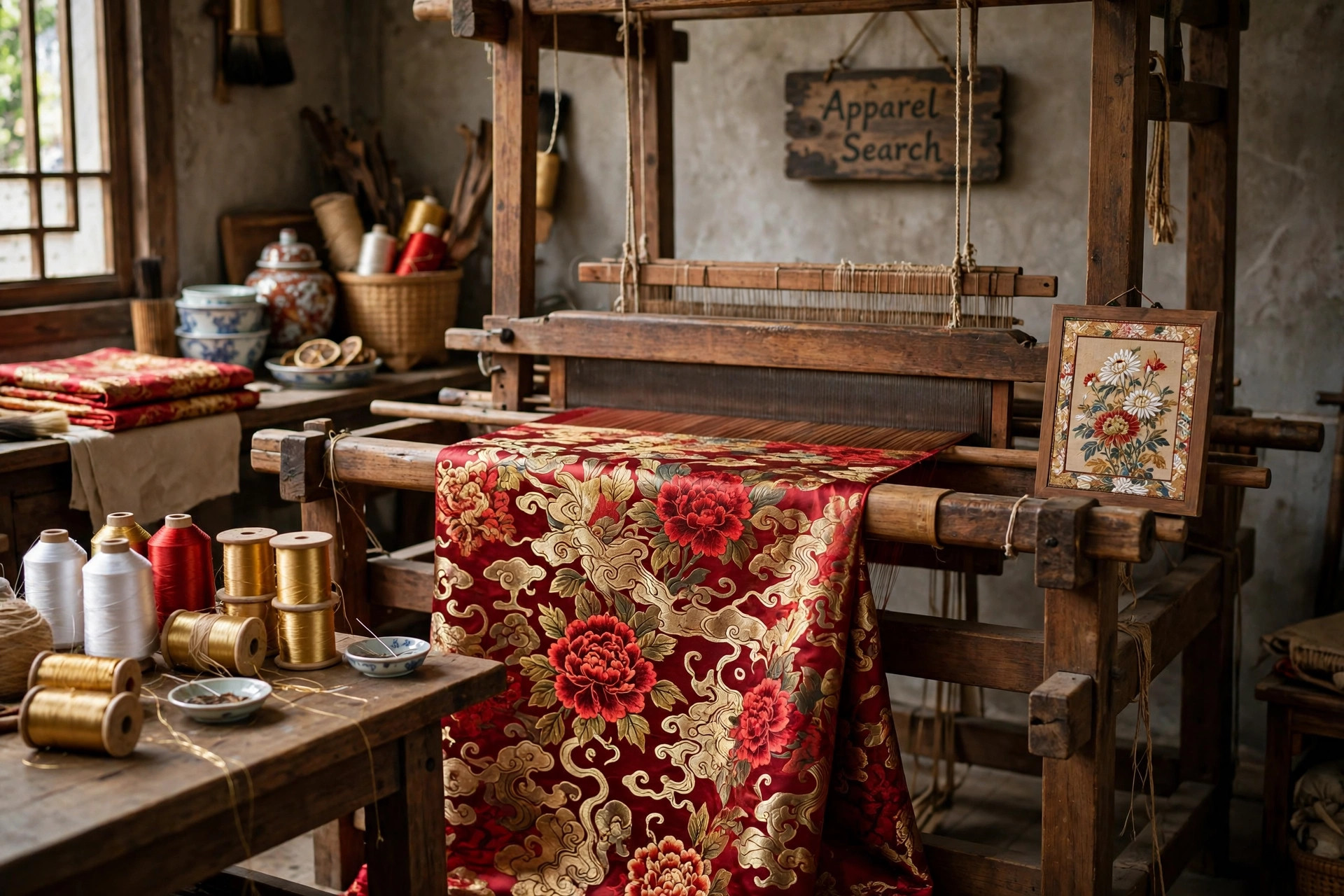
The Cloth
Jin: Pattern Woven In
Brocade — jin in Chinese — is a figured weave: extra weft threads are woven in only where the design needs them, so the pattern rises from the ground cloth as part of its structure rather than sitting on its surface. Turn a true brocade over and those pattern threads appear on the back as loose floats, the surest test that the design was made in the loom. Our brocade definition covers the weave's mechanics — supplementary weft, brocatelle, the damask distinction — in reference depth. This guide goes where a definition cannot: to the named regional traditions that made jin the prestige cloth of Chinese courts, scholars and minority weavers for well over a thousand years. Chinese tradition groups its summit as the four famous brocades, and they divide neatly by temperament: one imperial, one scholarly, one ancient and exuberant, one folk-geometric. A fifth art, kesi tapestry, stands beside them — not a brocade at all, but routinely ranked with them at the top of Chinese silk weaving.
Nanjing
Yunjin, the Cloud Brocade
Yunjin means “cloud brocade,” named — UNESCO's listing notes — for the cloud-like splendour of the finished cloth, and it is the imperial member of the family. Woven in Nanjing, Jiangsu province, on large, complicated drawlooms, yunjin incorporates silk, gold thread and even peacock-feather yarn, and it was once reserved for the highest garments in the empire: UNESCO records that the technique “was once used to produce royal garments such as the dragon robe and crown costume,” and that today it still makes high-end attire and is used to replicate ancient silk fabrics for researchers and museums. That second career matters: because yunjin's patterning is programmed into the loom's set-up rather than printed on, a historic weave can be re-created thread-for-thread, and Nanjing's weavers act as conservators of cloth that no longer exists anywhere else.
The protection is formal. In 2009 UNESCO inscribed the craftsmanship of Nanjing Yunjin brocade on the Representative List of the Intangible Cultural Heritage of Humanity (inscription 4.COM, element 00200). The listing describes a method comprising “more than a hundred procedures, including manufacturing looms, drafting patterns, the creation of jacquard cards for programming weaving patterns, dressing the loom and the many stages of weaving itself.” It also preserves the craft's most human detail: as the two weavers work — one operating the upper part of the loom, drawing the pattern, the other at the lower part passing the shuttle — they sing mnemonic ballads that remind them of the techniques they are using, turning the loom's choreography into song. Published accounts of the weaving put a two-person team's output at only about five to six centimetres a day, which is why the trade saying prices the cloth by the inch against gold.
Process
Weaving Yunjin, Step by Step
Pattern design and drafting
The design is drawn and then transcribed onto gridded drafting paper, enlarged and converted into weaving instructions — which warp threads lift, in which order, for every row of the pattern.
Programming the loom
The draft is embodied in the loom's pattern mechanism — historically a hand-tied system of cords, in UNESCO's description a set of jacquard cards — a programming stage that can take months for a complex design before any cloth exists.
Materials and dressing the loom
Silk warp and wefts are prepared alongside the luxury pattern yarns — gold-wrapped thread, silver, peacock feather — and the great loom is dressed: thousands of warp threads threaded, tensioned and checked.
Two weavers, one loom
The upper weaver draws the pattern cords in sequence; the lower weaver passes the shuttle, inserts the coloured and gold wefts by hand where the design calls for them, and beats the row home — singing the mnemonic ballads that keep the sequence straight.
Centimetres a day
The cloth grows at a few centimetres a day. Colours can be varied by the weavers' judgement as they go, so two lengths from one set-up are cousins, not twins — a hand-made quality no power loom copies.
The Other Three
Song, Shu and Zhuang
Song brocade — the scholar's brocade
Named for the Song dynasty (960–1279), when its style formed, Song brocade is Suzhou's refined answer to Nanjing's splendour: fine silk, soft harmonious colour, and patterns built on precise geometric frameworks — lattices and repeating frames filled with small flowers and auspicious motifs. Its lightness and flat, orderly surface made it the classic cloth for mounting paintings and calligraphy scrolls and for fine bookbinding, as well as for dress: a brocade for the library as much as the wardrobe.
Shu brocade — the oldest name
Shu brocade comes from Chengdu in Sichuan — ancient Shu — and carries the longest pedigree of the four, with origins placed in the Han dynasty and a city so identified with the trade that Chengdu was known as Jincheng, Brocade City. Shu work is known for rich, saturated colour, traditionally built on a five-colour scheme, and full, lavish floral patterning. Where yunjin awes, Shu brocade glows: the exuberant elder of the family.
Zhuang brocade — the people's geometry
Zhuang brocade (zhuangjin) is the traditional weaving of the Zhuang people of Guangxi, China's largest ethnic minority, with a history traced to the Song dynasty. It is worked in cotton with silk or coloured pattern wefts into a strong, durable cloth of bold geometric design — waves, clouds, grasses, flowers and animals, with the phoenix a dominant motif. Made for bedding, blankets, belts, bags and dress, it is the folk member of the four: pattern as community identity rather than court splendour.
| Brocade | Home | Temperament | Known for |
|---|---|---|---|
| Yunjin | Nanjing, Jiangsu | Imperial | Gold and peacock-feather yarn, dragon robes, UNESCO-listed 2009 |
| Song | Suzhou, Jiangsu | Scholarly | Geometric frameworks, scroll mounting, refined colour |
| Shu | Chengdu, Sichuan | Ancient, exuberant | Han-dynasty roots, saturated colour, lavish florals |
| Zhuang | Guangxi | Folk | Cotton ground, bold geometry, phoenix motifs, everyday goods |
Tapestry
Kesi, the Carved Silk
Kesi is not brocade, and the distinction is structural. A brocade's pattern wefts travel within a ground weave that a loom produces across the full width. Kesi has no ground weave in that sense at all: it is a plain-weave tapestry in which the weft does not travel. The method's Chinese name states it exactly — tongjing duanwei, “continuous warp, discontinuous weft.” The warp threads (traditionally fine raw silk) run unbroken through the whole piece. The weft (dyed silk) is cut at every colour change: the weaver works one small area of the picture at a time with a small shuttle wound with a single colour, builds that patch to its boundary, cuts the thread, and begins the next colour beside it. Where two colours meet, a hairline slit or seam remains — joined and managed by hand — and across a whole surface those seams give kesi its famous effect: a picture that looks carved rather than woven, which is why the craft's name is written with a character suggesting cutting and why its nickname is “carved silk.”
Because the weft is the picture, kesi behaves like painting in a way no brocade can. A kesi weaver works from a design sketched or placed behind the warp and can render brush-painting subjects — flowers, birds, landscapes, calligraphy — with graded colour and fine line, the image readable, tapestry-fashion, from both faces. The art reached an early summit in the Song dynasty: the twelfth-century weaver Zhu Kerou, a woman of Songjiang, is the most-recorded kesi artist of her era, with signed tapestry album leaves such as Butterfly and Camellia — a work under 26 centimetres square, now in the Liaoning Provincial Museum — still attributed to her. Suzhou became, and remains, the craft's centre, its workshops producing the imperial robes, hangings and album leaves that made kesi a collector's art; a famous modern measure of its slowness is the six years a Suzhou master, Fan Yuming, spent helping to reweave a fire-damaged kesi robe of the Wanli emperor for the Ming tombs museum. Kesi asks to be judged as woven painting, and priced accordingly: small, old and signed is its summit market.
Acquiring
Reading and Buying
The market for Chinese brocade mixes museum-grade handwork, honest workshop production, jacquard-loom commercial cloth and outright printed imitation under the same four famous names, so buy by tests, not labels. First, turn the cloth over: a woven brocade shows its pattern threads as floats on the back, while a print is flat and pale behind. Second, ask the structural question — for brocade, whether the pattern is a supplementary weft woven on a drawloom or jacquard; for anything sold as kesi, whether the weft is genuinely discontinuous, which you can verify at a colour boundary, where true kesi shows the fine slit-seamed join and a woven imitation does not. Third, match price to process: hand-drawloom yunjin is sold in centimetres of labour and priced like it, Song brocade for scroll mounting is a specialist product with named Suzhou workshops behind it, and Zhuang brocade's honest market is sturdy, colourful everyday cloth — a “yunjin” scarf at a souvenir-stall price is a jacquard or a print wearing the name, which may still be a pleasant scarf but is not the UNESCO-listed craft. The garments these cloths historically served — and serve again in the hanfu revival — are covered in our Traditional Dress guide to qipao and hanfu of China.
Common Questions
Common Questions
What are the four famous Chinese brocades?
The four famous brocades are Nanjing yunjin (cloud brocade), Suzhou Song brocade, Chengdu Shu brocade and Guangxi Zhuang brocade. The first three are historic Han Chinese silk traditions of the imperial and scholar classes; Zhuang brocade is the woven art of the Zhuang people, worked in cotton and silk with bold geometric pattern.
Is Nanjing yunjin really UNESCO-listed?
Yes. UNESCO inscribed the craftsmanship of Nanjing Yunjin brocade in 2009 on the Representative List of the Intangible Cultural Heritage of Humanity. UNESCO's listing describes two craftspeople working the upper and lower parts of a large loom to weave silk, gold and peacock-feather yarn into cloth once made for dragon robes and crown costume.
What is kesi?
Kesi is Chinese silk tapestry, nicknamed carved silk. Its warp threads run continuously through the whole piece while its weft threads are cut at every colour change — tongjing duanwei, continuous warp, discontinuous weft — so the weaver builds a picture area by area with a small shuttle for each colour. The hairline seams where colours meet give the surface its carved look.
How is brocade different from embroidery?
Brocade's pattern is woven: supplementary weft threads form the design as the cloth itself is made, so the motif is part of the fabric's structure and its threads show as floats on the back. Embroidery is stitched onto cloth that already exists. Turn a fabric over — woven floats mean brocade, stitch knots and thread ends mean embroidery.
Why is yunjin so expensive?
Because almost nothing about it can be hurried or mechanised. UNESCO counts more than a hundred procedures in the craft, from loom-making and pattern drafting to the weaving itself, which needs two people working one large loom together. Output is measured in centimetres per day, and the yarns — silk, gold thread, peacock feather — are costly before the first shuttle passes.
Keep Exploring
More to Explore
Sibling Textile Guides
World Textiles & Traditional Crafts
The section hub — every world textile guide, from Bengal's jamdani to Mali's mudcloth.
Visit the hub ↑Yuzen & the Kimono Silk Arts
Japan's silk arts — paste-resist painting and Nishijin weaving, yunjin's closest foreign counterpart.
Read ↑Jamdani: Bengal's Woven Air
Another great figured weave of Asia — discontinuous-weft muslin from Dhaka.
Read ↑