World Textiles & Traditional Crafts · Japan
Yuzen & the Kimono Silk Arts
Yuzen is painting that survives a dye bath: a design drawn on silk in lines of rice paste, coloured by brush inside those lines, steamed, washed, and revealed as a picture made entirely of dye. This guide goes deep on the craft — the hand-painted process step by step, the rival schools of Kyoto and Kanazawa, the stencil road of katazome, and Nishijin-ori, the woven art that shares Kyoto with it. For the kimono these silks become, see the Traditional Dress partner guide below.
The Art
Painting with Paste
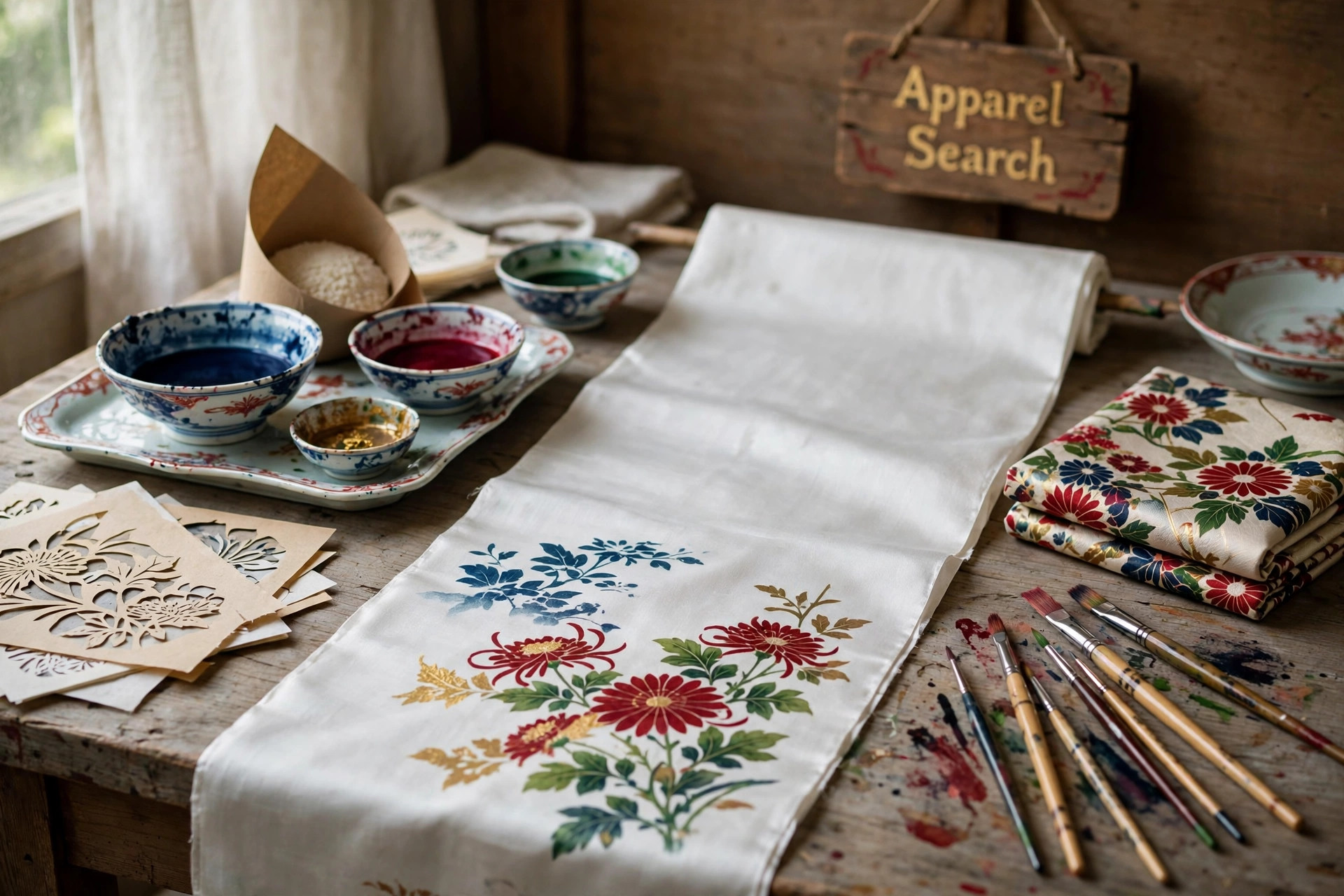
Every dyeing tradition faces the same problem: liquid dye on cloth wants to spread. Yuzen's answer, credited to the Kyoto fan painter Miyazaki Yūzensai in the late seventeenth to early eighteenth century, is a wall. The dyer pipes a paste of rice flour and rice bran — nori — along every outline of the design, lets it dry, and then brushes dye freely inside each enclosed field. The paste walls keep neighbouring colours from bleeding into one another, the way cloisonné enamel's metal strips keep its pastes apart. When the paste is washed out, it leaves hair-fine white lines — itome, “thread lines” — tracing the whole drawing through the finished cloth. Those white threads of undyed silk are yuzen's signature: no print and no weave draws quite that line.
The technique is named for Yūzensai himself, a painter of folding fans around Kyoto's Gion district who is said to have brought earlier paste-resist methods together into a way of rendering a painting through dye. It flowered in the Edo period because it solved a social problem as elegantly as a technical one: merchants restricted from wearing woven gold brocade could still wear a painted garden. Yuzen divides into two branches. Tegaki yuzen is hand-painted, every line piped and every colour brushed freehand. Kata yuzen works through stencils, trading some freedom for repeatability. Both are covered here — tegaki first, because the schools are unintelligible without the process.
Process
The Process, Step by Step
Hand-painted yuzen is a divided craft: in Kyoto especially, a bolt passes through many specialist hands — designer, paste artisan, colourist, ground dyer, washer, finisher — and a fine piece may take weeks. The sequence below follows the classic itome-yuzen (also called hon-yuzen) route.
Design and aobana sketch
The design is composed on paper, planned around the garment's panels so the picture flows across its seams. It is transferred to the white silk in aobana — the fugitive blue juice of the dayflower — a sketch ink that washes away in the final rinsing.
Itome nori — the paste lines
Using a paper cone like a baker's piping bag, the artisan traces every outline with a thin, even ridge of rice-paste resist. This is the defining act of yuzen: the ridge's steadiness decides the fineness of the white itome lines in the finished cloth.
Gojiru — preparing the ground
A soybean-based liquid, gojiru, is brushed over the cloth as a sizing and mordant. It helps the dyes bite evenly into the silk and keeps colours from creeping under the paste walls during the painting that follows.
Irosashi — painting the colours
Dye is brushed into each paste-walled field, motif by motif. Within a single petal or feather the colourist can grade the dye from deep to pale — bokashi shading — so a yuzen surface reads as painting, not colouring-in.
Covering and ground dyeing
The painted motifs are protected with a covering paste, and the background is dyed — brushed on (hiki-zome) or immersion-dyed (ji-zome). Ground dyeing is its own specialism: a flawless, even field across a whole bolt is harder than it looks.
Mushi — steaming
The cloth is steamed — around 80–100 °C for twenty minutes to an hour, depending on the stage — to fix the dyes permanently into the silk fibres. Steaming happens at least once, and at several points.
Yuzen-nagashi — the washing
The paste is washed out in clean running water — traditionally in Kyoto's rivers, in the famous yuzen-nagashi rinsing; today in specialised workshop sinks. Only now do the white itome lines and the full design appear together for the first time.
Finishing — gold and embroidery
The cloth is steamed straight, its width and length adjusted, and — in the Kyoto manner especially — enriched with gold leaf or embroidery before tailoring. A bolt that began as blank silk has become a wearable painting.
Schools
Kyo-yuzen and Kaga-yuzen
From Yūzensai's Kyoto root, two great regional schools grew — and telling them apart is the fastest education in yuzen there is. Tradition holds that the technique reached Kanazawa in 1712, when Yūzensai himself is said to have passed the paste method on while staying with a Kanazawa kimono merchant; whether or not the visit happened as told, Kaga-yuzen grew up under the wealthy Kaga domain's patronage and became Kyoto's deliberate opposite. A third school, Edo (Tokyo) yuzen, developed later with a chic, understated character of its own.
| Aspect | Kyo-yuzen (Kyoto) | Kaga-yuzen (Kanazawa) |
|---|---|---|
| Character | Gorgeous, courtly, celebratory | Calm, realistic, painterly in a quiet key |
| Enrichment | Gold leaf, gold and silver powder, embroidery and shibori freely combined | Little to none — the effect is achieved through dyeing alone |
| Motifs | Elegant, harmonious compositions, often many motifs combined | Realistic flowers, grasses, birds and landscapes observed from nature |
| Shading | Bokashi graded from a motif's centre outward | Soto-bokashi — shading darker at the edges, paler toward the centre |
| Signature detail | Richness of combined techniques | Mushikui — tiny ink-dark dots imitating insect-nibbled leaves |
| Production | Full division of labour among many specialists | Traditionally centred on the individual artist-dyer, whose seal a finished piece may carry |
The Kaga palette is a discipline, not a shortage. Kaga dyers build their work from the Kaga gosai, the five Kaga colours: indigo, crimson (enji), ochre, grass green and ancient purple (kodai-murasaki). Every leaf, petal and stream is mixed and graded from those five bases, which is why Kaga cloth holds together tonally the way a limited-palette painting does. Add the outward-darkening soto-bokashi — the reverse of Kyoto's shading — and the mushikui nibbled-leaf dots, a deliberate note of realism (real leaves, the school reasons, are eaten), and a Kaga-yuzen can be identified across a room: no gold, no embroidery, just dye, drawing and restraint. Kaga-yuzen was designated a national Traditional Craft in 1975, Kyo-yuzen in 1976 — recognition, a year apart, of two personalities from one root.
Stencil Dyeing
Katazome, the Stencil Road
Hand-piping every outline is slow, and Japan's dyers built a second road to patterned cloth: the stencil. In katazome, rice-paste resist is pushed through a cut paper stencil — a katagami — onto the cloth; the cloth is dyed; the paste washes out and the pattern stands in reserve. The stencils are a craft of the first rank: a katagami is cut from mulberry washi paper laminated with fermented persimmon tannin (kakishibu), making it stiff, brown and waterproof, and the finest openwork is held by itoire, a near-invisible net of silk threads across the back. The stencil-cutting centre of Ise, around Shiroko near Suzuka, supplied dyers nationwide for centuries, and Ise-katagami is protected today as an Important Intangible Cultural Property.
Katazome feeds yuzen in two ways. In kata-yuzen (stencil yuzen), yuzen's paste-and-colour work is applied through stencils — a method that expanded in the Meiji era, when synthetic dyes mixed into the paste itself (the utsushi-yuzen development of the 1870s) let a stencil carry colour as well as resist. And in Edo komon, stencil dyeing reaches its own extreme of precision: patterns so small that a samurai's formal cloth reads as a solid colour from across a room and resolves into tiny motifs only at arm's length. The stencil and freehand roads are price points of one idea — paste first, dye second — and a Kyoto workshop may use both on the same bolt.
The Woven Partner
Nishijin-ori, the Woven Partner
Stand a yuzen bolt beside a Nishijin obi and you hold Kyoto's two answers to one question — how does pattern get onto silk? Yuzen dyes the pattern onto cloth already woven (ato-zome, dyed after). Nishijin-ori dyes the yarn first (saki-zome, dyed before) and builds the pattern structurally on the loom: brocade (nishiki), damask, gauze, velvet and tapestry weave are all Nishijin products, and the name names the place, not one technique. Nishijin weaving is a designated national Traditional Craft (1976) covering twelve recognised varieties, produced in small lots of many designs by specialist workshops — dyers, pattern-card cutters, warp preparers, weavers — each handling one stage.
The district's name is a war memorial. During the Ōnin War (1467–1477), the western army made its headquarters — its “western position,” nishi-jin — in Kyoto's northwest. When the fighting ended in the 1480s, weavers who had fled returned and resettled on that ground, and the textiles woven there took the camp's name. Court and samurai demand rebuilt the trade; gold brocades and damasks in the Ming Chinese manner joined the repertoire. The modern chapter opened in the Meiji period: in 1872 Kyoto sent three Nishijin artisans to Lyon, France, and the survivors brought back the Jacquard system — punched cards controlling individual warp threads — which transformed Nishijin production and is commemorated in the wooden Jacquard loom at the Nishijin Textile Center. Today Nishijin-ori supplies above all the formal obi, whose woven splendour balances yuzen's painted one; a formal outfit often sets a dyed kimono against a woven obi precisely so the two arts argue with each other. The garment system they serve is explained in our guide to the kimono of Japan, and the wider sector in our Japan clothing industry page.
Acquiring
Reading and Buying Yuzen
Yuzen rewards a buyer who reads it in order. First, the line: in tegaki work the white itome lines are hand-piped and breathe slightly — varying a fraction in width, alive in a way a printed outline is not. In kata-yuzen the lines are stencil-true and repeat exactly; both are legitimate, but they are different products at different prices, and a seller should say which you are holding. Second, the colour: hand-brushed dye sits in the silk with soft bokashi gradations and shows through to the back, while a yuzen-style print sits on the surface and is pale behind. Third, the school: gold and embroidery point to Kyoto, dye-alone realism and nibbled leaves to Kanazawa — and a Kaga piece by a named artist may carry the artist's registered seal. Finally, the honest limits: yuzen silk asks for specialist cleaning and storage away from light. Buy from a dealer who names the technique, the school and the fibre without being asked twice.
Common Questions
Common Questions
What is yuzen?
Yuzen is a Japanese resist-dyeing technique for silk in which outlines are drawn in rice-paste resist and dyes are brushed inside them, so a design can be painted in many colours without the colours bleeding into each other. The fine white lines left where the paste sat, called itome, are its signature. It is named for the Kyoto fan painter Miyazaki Yūzensai, credited with establishing the technique in the Edo period.
What is the difference between Kyo-yuzen and Kaga-yuzen?
Kyo-yuzen, from Kyoto, is gorgeous and courtly: bright harmonious colours enriched with gold leaf, metallic powder, shibori and embroidery, made by a full division of specialist labour. Kaga-yuzen, from Kanazawa, is restrained and realistic: flowers and plants rendered through dyeing alone in the five Kaga colours, with shading that darkens toward a motif's edge and tiny insect-nibbled leaf marks called mushikui.
What are the Kaga five colours?
The Kaga gosai are the five base colours of Kaga-yuzen: indigo, crimson (enji), ochre, grass green and ancient purple (kodai-murasaki). Kaga dyers build their calm, naturalistic palettes from these five, mixing and grading them rather than reaching for a wider, brighter range.
What is the difference between tegaki yuzen and kata yuzen?
Tegaki yuzen is hand-painted: every resist line is piped freehand and every colour brushed in by hand, one cloth at a time. Kata yuzen is stencil yuzen: the design is applied through cut paper stencils, which allows repeats, larger production runs and lower prices. Both use rice-paste resist; the difference is the hand versus the stencil in applying it.
How is yuzen different from Nishijin-ori?
Sequence. Yuzen is a dyed textile: plain silk is woven first and the pattern is dyed onto it afterwards. Nishijin-ori is a woven textile: the yarns are dyed first and the pattern is built into the cloth on the loom. Kyoto's kimono silk arts divide along that line — yuzen paints the cloth, Nishijin weaves the picture in.
Keep Exploring
More to Explore
Sibling Textile Guides
World Textiles & Traditional Crafts
The section hub — every world textile guide, from Bengal's jamdani to Mali's mudcloth.
Visit the hub ↑Shibori: Japan's Shaped Resist
Japan's other great resist art — bound, stitched, pleated and clamped cloth, in indigo.
Read ↑Chinese Brocades & Kesi
The woven silk arts of China — yunjin cloud brocade and carved-silk kesi tapestry.
Read ↑The Garment Partner
The Kimono of Japan
The garment these silks become — its types, formality and wearing, in our Traditional Dress series.
Read ↑Japan Clothing Industry
Japan's apparel and textile industry directory — the modern industry behind the traditional craft.
Explore ↑Definitions & Fabric Partners
Resist Printing & Batik
The full resist map — wax, paste, binding and yarn resists compared in the Printing Methods series.
Read ↑Silk Fabric Guide
The fibre beneath the art — silk types, weights and care, in our Fabric Guides series.
Read ↑Ikat Definition
Kasuri's worldwide family: pattern dyed into the yarn before weaving, defined in depth.
Read ↑