Printing in Negative
Every other method in the Textile Printing Methods Guide puts color onto fabric. Resist methods do the opposite: they protect parts of the cloth from color. A resist — wax, paste, or simple pressure from binding — is applied in a pattern, the whole cloth is dyed, and where the resist sits, the dye cannot reach. Remove the resist and the pattern appears: light design on a dyed ground, or layers of designs built dye bath after dye bath.
Strictly, resist work is dyeing rather than printing, but it belongs in any printing guide because it produces the same thing buyers ask printing for — patterned cloth — and because traditions like block printing and batik constantly combine: blocks print the color, wax blocks it out, sometimes on the same length of fabric.
The tell of a true resist: because dye penetrates the cloth, a genuine batik or tie-dye shows the pattern almost as strongly on the back of the fabric as on the front. A surface print shows a pale ghost on the back. It is the quickest authenticity check in the trade.
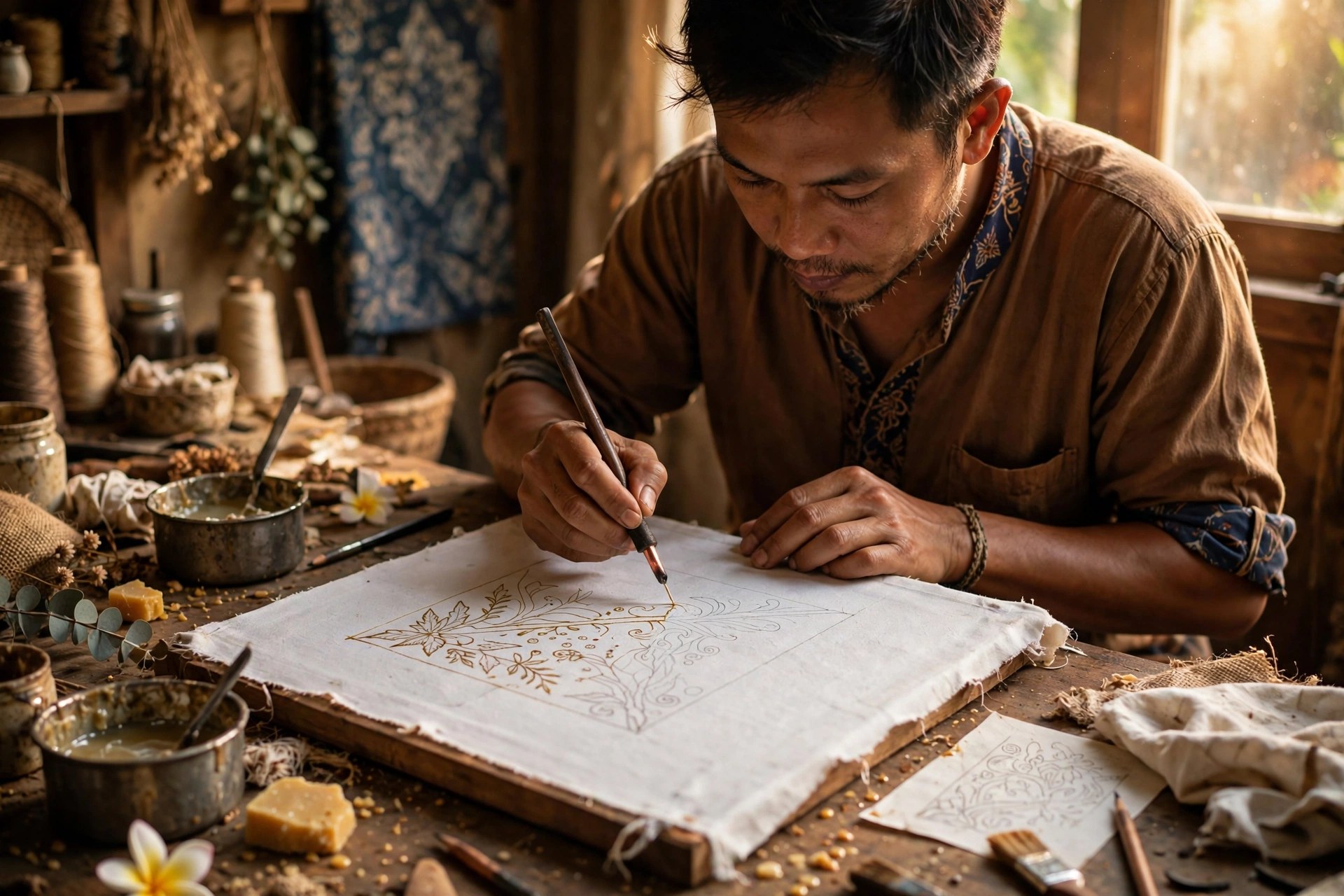
Batik: Writing with Wax
- Draw the design. The motif is sketched on washed cotton or silk, traditionally in pencil or charcoal.
- Apply the wax. For hand-drawn work (batik tulis), a tjanting — a small copper cup with a spout on a handle — draws lines of molten wax that soak into the cloth. For repeat work (batik cap), a copper stamp presses the wax on in one impression, the metal cousin of a wooden printing block.
- Dye the first color. The waxed cloth goes into the dye bath, lightest color first. The waxed areas keep the cloth's original color.
- Build the layers. More wax protects areas that should keep the first color; the cloth is dyed again in the next, darker shade. Complex batik may cycle through many baths.
- Remove the wax. The cloth is boiled or ironed between absorbent layers to strip the wax, revealing all the colors at once — and the fine crackle veins where dye crept into cracks in the wax along the way.
Batik's heartland is Indonesia — Javanese batik is UNESCO-listed cultural heritage — with deep traditions across Malaysia, India, and West Africa, where the imported technique grew into the wax-print aesthetic discussed below.
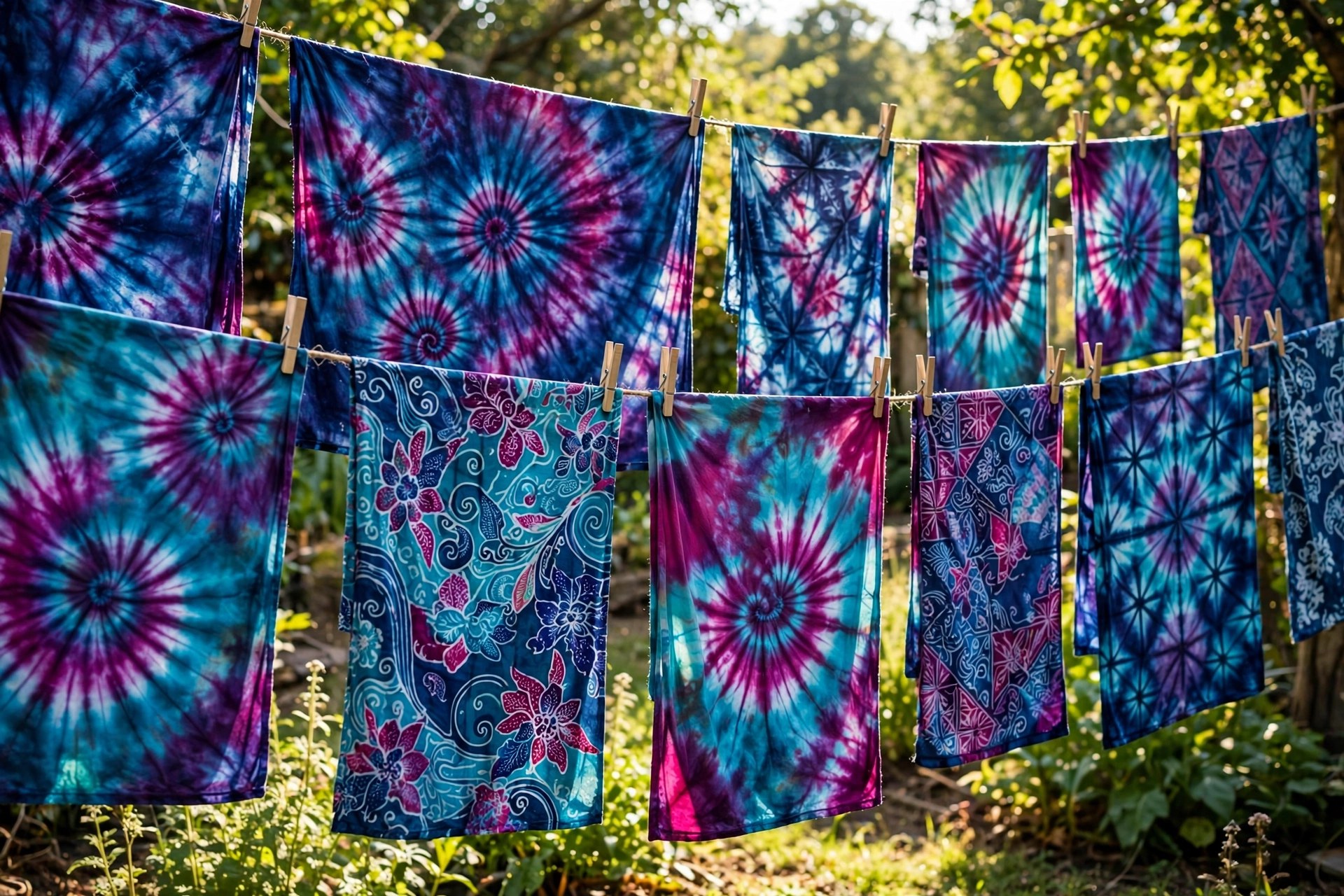
The Binding Family: Tie-Dye and Shibori
No wax at all here — the resist is pressure. Folding, twisting, pleating, stitching, clamping, or tying the cloth squeezes regions so tightly that dye cannot penetrate evenly. Untie after dyeing and the squeezed areas bloom open as pattern: concentric circles where a point was bound, chevrons from accordion folds, spiderwebs from spirals. Japanese shibori systematizes these techniques into named disciplines — stitched (nui), pole-wrapped (arashi), clamped-board (itajime) — each with a characteristic geometry.
Tie-dye's accessibility is its economics: the equipment is string, boards, and dye, so it thrives everywhere from craft studios to small garment workshops, and it returns to fashion in cycles whenever hand-made, one-of-a-kind pattern is in demand. No two pieces are ever identical, which sellers treat as a feature and quality controllers treat as a specification to define loosely.
Paste Resists and Ikat
A third resist family paints or prints a paste — rice paste in Japanese katazome (applied through a stencil), mud and gum mixtures in Indian dabu printing — which is dyed over and washed out. And one step further out sits ikat, where the resist is applied not to cloth but to the yarns before weaving: bundles of threads are bound, dyed, and then woven so the pattern emerges, feather-edged, in the loom. Ikat is resist dyeing rather than printing, but it completes the resist map: wax on cloth, pressure on cloth, paste on cloth, binding on yarn.
The Industrial Echo
The most famous resist-look fabric in the world is mostly not resist at all: "African wax prints" are produced industrially — resin-resist methods in the original Dutch and West African mills, and today mostly rotary screen printing that reproduces the batik crackle and two-sided look at volume. The honest labeling matters commercially and culturally: genuine hand batik is an artisan product priced like one, and printed imitations are a different product that happens to share the pattern language.
More Printing Methods
- Block Printing — batik's partner craft: carved blocks, printed color, shared artisan roots.
- Screen Printing Guide — the industrial method that also reproduces resist looks.
- Rotary Screen Printing — wax-print aesthetics at mill volume.
- Sublimation Printing — all-over pattern on polyester, the modern way.
- Direct to Garment (DTG) — digital garment prints, including tie-dye-look artwork on plain shirts.
- Direct to Film (DTF) — transfers for almost any fabric.
Common Questions
- What is the crackle effect in batik?
- Crackle (called crakeling) is the fine web of dark lines that appears in the light areas of batik. The dried wax coating inevitably cracks as the cloth is handled and dipped, and dye seeps into the cracks, veining the background. Batik makers control it deliberately — flexing or crumpling the waxed cloth for heavy crackle, handling it gently for almost none — and collectors value it as proof of a genuine wax process.
- What is the difference between batik and tie-dye?
- Both are resist methods, but the resist is different. Batik uses hot wax painted or stamped onto the cloth to mask areas from the dye, which allows precise, drawn designs — motifs, lettering, pictures. Tie-dye uses physical binding — folding, twisting, stitching, and tying — to squeeze areas tight enough that dye cannot penetrate, which produces bursts, circles, stripes, and mirrored patterns rather than drawn detail. Japanese shibori is the refined, highly systematic branch of the binding family.
- Can resist patterns be printed by machine instead?
- The look can: mills print wax-look and tie-dye-look designs by rotary screen or digital printing, most famously the "African wax print" fabrics that imitate batik crackle at industrial volume. But those are prints of a resist pattern, not resist dyeing — the color sits on the surface in the usual way. Genuine batik colors both faces of the cloth nearly equally, which is also the classic way to tell the real process from an imitation.
- What fabrics work for batik and tie-dye?
- Natural, absorbent fibers take dye evenly and hold the resist well: cotton and silk are the classic batik grounds, with rayon/viscose also popular for tie-dye garments. Synthetics resist household dyes themselves, so polyester won't take a standard dye bath no matter how it is bound or waxed. Cloth must be pre-washed so sizing and finishes don't act as accidental resists.
Back to the Textile Printing Methods Guide
See how resist methods compare with screens, digital, and transfers in the main methods guide.
Textile Printing Methods Guide