World Textiles & Traditional Crafts · Japan
Shibori: Japan's Shaped Resist
Shibori is what happens when cloth is squeezed, stitched, pleated, wrapped or clamped so tightly that dye cannot reach it — then released to reveal a pattern that is really a record of pressure. This guide covers the six technique families, the indigo vat at the craft's heart, the towns of Arimatsu and Narumi that built an industry on binding cloth, and how to tell hand-bound cloth from a printed imitation.
The Craft
What Shibori Is
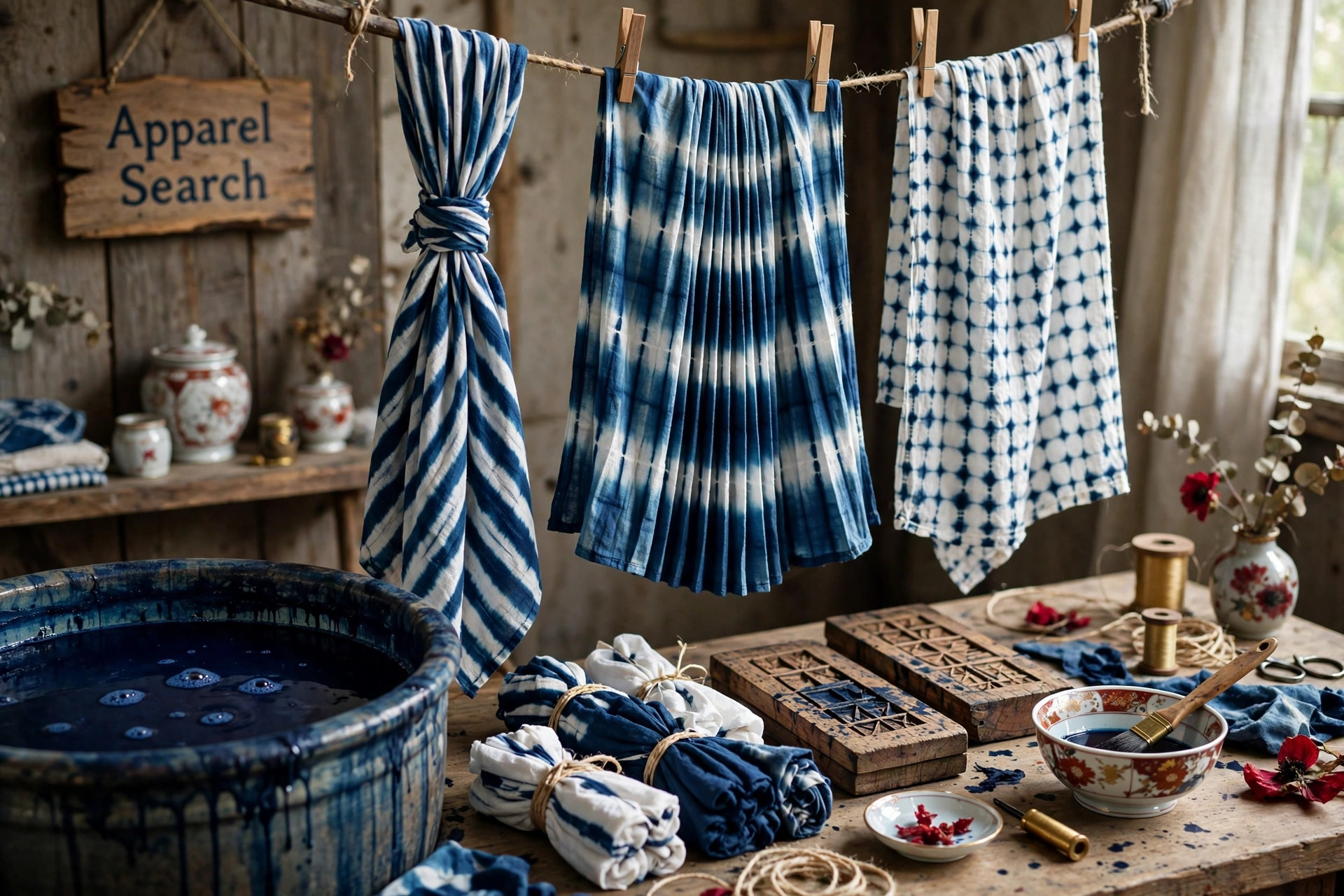
Shibori is a family of resist-dyeing methods, not a single technique. The word comes from the Japanese verb shiboru — to wring, squeeze or press — and that verb is the whole recipe. The dyer first shapes the cloth: pinching it into points, stitching along a drawn line, pleating it into fans, wrapping it around a pole, or folding it between boards. The shaped cloth is bound, tied or clamped so the shaping holds under pressure. Only then does it meet the dye. Where the cloth is compressed, dye penetrates weakly or not at all; where it lies open, it takes the full colour. When the bindings come off, the pattern blooms — pale shapes in a dyed field, every edge softened by the dye that crept under the binding.
That softness is shibori's signature. A shibori pattern cannot be perfectly repeated, because no two bindings compress identically, and skilled dyers treat that controlled accident as the point of the craft. The textile scholar Yoshiko Iwamoto Wada, co-author of the 1983 book Shibori: The Inventive Art of Japanese Shaped Resist Dyeing, summarised the method as patterning cloth by plucking, stitching or folding it and then tightly knotting, binding or clamping it so dye cannot get in. Shibori belongs to the wider resist family mapped in our guide to resist printing and batik — wax on cloth in batik, paste on cloth in katazome, pressure on cloth here — but no other branch developed so precise a vocabulary of named techniques.
History
A Thousand Years of Shaped Resist
Resist-dyed cloth survives in Japan from the eighth century. Fragments preserved in the Shōsōin, the imperial repository at Tōdai-ji temple in Nara — among the treasures donated after the death of Emperor Shōmu in 756 — show bound, wax and clamped resists already in use. Reference works hosted by Columbia University's Japan Architecture and Art Net Users System (JAANUS) describe three early resist kinds: kōkechi, bound resist; rōkechi, wax resist; and kyōkechi, cloth clamped between carved boards. The wax and board methods faded by the early Kamakura period, but bound resist endured — through the stitched splendour of tsujigahana in the sixteenth century, and into the Edo period (1603–1868), when shibori became both a luxury silk art and the everyday patterning of indigo cotton.
The Edo flowering had an economic engine. Sumptuary rules restricted merchant display, and pattern made by hand labour rather than costly woven gold became a legal way to be splendid. At the top of the market, silk kimono cloth could be covered entirely in tiny bound dots — a single garment consuming months of tying by many hands. At the everyday end, indigo cotton shibori clothed working Japan, and the blue-and-white cloth still reads as the shorthand for Japanese summer dress. For the garment that carried this pattern, see our Traditional Dress guide to the kimono of Japan.
Technique
The Six Families
Teaching lists sort shibori into six families; Arimatsu counts a hundred tying variations alone, but these six cover the core vocabulary, and real pieces combine two or three on one cloth.
Kanoko — bound spots
The dyer pinches up a small point of cloth and binds it tightly with thread, point after point, sometimes thousands of times across a bolt. Each binding leaves a small ring or dot — kanoko means “fawn spots,” after a young deer's dappled back. It is the family closest to Western tie-dye, and in its finest silk form among the most labour-hungry textiles ever made.
Miura — looped binding
Instead of knotting each point, the dyer plucks the cloth with a small hooked needle and loops thread around each plucked section in a continuous run, with no knots at all. The loops hold by tension, so a finished piece can be undone by pulling the thread's end. Miura's flowing, watery lines made it a workhorse for everyday cloth.
Kumo — pleated webs
Cloth is pleated into fine, even folds and bound at measured intervals, sometimes around a core. Opened out, the bindings read as radiating webs, starbursts or concentric rings — kumo means “cloud” and echoes the spider-web look of its best-known patterns. Precision lives in the pleating: uneven folds print as uneven webs.
Nui — stitched resist
A running stitch is sewn through the cloth along a drawn design, then pulled tight so the cloth gathers into dense puckers along the stitch line before dyeing. Nui is the most drawing-like family: curves, outlines and pictorial motifs are all possible, because the needle can go anywhere a pencil can. It is also the slowest to prepare.
Arashi — pole-wrapped
Cloth is wrapped diagonally around a pole, bound with thread from end to end, then pushed down the pole so it compresses into tight pleats. Dyed and unwrapped, it carries bold diagonal stripes — arashi means “storm,” and the slashing lines earn the name. The pole's diameter and wrap angle set the scale of the storm.
Itajime — board-clamped
Cloth is folded — often into triangles or squares, origami-fashion — and clamped firmly between two shaped boards, then dyed. The boards shield their exact shape, so itajime produces shibori's crispest geometry: repeated diamonds, hexagons and chevrons in mirror symmetry. It descends from the kyōkechi board-resist preserved in the Shōsōin.
The Dye
Indigo, the Classic Dye
Shibori can be dyed in any colour, and luxury silk work used many — safflower red among them. But the dye that made shibori a national cloth is indigo, ai in Japanese. A traditional indigo vat is a living, fermented brew built from composted indigo leaves (sukumo); the cloth enters the vat yellowish green and turns blue in the air as the dye oxidises on the fibre. Depth is built dip by dip, so a dyer can stop at powder blue or keep going to a blue almost black. Indigo suited shibori perfectly: it dyes by immersion, holds fast on cotton — the fibre of everyday shibori — and its graduated blues display the contrast between bound and unbound cloth, the entire visual content of the pattern, better than any flat colour could. The home-craft descendant of this vat work is covered in our tie-dye patterns and techniques guide.
Place
Arimatsu and Narumi
One town turned shibori from a scattered craft into an industry. Arimatsu, now a district of Nagoya in Aichi Prefecture, dates its shibori trade to 1608, when — the town's tie-dyeing museum, the Arimatsu Narumi Shibori Kaikan, records — Takeda Shokuro and other pioneers set up the business on the Tōkaidō, the great road between Kyoto and Edo. The location was the business plan: travellers on Japan's busiest road bought shibori cotton as gifts and summer wear, and the town organised itself around their demand. Households specialised by technique — one street's families tying kanoko, another's stitching nui — and neighbouring Narumi shared the trade so closely that the two names are still spoken as one: Arimatsu-Narumi shibori. Utagawa Hiroshige's woodblock prints of the Tōkaidō showed the shops and their hanging cloth to the whole country — the prints label the scene Narumi, although the cloth sold was Arimatsu's — and Aichi Prefecture lists Arimatsu Narumi shibori as a designated traditional craft, recognised on 4 September 1975. The district survives as a preserved streetscape of dyers' houses, workshops and its museum, and its annual shibori festival still draws visitors each June.
Distinctions
Shibori Is Not Kasuri
The two Japanese resist arts most often confused are shibori and kasuri, and the difference is a single question: when is the resist applied? Shibori resists finished cloth — the bolt is woven first, then shaped, bound and dyed. Kasuri resists yarn — bundles of warp or weft thread are bound and dyed before weaving, and the pattern exists only as coloured sections inside the yarn until the weaver aligns them on the loom. That is why kasuri motifs feather at the edges: woven threads never sit with machine perfection, so the stored pattern trembles as it assembles. Kasuri is Japan's branch of the worldwide ikat family, covered in full in our ikat definition. A field test follows: shibori often keeps a faint pucker from binding, while kasuri patterns run through the yarn and show on both faces of a flat cloth.
| Question | Shibori | Kasuri (ikat) |
|---|---|---|
| Resist applied to | Woven cloth, before dyeing | Yarn bundles, before weaving |
| Pattern appears when | Bindings are removed after dyeing | Dyed yarn sections align on the loom |
| Edge character | Soft halo where dye crept under binding | Feathered step where threads shift in weaving |
| Surface feel | Often faintly puckered at bound points | Flat; pattern is structural |
Acquiring
Buying and Collecting
Honest shibori announces itself. Turn the cloth over: because the dye bath surrounded the whole fabric, a genuine piece shows its pattern nearly as strongly on the back as on the front, while a shibori-look print is pale on the reverse. Run a finger across bound-dot work and you may feel the slight pucker where the bindings squeezed the cloth. Expect — and value — small irregularities: a dot that leans, a web that breathes unevenly. Mechanical exactness across a long repeat is the fingerprint of a print, not of hands. Price follows labour: itajime and simple arashi are the most affordable hand-dyed families; fine nui stitchwork and dense hand-tied kanoko on silk sit at the top, because the tying hours are countable in the pattern. Sellers should say which family a piece is, whether the dye is natural indigo or synthetic, and whether the cloth is hand-dyed or printed — a reputable dealer answers all three without hesitation. Vintage pieces reward the usual checks: hold silk to the light for weak spots, and check underarm and fold lines first.
Today
Shibori in Fashion Now
Shibori's modern life runs on two tracks. In Japan, Arimatsu and Kyoto workshops still produce yukata, kimono cloth, scarves and interior textiles by hand, taught and exhibited as living heritage. Internationally, the techniques entered contemporary textile art after Yoshiko Wada's 1983 book introduced them to English-speaking makers, and they have cycled through fashion ever since — surfacing whenever designers want pattern with visible evidence of the hand: indigo shibori denim, stitched-resist dresses, board-clamped geometric silks. Fashion also sells much shibori-look printing, a legitimate fabric but a different product, priced and labelled as print rather than dyeing. Knowing the six families lets a buyer tell which of the two they are holding.
Common Questions
Common Questions
What is shibori?
Shibori is Japan's family of shaped-resist dyeing techniques. Cloth is bound, stitched, pleated, wrapped around a pole or clamped between boards before dyeing, so the compressed areas resist the dye and the pattern appears when the bindings are removed. The word comes from the verb shiboru, to wring, squeeze or press.
What is the difference between shibori and tie-dye?
Shibori is the older, systematised Japanese discipline behind much of what the West calls tie-dye. Western tie-dye usually means rubber-banded spirals and bursts; shibori sorts the same physical idea into named families — kanoko, miura, kumo, nui, arashi and itajime — each with its own tools, geometry and centuries of workshop practice behind it.
What is the difference between shibori and kasuri?
Timing. Shibori resists finished, woven cloth: the pattern is made on the cloth before dyeing. Kasuri, Japan's form of ikat, resists the yarn before weaving: bundles of thread are bound and dyed first, and the pattern only appears as those dyed sections align on the loom, which gives kasuri its soft, feathered edges.
Why is shibori usually blue?
Because its classic dye is indigo. Fermented indigo vats suit immersion dyeing, build colour dip by dip, and hold fast on cotton, so indigo-and-white became shibori's signature during the Edo period. Shibori is also worked in other dyes, including safflower red on silk, but blue remains the colour most buyers meet first.
How can I tell hand-dyed shibori from a print?
Look at the back and feel the cloth. In genuine shibori the dye has passed through the fabric, so the pattern shows almost as strongly on the reverse, and bound areas often keep a slight puckered texture from the compression. A shibori-look print sits on the surface, is flat and even, and usually repeats with mechanical exactness.
Keep Exploring
More to Explore
Sibling Textile Guides
World Textiles & Traditional Crafts
The section hub — every world textile guide, from Bengal's jamdani to Mali's mudcloth.
Visit the hub ↑Yuzen & the Kimono Silk Arts
Japan's other great dye art: rice-paste painting, the Kyo and Kaga schools, and Nishijin weaving.
Read ↑Bandhani: India's Tied Dots
The pinch-tied dot tradition of Kutch and Rajasthan — shibori's closest Indian cousin.
Read ↑The Garment Partner
The Kimono of Japan
The garment shibori cloth becomes — its types, formality and wearing, in our Traditional Dress series.
Read ↑Japan Clothing Industry
Japan's apparel and textile industry directory — the modern industry behind the traditional craft.
Explore ↑Definitions & Technique Partners
Resist Printing & Batik
The full resist map — wax, paste, binding and yarn resists compared in the Printing Methods series.
Read ↑Ikat Definition
Kasuri's worldwide family: pattern dyed into the yarn before weaving, defined in depth.
Read ↑Tie-Dye Patterns & Techniques
The home-craft side of binding and dyeing — patterns and techniques to try at the kitchen table.
Read ↑