World Textiles & Traditional Crafts · Gujarat & Rajasthan
Bandhani: India’s Tied Dots
Bandhani is pattern made by refusing dye. Across Kutch and Saurashtra in Gujarat and across Rajasthan, a length of fine cloth is pinched up — point by point, thousands of times — and each tiny peak is wound tight with thread. Only then does the cloth meet the dye vat. Where the thread binds, the dye cannot reach, so when the knots are finally pulled open the cloth blooms with dots: single specks gathered into flowers, bells, elephants and dancing figures, each dot a small act of patience done weeks earlier at a kitchen table. This guide follows the tied dot through its whole life — the Khatri dyers who built the craft, the long tying and the staged dye baths, the bridal reds and the wave-striped cousin called leheriya, and how to tell a hand-tied cloth from the printed imitations that copy its face and miss its soul.
The Craft
Tie First, Dye After
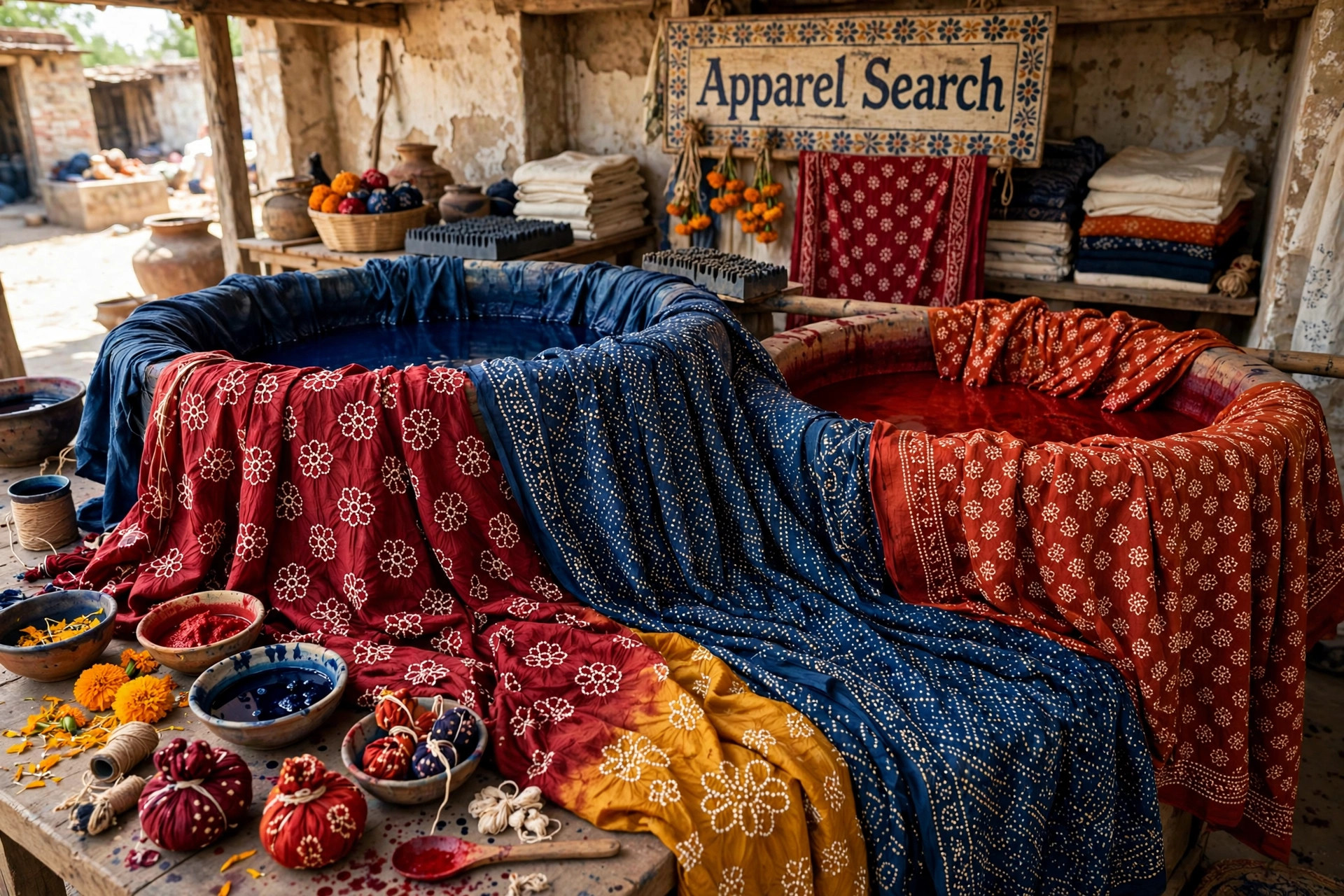
Bandhani is a resist dyeing: instead of adding pattern on top of finished cloth, the artisan protects parts of the cloth from the dye, and the pattern is what the dye leaves behind. The word itself says how — bandhani and its twin bandhej come from the Sanskrit root bandh, to bind or tie. A single tied dot is called a bheendi (also spelled bhindi) in Kutch; four dots together make a counting unit, a kadi, and tyers have traditionally been paid by the kadi — a reminder that the unit of this craft is not the metre but the knot.
The sequence is unvarying and unforgiving, because a mistake tied in cannot be untied out of the colour. The cloth — fine cotton, silk or georgette — is washed and prepared, and the design is marked through a perforated stencil dusted with geru, a fugitive red-earth pigment, or with blocks, so the tyer knows where every dot belongs. Then comes the tying itself, overwhelmingly women’s home-based work: each point of cloth is plucked up with the fingernails and bound round and round with thread until it forms a hard little peak. Rajasthani tyers have traditionally grown the little-finger nail long, or worn a small pointed metal ring, to lift the points; Gujarati tying is described in the craft’s own Geographical Indication filings as largely bare-handed work. A simple piece may take days; a fine, dense sari can occupy a tyer for weeks — filings for the craft record tying times from a few days to as long as ninety days for a single piece.
Dyeing is staged, lightest colour first, and it is a puzzle worked backwards. For a multi-coloured design, the cloth may be dyed yellow first; the dots that must stay yellow are then tied off, other areas are discharged or left open, and the cloth enters the next, deeper bath — and so on, colour by colour, until the final ground colour, often the famous deep red of Jamnagar or a rich maroon, green or black. The cloth dries with its knots still closed. Only at the very end is it pulled firmly crosswise, so that thousands of bindings snap open at once and the pattern reveals itself in a single gesture — the moment every bandhani maker works toward.
The Makers
Kutch, Jamnagar and the Khatri Dyers
Bandhani’s map is the dry northwest of India. In Gujarat, the great centres are Kutch — Bhuj, Mandvi, Anjar and the villages around them — and Saurashtra, above all Jamnagar, with Rajkot and Jetpur nearby. Jamnagar is so identified with the craft that its red bandhani is a byword, credited locally to the quality of its water; a fifteenth-century Gujarat text already names Mandvi for its dyed odhnis, the veils that remain bandhani’s classic form alongside the sari. In Rajasthan the tying and dyeing spread through Jaipur, Jodhpur, Bikaner, Sikar, Udaipur and Ajmer, each with its own palette and habits. Both Kutch Bandhani and Jamnagari Bandhani hold registered Geographical Indication (GI) status in India — legal recognition that the name belongs to its place and its makers.
The makers, historically and still, are above all the Khatri community — dyers by hereditary occupation, Muslim and Hindu Khatri families alike — who are credited in Gujarat tradition with bringing the craft into Kutch from Sindh. Around them works a whole ecology of hands: the women and girls who tie at home, the dyers (in Rajasthan often Rangrez) who run the vats, the merchants who commission, mark and finish. That division is the craft’s economics in miniature. Tying is the most time-hungry stage and the worst paid per hour; dyeing and trading carry the visible skill and the margin. Any honest account of bandhani has to hold both truths: it is one of the world’s most exquisite uses of a dot, and it rests on an enormous amount of patient, low-paid handwork — which is precisely why the printed imitation, flat and fast, is such a threat, and why the GI names and maker-led brands matter.
Patterns
A Language of Dots
Because the dot is the only mark, bandhani’s artistry lies in arrangement — and its arrangements have names, handed down in workshops, not pattern books:
- Ekdali — the single dot
- The simplest unit used as a design in itself: one dot, repeated in a regular field. Its restraint is its elegance, and on a fine ground it shows off the tyer’s evenness better than any flourish.
- Trikunti, satbandi and the counted groups
- Small counted clusters — three knots, seven dots and their relatives — that build the texture of borders and fields between the larger figures.
- Shikari / shikargah — the hunt
- Figurative scenes built entirely from dots: animals, birds, hunters and human figures. Shikari is the master-tyer’s showpiece, proof that a pointillist language can carry narrative.
- The auspicious figures
- Elephants, peacocks, parrots, flowering shrubs, dancing women, mango and lotus forms recur across bridal and festive cloth, carrying the usual auspicious freight of Indian textiles — prosperity, fertility, joy — in dotted form.
- Chunri and the named cloths
- Finished cloths carry their own names: chunri (chundadi), the dotted veil; khombi, a shawl form; chandrakhani, red-and-black odhnis traditionally associated with Muslim brides; and the gharchola, treated below. In Tamil Nadu the same tied-dot family is known as sungudi, and as chunri in Pakistan — one technique, many regional dialects.
Colour speaks as loudly as pattern. The classic palette — yellow, red, green, blue, black and maroon — is a social language: red above all for marriage, yellow for spring and new mothers, saffron with renunciation, black and maroon with mourning. A knowledgeable reader in Kutch does not just admire a bandhani odhni; she reads it.
The Bridal Cloth
Gharchola: A Grid of Gold and Dots
The summit of Gujarati bandhani is the gharchola: a bridal cloth, traditionally in deep red silk or cotton-silk, woven through with a checked grid of gold zari thread, and then tied so that every square of the grid holds its own dotted motif — an elephant in one, a peacock in the next, a dancer, a parrot, a flowering shrub. The grid is counted in sections, traditionally twelve (bara bhaag) or fifty-two (baavan bhaag), and the finished cloth is at once a weave, a tie-dye and a picture gallery. It is given to a bride and worn for the wedding and the ceremonies around it, which is why, in Gujarat, bandhani and marriage are almost synonyms — and why this guide, which is about cloth, points you to our partner guide for the wearing itself: the sari of India tells the garment story, including the drapes these cloths are worn in. Here it is enough to say that the gharchola is made to be seen spread across the front of a drape, its grid displayed like a jewel case.
Bandhani’s age is part of its prestige. Dotted garments appear in the sixth-century paintings of Ajanta’s Cave 1, in scenes of the Buddha’s life — the earliest widely cited visual evidence of the tied-dot pattern — and the seventh-century Harshacharita of Bana describes tied-and-dyed cloth in a royal wedding context, a reference the craft’s own GI filings still cite. Claims that push dyeing in the Indus Valley back to 4000 BCE are often repeated for bandhani as a whole; the careful statement is narrower — dyeing is ancient in the region, dotted cloth is clearly visible by Ajanta’s time, and the living Kutch–Rajasthan tradition traces its documented families and centres over the last several centuries, with Khatri migration from Sindh at its root.
The Cousin
Leheriya: The Wave Beside the Dot
No account of bandhani is complete without separating it from its striped cousin, because the two are sold side by side and confused constantly. Leheriya makes stripes, not dots. The cloth is rolled diagonally into a long rope, bound tightly at intervals along the roll, and dyed; opened out, the resist reads as continuous diagonal waves running across the cloth — lehar is the Hindi word for a wave, and the name is exact. A second rolling and binding at the opposite angle, with a second colour, produces the checked wave-crossing called mothra. Leheriya is Rajasthan’s speciality, centred on Jaipur and Jodhpur and traditionally worked on light cottons and fine georgettes in turban cloths and odhnis of extraordinary brightness. Bandhani ties points; leheriya ties a roll. Once that single mechanical difference is clear, the two cloths never blur again — and our resist printing and batik guide places both in the wider resist family, while the tie-dye patterns guide shows the home dyer’s version of the same binding logic at a kitchen table.
Buying Honestly
Spotting Real Bandhani
The tests are tactile. First, feel for the pucker: genuine bandhani is traditionally sold unpressed, and your palm should find a fine, irregular crinkle where every knot sat — a texture no iron has flattened and no print can fake. Second, turn it over: because the dye bath went through tied cloth, the pattern reads almost as strongly on the reverse as on the face; a surface print is pale behind. Third, look closely at the dots: hand-tied dots vary — a fraction larger, smaller, softer — and that breathing irregularity is the signature of the fingernail and the thread. Perfect, identical dots in perfect rows are a screen’s work.
Then ask the commercial questions. What fibre — silk and cotton bandhani are both traditional, but should be priced and labelled differently. Where was it tied — Kutch Bandhani and Jamnagari Bandhani are GI-registered names, and a seller using them should say why. And how fine is the tying: dot density is labour, and labour is the honest core of the price. Contemporary designers have carried bandhani into jackets, dresses and scarves for international runways, and the best of that work commissions tying at traditional fineness rather than printing the look. Bought that way — real knots, named makers, fibre declared — a bandhani cloth is several weeks of a tyer’s life, opened in a single pull.
Common Questions
Common Questions
What is bandhani?
Bandhani — also called bandhej — is a resist-dyeing craft from Gujarat and Rajasthan in which thousands of tiny points of cloth are pinched up and tied tightly with thread before dyeing. Each tie keeps the dye out, so when the thread is removed the cloth is patterned with small dots of the earlier colour. The word comes from the Sanskrit bandha, to tie.
What is the difference between bandhani, bandhej and chunri?
They are regional names for closely related things. Bandhani and bandhej name the same tied-dot craft and cloth, with bandhej common in Gujarat usage. Chunri (chundadi) names a dotted cloth or veil — typically a bandhani odhni with dotted patterns — and is also the word used for the craft in Pakistan. The technique is the same family throughout: tie first, then dye.
How is bandhani different from leheriya?
Bandhani ties points; leheriya ties a roll. In bandhani, thousands of separate pinched points are tied, giving dots. In leheriya, the cloth is rolled diagonally into a rope and bound at intervals along the roll, giving continuous diagonal stripes — its name comes from lehar, a wave. Leheriya is a Rajasthani speciality, strongly associated with Jaipur and Jodhpur.
How can you tell real bandhani from a print?
Feel and look. Real bandhani keeps a fine, irregular pucker where each knot sat and is traditionally left unpressed, with a lightly crinkled hand; its dots vary slightly and the pattern reads almost as strongly on the reverse as on the face, because the dye went through the cloth. A print is flat, perfectly regular, and much paler on the back.
What is a gharchola?
A gharchola is a bridal bandhani cloth of Gujarat, traditionally red, woven with a checked grid of gold zari thread and tied with a different dotted motif inside each square — elephants, peacocks, dancers, flowering shrubs. Grids are traditionally counted in sections, such as twelve (bara bhaag) or fifty-two (baavan bhaag). It is given and worn for weddings, which is why red bandhani is so closely tied to marriage.
Keep Exploring
More to Explore
Sibling Textile Guides
Kantha: Bengal’s Stitched Cloth
Running stitch on layered old saris — India’s other great household cloth tradition.
Read ↑Jamdani: Bengal’s Woven Air
Figured muslin woven thread by thread around Dhaka, UNESCO-listed in 2013.
Read ↑Shibori: Japan’s Shaped Resist
Japan’s systematic binding family — bandhani’s disciplined Pacific cousin.
Read ↑Traditional Dress Partner
India — The Sari
How these cloths are worn: the sari’s drapes, regions and occasions, in full.
Read ↑World Textiles Hub
Every guide in this series, plus the cloths Apparel Search already covers elsewhere.
Visit the hub ↑Resist & Technique Partners
Search Apparel Search