What DTF Printing Is
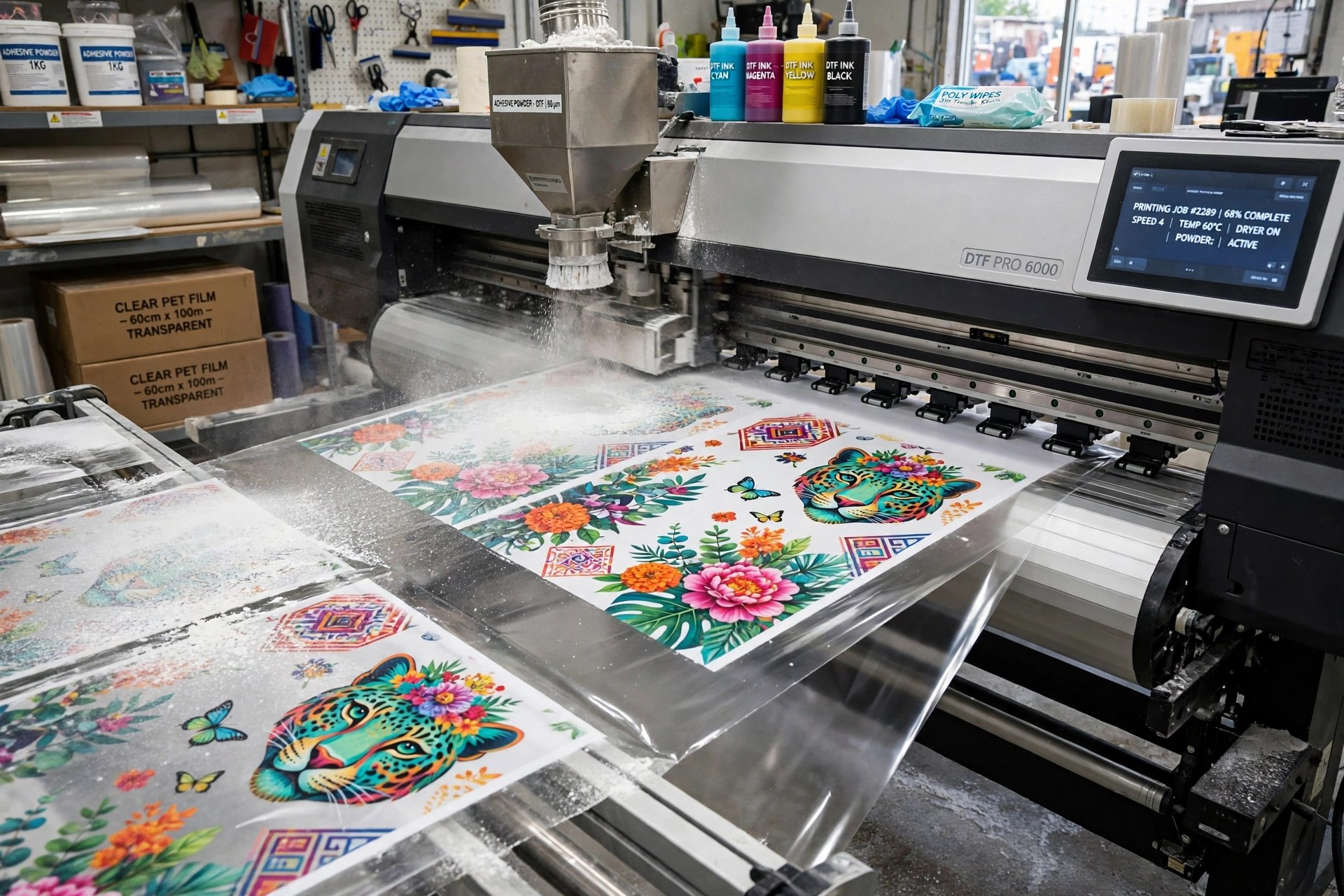
Direct to film printing prints a design with water-based pigment inks onto a coated PET film, coats the wet ink with a hot-melt adhesive powder, cures it — and stops. The result is a finished transfer that can be stored, sold, or shipped, and heat-pressed onto a garment in about fifteen seconds whenever it is needed. In the Textile Printing Methods Guide family tree, DTF belongs with the heat transfer methods — but unlike older transfer papers, it needs no weeding, no pretreatment, and no particular fabric.
That decoupling — print centrally, press anywhere — is why DTF grew so fast. A transfer business can print gang sheets for dozens of customers; a small brand can keep a drawer of transfers and press garments to order with nothing but a heat press.
The DTF Process
- Print. The design prints mirror-image onto film: CMYK color first, then a white ink layer over the whole design (the printer lays it in one pass, color then white). The white layer makes the print opaque on any garment color.
- Powder. While the ink is wet, fine hot-melt adhesive powder is applied over the sheet and the excess shaken off. The powder sticks only to the ink.
- Cure. The sheet passes through a dryer or under a hover press until the powder melts and gels — the transfer is now dry, stable, and storable.
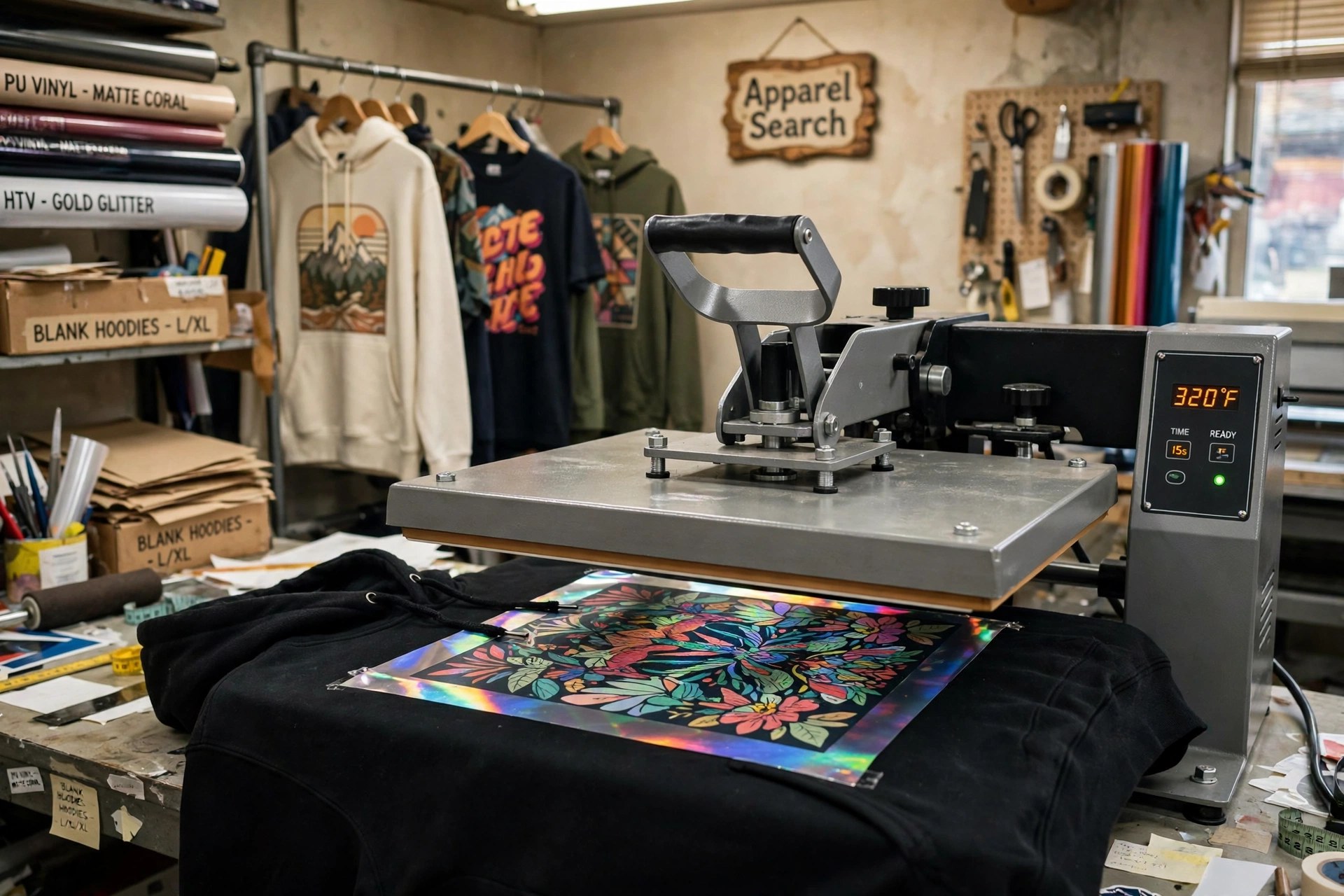
- Press. The transfer is positioned on the garment and pressed — typically around 150–165°C (300–330°F) for 10–15 seconds — then the film is peeled (warm or cold depending on the film type).
- Second press. A brief second press with a finishing sheet settles the transfer into the fabric, improves wash durability, and takes the shine off.
Why DTF Spread So Fast
- Fabric freedom. Cotton, polyester, blends, nylon, denim, fleece, caps, bags — the adhesive does not care what fiber is underneath. No pretreatment, no ink-fiber matching of the kind digital printing demands.
- Transfers are inventory. Print in efficient batches, stock the transfers, press on demand. A design can be printed in one city and applied in another.
- Fine detail and small text. Because there is no weeding, tiny lettering and intricate designs that defeat cut vinyl are routine.
- Low entry cost. A converted or purpose-built printer plus a heat press starts a business; no screens, no dryer tunnel full of shirts.
- Gang sheet economics. Nesting many designs on one sheet of film spreads the print cost across every job on it.
The Honest Limits
- Hand feel. The design is a thin film bonded on top of the fabric. It is softer and stretchier than early transfers, but a large solid print feels like a layer — unlike DTG on a light shirt or a water-based screen print, which live in the fabric.
- Breathability. A solid transfer seals the fabric under it; big prints on sportswear can feel clammy. (For polyester sportswear, sublimation still wins — it adds nothing at all.)
- Durability is good, not supreme. Well-made DTF withstands dozens of washes, but edges can eventually lift if pressing or curing was sloppy. Process discipline is everything.
- Very long runs. Pressing piece by piece cannot match an automatic screen press once quantities climb into the many hundreds of identical prints.
DTF vs. DTG vs. Screen
DTG prints directly on cotton with the softest digital hand, but only on cotton and only at the printer. Screen printing owns long runs and effect inks. DTF sits between and beyond them: slightly more film feel than DTG, far more fabric freedom than either, and a transfer that waits patiently in a drawer for the order to arrive. Choosing is a routing question — fabric, quantity, and hand-feel expectations — and the methods comparison table in the main guide lays the three side by side.
More Printing Methods
- Direct to Garment (DTG) — straight onto cotton, no film, no transfer.
- Screen Printing Guide — the volume workhorse DTF defers to at long runs.
- Sublimation Printing — zero hand feel on polyester sportswear.
- Heat Transfer Printing — the wider transfer family DTF belongs to.
- Rotary Screen Printing — yardage printing at mill scale.
- Block Printing — hand printing, artisan style.
Common Questions
- What fabrics can DTF print on?
- Nearly all of them. Because the design is carried on film and bonded with a hot-melt adhesive layer, DTF transfers adhere to cotton, polyester, blends, nylon, denim, fleece, and even many hard-to-print items like caps and bags. That fabric freedom — no pretreatment, no fiber matching — is the main reason DTF spread so quickly through garment decoration.
- How long do DTF transfers keep before pressing?
- Properly cured and stored flat, dry, and out of humidity, finished DTF transfers keep for months — commonly six months or more — before pressing. That shelf life is a core advantage: transfers can be printed in efficient batches, stocked, shipped, and pressed onto garments on demand.
- Does DTF feel like a sticker on the shirt?
- DTF has a noticeable film feel compared with a water-based screen print or a DTG print on a light shirt, especially over large solid areas. Modern films and powders have made transfers thinner and stretchier than early versions, and small-to-medium chest designs feel unobtrusive, but a full-front solid design will always feel like a layer, because it is one.
- What is a gang sheet?
- A gang sheet arranges many designs — different sizes, different jobs — nested together on one length of film so the printer's width and run are fully used. Because DTF is priced largely by film area, ganging designs together is the main cost lever: a sheet packed with chest logos, sleeve prints, and neck labels costs little more to print than a sheet carrying one large design.
Back to the Textile Printing Methods Guide
Compare DTF with every other printing method — fabrics, run lengths, hand feel, durability, and cost — in the main guide.
Textile Printing Methods Guide