What DTG Printing Is
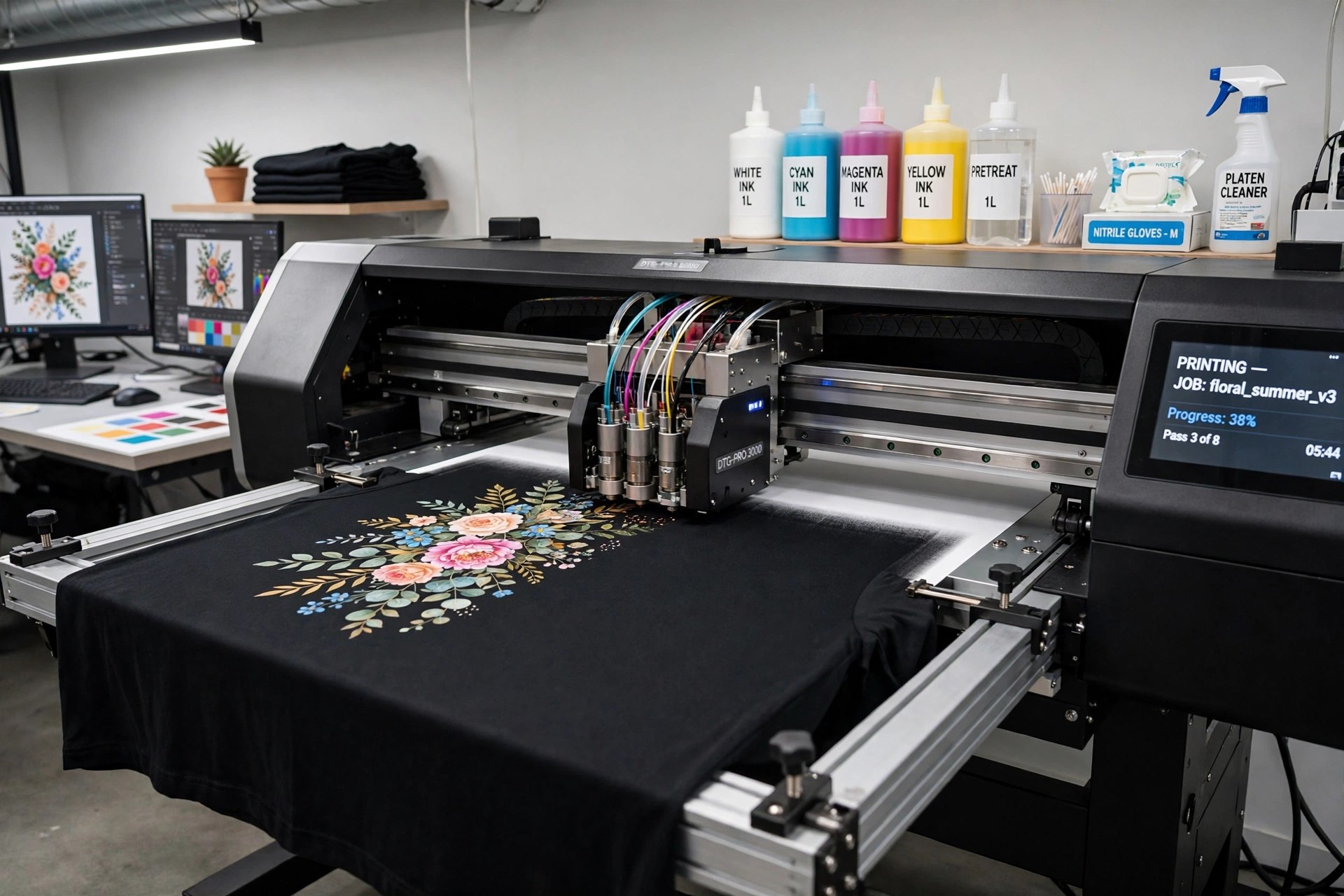
Direct to garment printing uses a purpose-built inkjet printer to print a design straight from a digital file onto a finished garment. In the landscape of the Textile Printing Methods Guide, DTG is the purest digital method: no screens, no films, no transfers — load the shirt, print it, cure it, ship it. It is the technology that made print-on-demand possible, because the cost of printing one shirt is essentially the cost of printing the fiftieth: a little ink and a few minutes.
DTG handles photographic detail and unlimited colors in a single pass, which is exactly what screen printing finds hardest. In exchange, it is tied to cotton, it is slow per piece compared with an automatic screen press, and its quality lives or dies on one unglamorous step: pretreatment.
The DTG Process
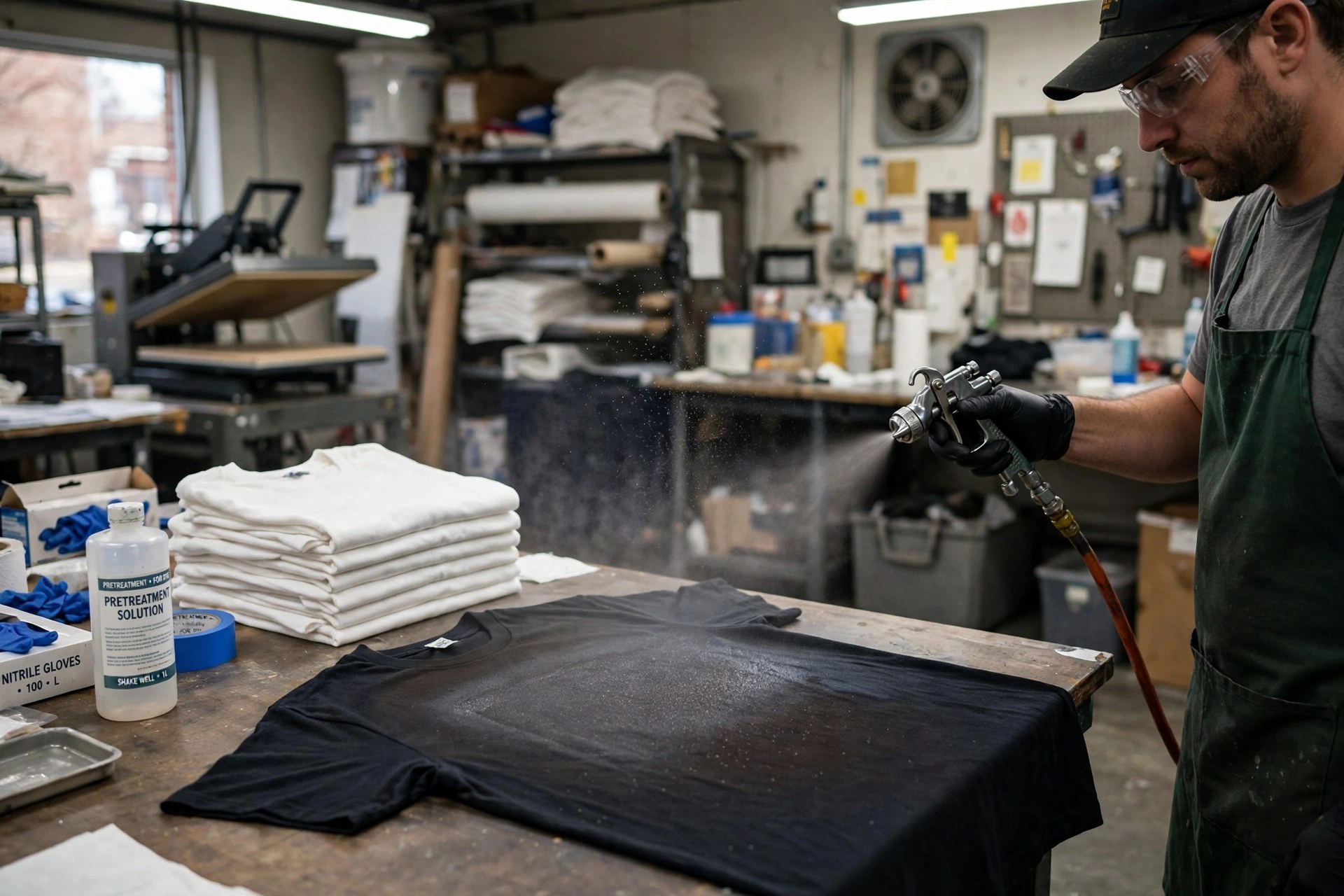
- Pretreat. The print area is coated with pretreatment solution — sprayed by machine or hand, or rolled on — then dried and heat-pressed flat. On dark garments this step is mandatory: it keeps the ink on the surface and lets the white layer below the colors do its job.
- Load. The garment is dressed onto the printer's platen, smoothed and squared. Wrinkles and stray fibers print exactly as they sit, so operators hoover and lint-roll as they go.
- Print. On dark garments the printer first lays a white underbase, then the CMYK color layer on top. On white and light garments it prints color only. A detailed A3-size print takes roughly one to three minutes.
- Cure. The print is fixed with a heat press or conveyor dryer. Undercured DTG washes out fast; properly cured, it settles into the fibers and softens with washing rather than cracking.
Where DTG Shines
- Print-on-demand and one-offs. No setup means a single shirt is a rational order. Online stores print after the sale, holding no printed inventory.
- Photographic and high-color artwork. Gradients, skin tones, and forty-color illustrations print in one pass at no extra cost per color.
- Short runs and sampling. A designer can hold a real printed sample within the hour, and small brands can test designs before committing to screens.
- Personalization. Every garment can carry a different name, photo, or variant — impossible economics for screens.
Where DTG Struggles
- Polyester and synthetics. Standard DTG inks are made for cotton and high-cotton blends. On polyester, use sublimation (light garments) or DTF transfers.
- Speed at volume. One garment at a time, a minute or more each, cannot chase an automatic screen press printing hundreds per hour. Long runs of one design belong to screens.
- Dark-garment brightness and cost. The white underbase uses the most ink and the most time; large dark prints are DTG's most expensive output, and print quality depends heavily on pretreatment discipline.
- Placement. DTG prints flat, single areas within the platen's size. All-over prints, sleeves, and seams are transfer or yardage territory.
For the wider digital picture — roll-to-roll printing of yardage as well as garments — see our digital textile printing guide.
DTG vs. Screen vs. DTF
Against screen printing, DTG trades speed and spot-color punch for zero setup and unlimited color. Against direct to film, DTG prints straight onto the garment with a softer result on cotton, while DTF prints a transfer that can wait on a shelf, ship across the country, and press onto fabrics DTG cannot touch. Many shops run all three: DTG for cotton one-offs, DTF for blends and caps, screens for volume.
One caution unique to digital: because DTG can reproduce any image perfectly in minutes, it is the method most often used to print artwork the printer has no right to use — customer-uploaded photos, logos, and characters. The liability lands on the seller. Our Fashion Law & Intellectual Property Guide covers copyright in printed designs and what print-on-demand sellers should check before pressing print.
More Printing Methods
- Screen Printing Guide — screens, inks, and the run lengths where the workhorse wins.
- Direct to Film (DTF) — print now, press later, onto almost any fabric.
- Sublimation Printing — the polyester answer to DTG's cotton limit.
- Rotary Screen Printing — how printed yardage is made at mill scale.
- Block Printing — hand printing for artisan and boutique production.
- Resist Printing & Batik — wax, binding, and dye: pattern by resistance.
Common Questions
- Why does DTG need pretreatment?
- DTG inks are water-based pigment inks. On untreated cotton the ink soaks down into the fibers and the print looks dull and washes poorly. Pretreatment is a coating sprayed or rolled onto the print area that keeps the ink sitting up on the surface, and on dark garments it also reacts with the white underbase so colors stay bright. Light garments sometimes print without it; dark garments always need it.
- Does DTG work on polyester?
- Standard DTG is a cotton technology: its inks are formulated for natural fibers, and results on polyester are usually poor — dull, and prone to dye migration. Print polyester with sublimation if the garment is white or light, or with DTF transfers, which adhere to polyester well. Some newer machines and ink sets claim better polyester results, but it remains the exception, not the rule.
- How long does a DTG print last?
- A properly pretreated and cured DTG print on cotton typically survives dozens of washes with gradual softening of the image rather than cracking. It is not as bulletproof as a well-cured plastisol screen print or sublimation, and harsh washing — hot water, tumble drying, bleach — shortens its life. Wash DTG garments inside out, cool, and line-dry for the best results.
- DTG or screen printing: which is better?
- Neither — they own different jobs. DTG is better for one-offs and short runs, photographic artwork, and print-on-demand where every shirt can be different and there is no setup to pay for. Screen printing is better for longer runs of the same design, exact spot colors, dark garments at volume, and special-effect inks. Most modern print shops run both and route each order by quantity and artwork.
Back to the Textile Printing Methods Guide
See where DTG fits among all the methods — fabrics, run lengths, hand feel, durability, and cost compared.
Textile Printing Methods Guide