Screen Printing, Made Continuous
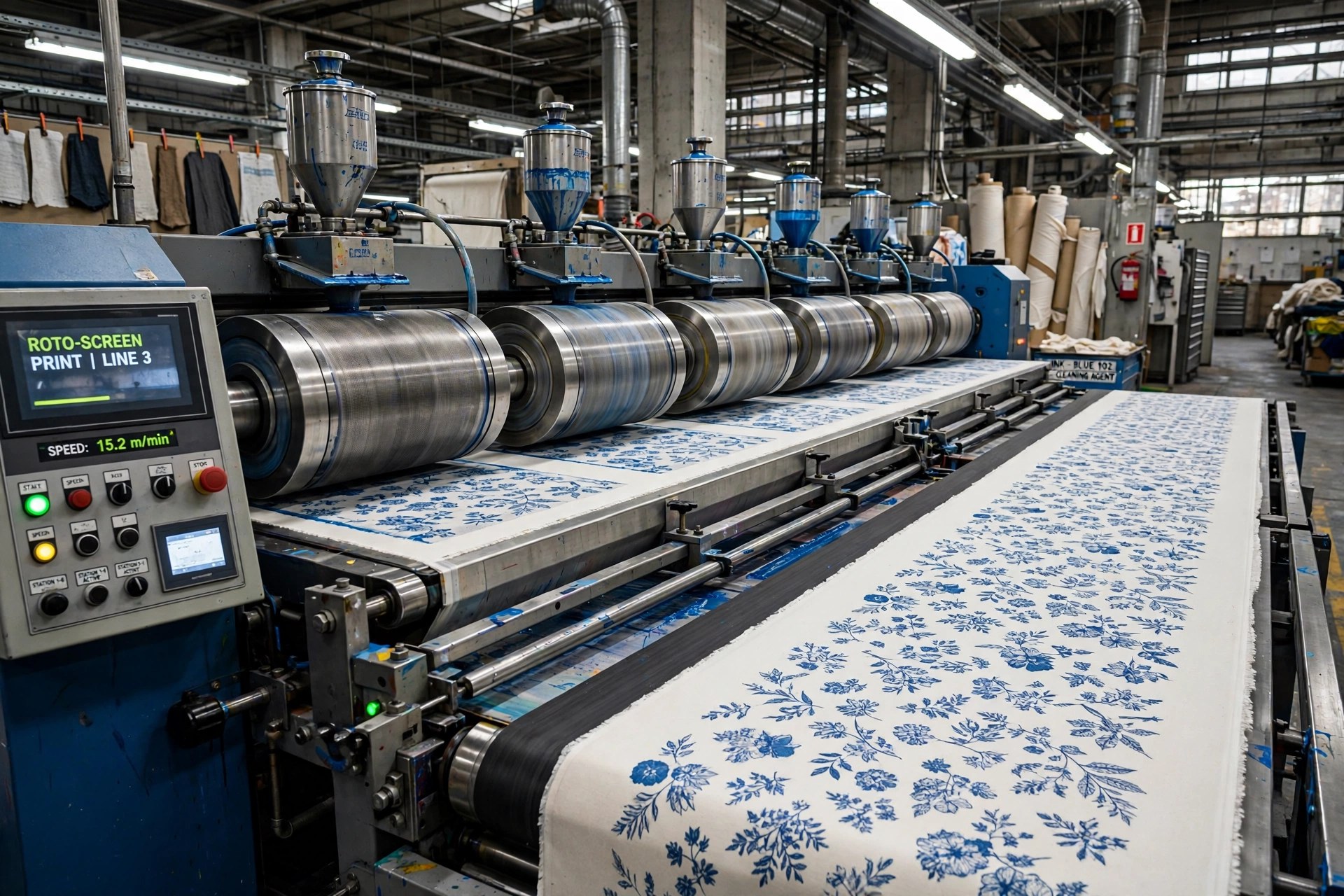
Rotary screen printing takes the flat screens of the garment screen printing process and bends them into seamless cylinders. Each cylinder is a thin nickel mesh tube engraved with one color of the design. The cylinders sit in a row across a moving belt; fabric glued lightly to the belt passes under them in one continuous journey, collecting color after color without stopping. Inside each cylinder, a pump feeds print paste and a squeegee (or magnetic rod system) presses the paste through the mesh as the screen turns.
Within the Textile Printing Methods Guide, rotary is the yardage heavyweight: it exists to print fabric — thousands of meters of it — before the fabric is cut into garments. Most printed apparel fabric in the world, from dress prints to shirtings, comes off a rotary line (or its older flatbed relative) somewhere.
How a Rotary Line Runs
- Engraving the screens. The design is separated by color and each color is engraved into a nickel cylinder — by laser or by the older lacquer-and-exposure route. The repeat must match the screen circumference (64 cm is standard).
- Make-ready. Screens are mounted in order, paste is mixed to the approved recipe — pigment, reactive, disperse, or vat systems chosen for the fiber — and registration is dialed in on waste fabric.
- Printing. Fabric feeds from the roll, is bonded to the belt, and travels under every screen in sequence. Speeds of 30–80 meters per minute are normal.
- Drying. The printed web passes straight into a hot-air dryer so colors do not mark off as the cloth is wound up.
- Fixation and washing. Depending on the dye class, prints are steamed to fix reactive or vat dyes, or heat-fixed for pigments, then washed to remove unfixed color and thickeners, dried, and finished.
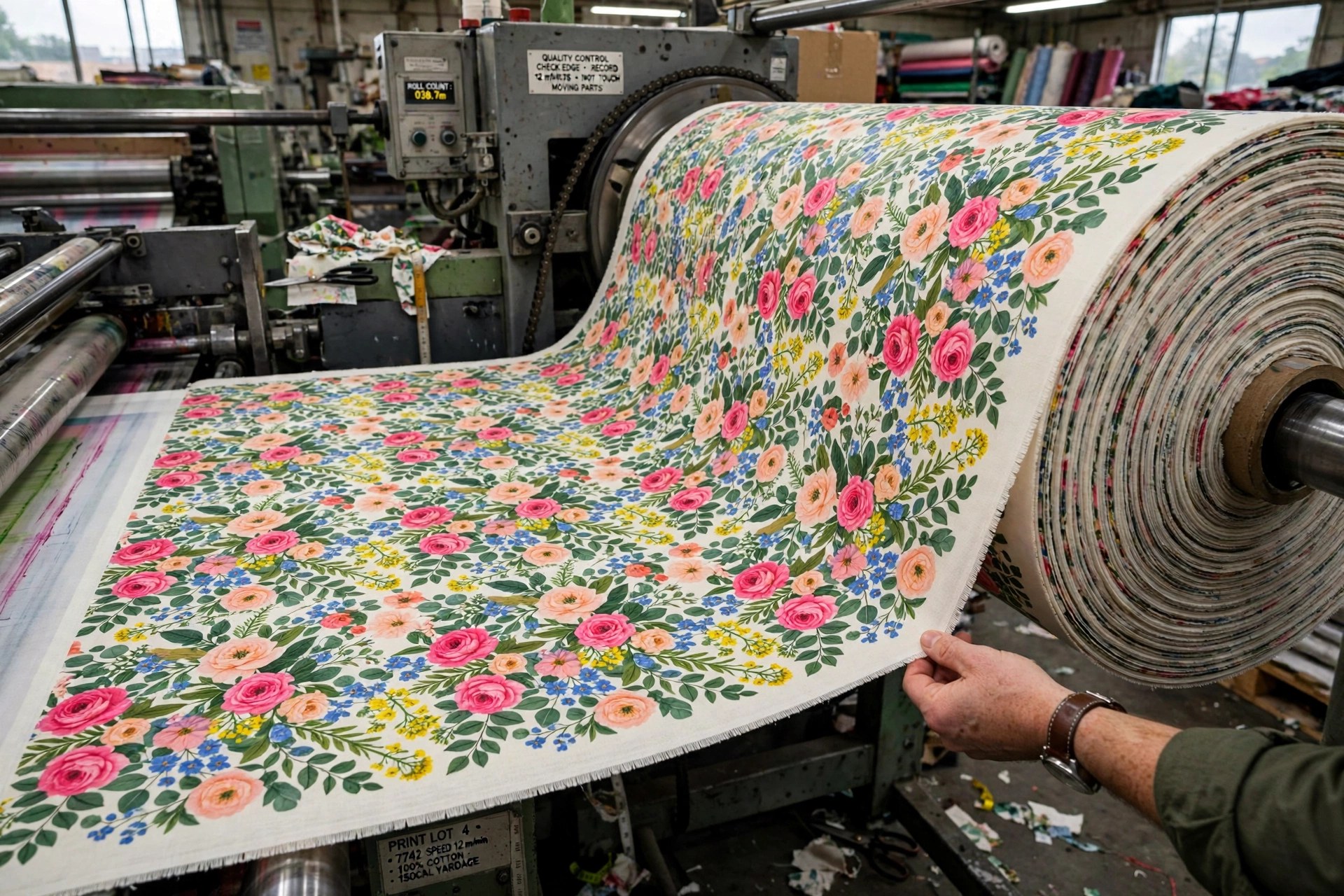
- Inspection. Printed yardage is inspected on the roll — misregistration, screen marks, color drift, and repeats out of line all become claims if they reach the cutting table.
Rotary vs. Flatbed vs. Digital Roll-to-Roll
Against flatbed screen printing
Flatbed prints yardage in steps — screen down, print, lift, advance — which suits shorter runs, very large repeats, and delicate fabrics, but at a fraction of rotary's speed. Think of flatbed as the sampling and specialty tool, rotary as the production tool. (The older cylinder method, roller printing with engraved copper rollers, is rotary's direct ancestor — see the roller printing definition.)
Against digital roll-to-roll
Digital printing needs no screens and prints any image a file can hold, so it owns sampling, strike-offs, and short runs. But its cost per meter stays roughly flat, while rotary's plunges as meters accumulate — past a few thousand meters, rotary is usually decisively cheaper, with deeper, more saturated color. The modern mill runs both: digital to sell the design, rotary to ship it.
What Decides a Rotary Job
- Quantity. Engraving a screen per color is real money; mills quote minimums (commonly 1,000–3,000 m per design) to spread it.
- Color count. Lines carry 8–16 stations typically (more exist), and every color adds a screen, paste, and registration time.
- Repeat discipline. The design must tile at the screen's circumference — a constraint the designer inherits from the machine.
- Fabric behavior. The belt system handles most wovens and many knits; very unstable or heavy fabrics need preparation and slower speeds.
More Printing Methods
- Screen Printing Guide — flat screens for garments and panels, rotary's close relative.
- Digital Textile Printing — roll-to-roll inkjet: rotary's partner for sampling and short runs.
- Block Printing — repeats printed by hand, one impression at a time.
- Resist Printing & Batik — pattern and dye combined in the traditional methods.
- Direct to Garment (DTG) — digital printing aimed at finished garments instead of yardage.
- Direct to Film (DTF) — transfers that press onto almost anything.
Common Questions
- How fast is rotary screen printing?
- A rotary line typically runs at 30 to 80 meters per minute depending on the design, fabric, and number of colors — tens of thousands of meters per shift. That is an order of magnitude faster than flatbed screen printing and far faster per meter than digital roll-to-roll, which is why rotary remains the default for bulk fashion yardage despite digital's growth in sampling and short runs.
- What is the standard repeat size in rotary printing?
- The classic rotary screen circumference is 64 cm (about 25.2 inches), so the design repeat must fit that circumference — or a multiple or fraction the mill can work with. Larger screens (around 82, 91, or 101 cm) exist for bigger repeats. This is a real design constraint: a fashion print is drawn to the repeat from the start, and changing the repeat later can mean re-engraving every screen.
- Why does rotary printing need minimum quantities?
- Each color requires an engraved nickel screen, and the machine must be set up, registered, and washed down between designs. Those fixed costs are the same for 300 meters as for 30,000, so mills set minimums — often 1,000 to 3,000 meters per design, varying by mill and fabric — below which the cost per meter becomes unworkable. Shorter runs go to flatbed screens or digital printing instead.
- Rotary or digital: which should a brand choose for fabric?
- Digital wins for sampling, strike-offs, photographic designs, many colors, and runs under a few hundred meters — no screens, no engraving, quick turnaround. Rotary wins when the design is proven and the quantity is real yardage: lower cost per meter, excellent consistency, and deep color saturation. Many brands sample digitally and bulk-print rotary, approving a rotary strike-off against the digital sample because the two rarely match color perfectly.
Back to the Textile Printing Methods Guide
Compare rotary printing with every other method — fabrics, run lengths, hand feel, durability, and cost — in the main guide.
Textile Printing Methods Guide