Printing Before Machines
Block printing is the ancestor of everything else in the Textile Printing Methods Guide: a raised design on a block is inked and pressed onto fabric, one impression at a time, row after row, until the cloth is covered. It was practiced in Asia for well over a thousand years before printed Indian cottons transformed European taste in the seventeenth century — and it never actually stopped. In artisan centers today, the same motions print fabric for boutique fashion labels and home textiles around the world.
What block printing sells is not efficiency. A skilled printer produces a few meters an hour where a rotary screen line produces thousands. It sells the hand of the maker: slight shifts in registration, a deeper impression here, a lighter one there — exactly the qualities machine printing is engineered to eliminate.
The Process, Step by Step
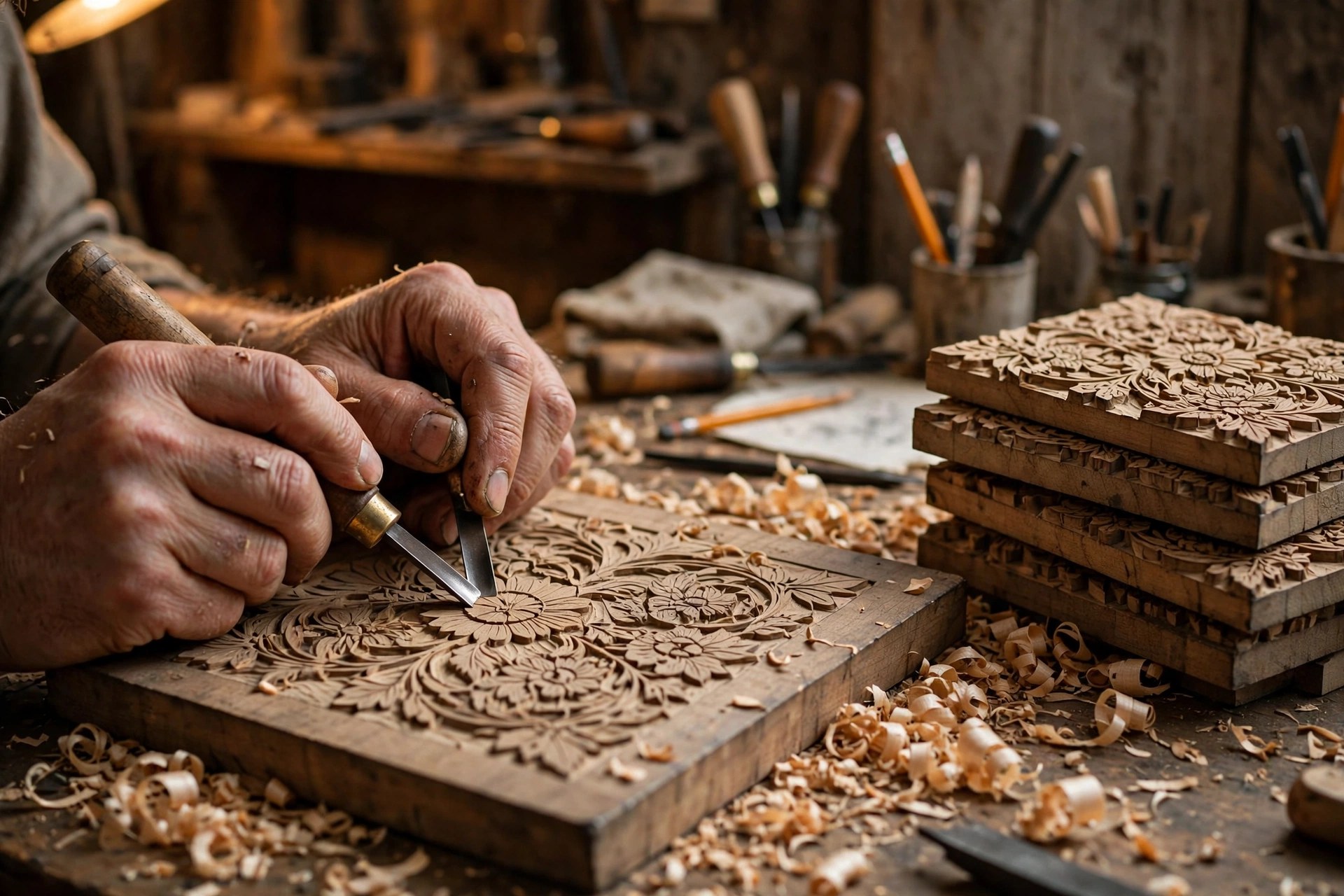
- Carving the block. The design is drawn or transferred onto a block of seasoned hardwood (traditionally teak or sheesham) and carved in relief — the printing surface left raised, the background cut away. One block per color. Fine detail is sometimes set in brass strips embedded in the wood.
- Preparing the fabric. Cloth is washed to remove sizing and shrinkage, dried, and stretched taut over a long padded printing table, pinned so it cannot creep as work proceeds.
- Loading the color. Dye or pigment paste sits in a shallow tray topped with a floating pad or sieve. The printer presses the block onto the pad to pick up an even film of color — the "ink pad" moment that decides whether the impression is crisp or flooded.
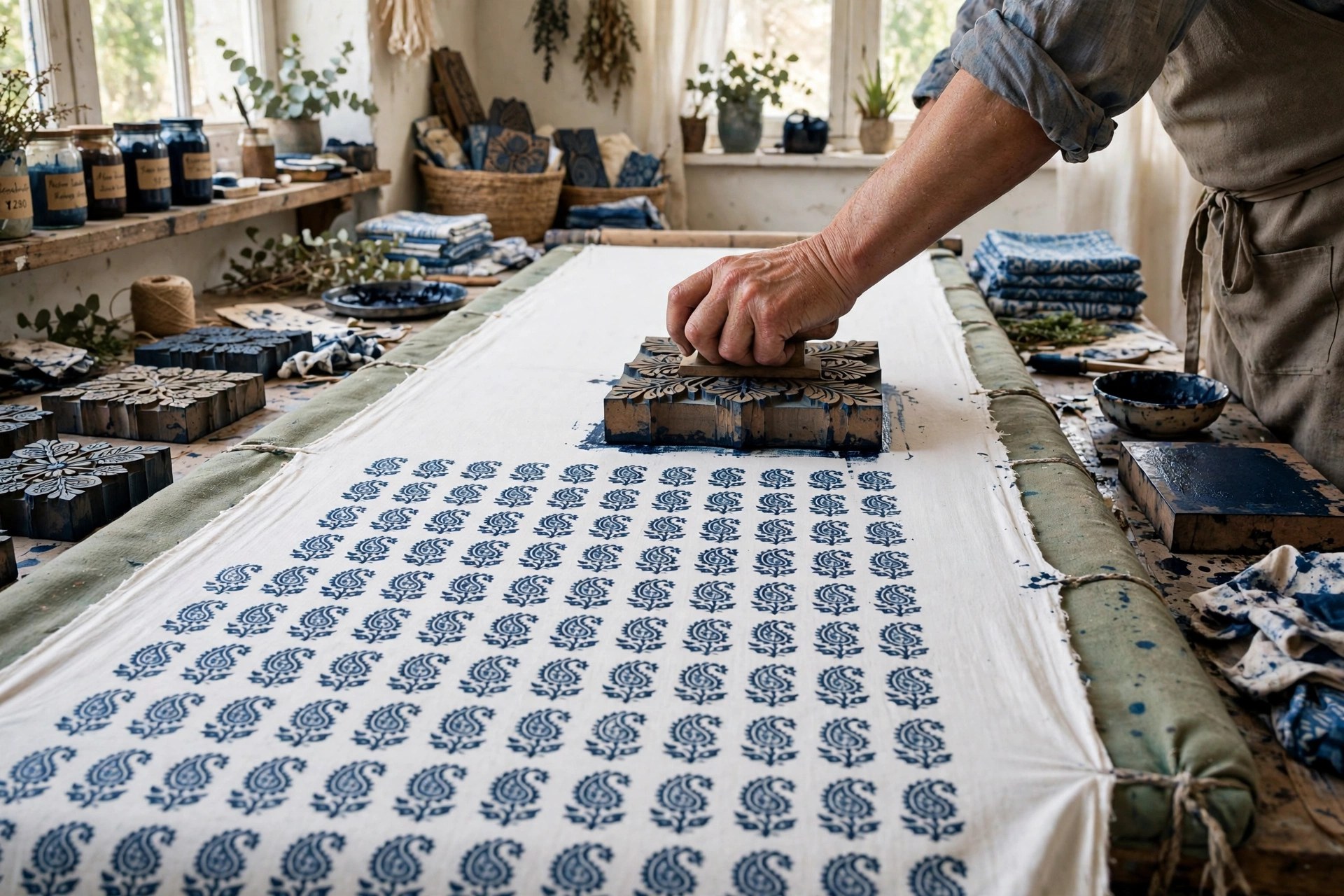
- Printing the repeat. The block is set down in position and struck or pressed firmly — traditionally with a practiced blow of the hand. Small registration marks carved at the block's corners guide alignment. The printer walks the length of the table, impression by impression, row by row.
- Adding colors. Once the first color dries, the next block prints its color inside the outline, registered by eye. Sequence and drying discipline keep colors clean.
- Fixing and finishing. Pigment prints are cured with heat; dye-based work (including prints combined with resist and mordant techniques) is steamed or treated, then washed to remove excess color and reveal the final shade.
Styles with Names of Their Own
Several block printing traditions are strong enough to anchor product lines. Bagru and Sanganer prints from Rajasthan are known for their floral motifs on natural grounds; Ajrakh combines block printing with resist and mordant dyeing in a long, multi-stage process producing deep indigo, madder red, and black geometry. Kalamkari blends hand painting with blocks. Outside India, related relief traditions — from Japanese woodblock-influenced prints to African wax-print aesthetics (industrially printed today, but descended from batik and block work) — show how universal the idea is: carve the pattern once, print it forever.
Block Printing in a Modern Business
- Where it fits: boutique and resort fashion, scarves, quilts, table linen, and limited runs where "hand printed" is part of the product's value.
- Costs: carving is a one-time cost per design; the real cost is skilled labor per meter, so pricing is per-piece artisan pricing, not mill pricing.
- Lead times: weather matters — humidity and monsoon slow drying; honest suppliers quote accordingly.
- Quality language: agree in advance that slight variation is inherent, and approve a strike-off length, not a single perfect motif.
When a buyer loves a block print but needs ten thousand meters at machine consistency, the usual path is to reproduce the design by screen printing — keeping the look, losing the hand. Knowing both methods is what lets a brand choose deliberately rather than by accident.
More Printing Methods
- Resist Printing & Batik — block printing's frequent partner: wax and resist work, often with the same blocks' cousins, the copper cap stamps.
- Screen Printing Guide — the industrial descendant of the stencil-and-block idea.
- Rotary Screen Printing — the same repeating pattern, at thousands of meters.
- Direct to Garment (DTG) — the digital opposite pole: no block, no screen, one shirt at a time.
- Direct to Film (DTF) — printed transfers for almost any fabric.
- Sublimation Printing — photographic all-over prints on polyester.
Common Questions
- Why is block printed fabric slightly irregular?
- Because every impression is placed and pressed by hand. Pressure varies a little, ink loads vary a little, and each repeat is aligned by eye against registration marks, so tiny shifts and overlaps are inevitable across a length of cloth. In artisan markets that irregularity is not a defect — it is the visible evidence of hand work, and buyers pay for it. Machine printing is purchased precisely when those variations are not wanted.
- What fabrics are best for block printing?
- Smooth, stable, absorbent fabrics print best: cotton (especially fine mulmul and cambric), linen, and silk are the classics. The surface must be flat enough for the block to meet it evenly, so heavy textures, deep piles, and very stretchy knits print poorly. Fabric is washed and ironed before printing so shrinkage and sizing do not distort the work.
- How many colors can a block print have?
- One block per color, printed in sequence — outline block first, then each fill color registered inside it. Traditional work commonly uses two to five blocks; elaborate designs use more, and each additional block adds carving cost, printing time, and registration risk. Printers plan the sequence carefully, usually light colors before dark, with drying time between passes.
- Is block printing still used commercially?
- Yes — as a deliberate artisan product, not a mass method. Block printing centers in India and elsewhere supply boutique fashion brands, home textiles, and resort wear worldwide, and the hand-made story is part of the price. It cannot compete with rotary screen printing on volume or unit cost, and does not try to: it competes on character, heritage, and small-batch flexibility.
Back to the Textile Printing Methods Guide
Place block printing among all the methods — hand, screen, digital, and transfer — in the main comparison guide.
Textile Printing Methods Guide