World Textiles & Traditional Crafts · West Africa
African Wax Prints
No cloth tells a better trade story. Wax print began as a Dutch factory’s imitation of Indonesian batik, failed in Indonesia, and then — carried into West African ports in the 1880s — was adopted, renamed, re-patterned and made meaningful by African traders and wearers until it became the most recognisable printed cotton in the world. This guide follows the cloth itself: the resist process behind its two-sided colour, the mills of Haarlem and Helmond, the Nana Benz wholesalers of Lomé who named its designs, the proverb language woven into its patterns, and the copying wars and designer collections that define it today.
The Cloth
A Cloth With Three Birthplaces
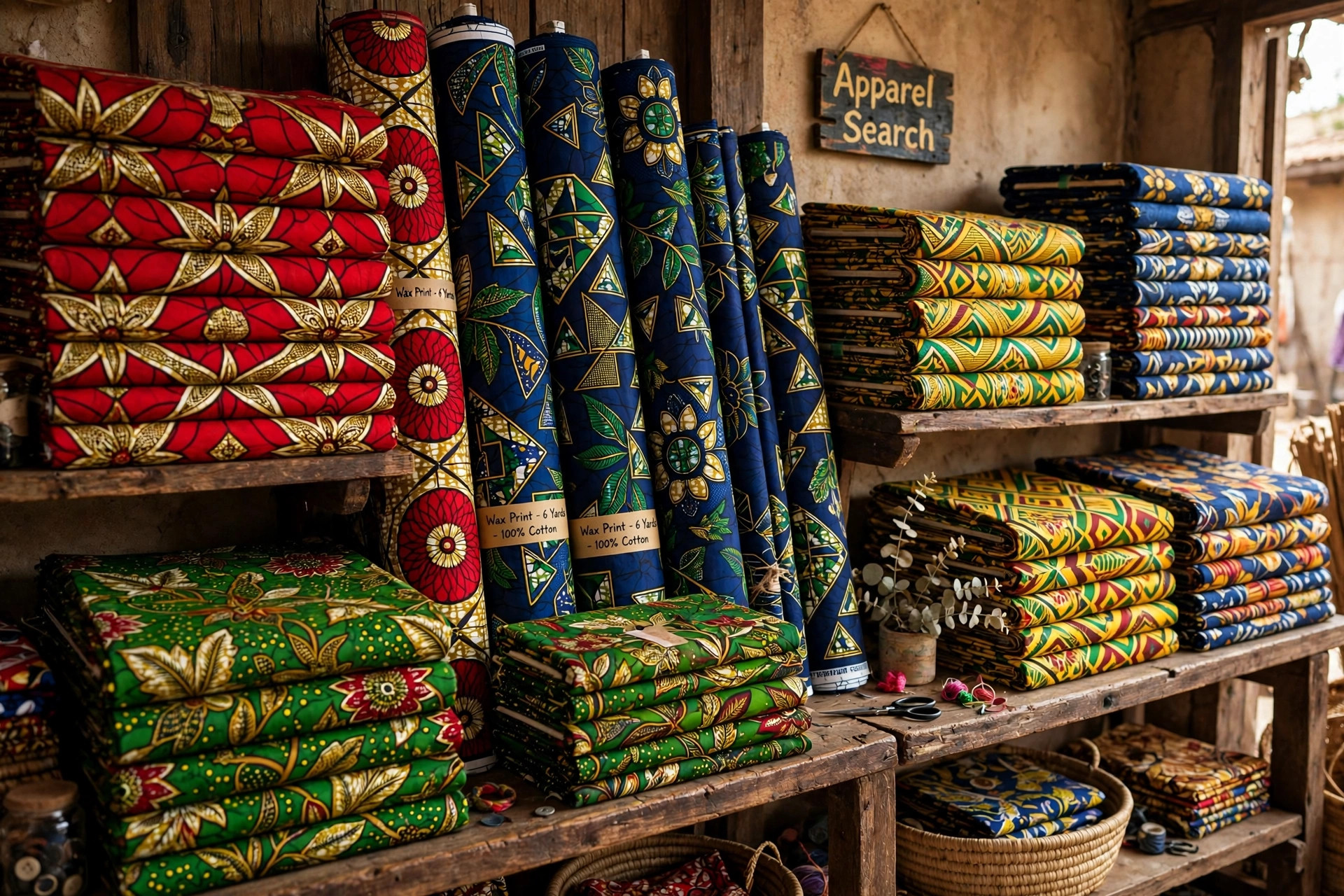
African wax prints — also sold as Dutch wax, Wax Hollandais and, in much of West Africa, Ankara — are industrially printed cottons with a batik-inspired design, saturated colour, and one unmistakable technical signature: the pattern shows with almost equal intensity on both faces of the cloth. There is no pale wrong side. That two-sided clarity, together with the fine crackle veining left where the resist cracked in production, is what separates a true wax print from an ordinary surface print.
The cloth’s history is genuinely global, and this guide tells it as a history — of making, trading and meaning — rather than as a styling guide. For how the cloth is tailored and worn day to day in East and Central Africa, see our kitenge guide, which owns garment styling in this library. For celebration dress in Nigeria — the weddings, aso ebi and grand robes this cloth dresses — see our Traditional Dress guide to Nigeria’s dashiki and agbada. What follows here is the cloth itself: where the technique came from, who industrialised it, who named its patterns, and who designs with it now.
Cloth is normally sold as a full piece of 12 yards (about 11 metres) or a half piece of 6 yards — lengths cut for tailoring, not finished garments. The maker’s name, the design’s name and its registration number are printed on the selvedge, protecting the design and attesting to quality. In West African households, good wax cloth is also a store of value: lengths are kept, gifted at marriages and naming ceremonies, and handed on.
Origins
From Javanese Batik to Dutch Mills
The starting point is batik, the Indonesian — above all Javanese — method of dyeing cloth with wax resist: hot wax is drawn or stamped onto cotton, the cloth is dyed, the wax keeps the dye out where it sits, and repeated waxing and dyeing builds a multi-coloured design. Our resist printing and batik guide walks through that hand process step by step; the wax print story begins where the hand process meets the factory.
During the Dutch colonisation of Indonesia, Dutch merchants and factory owners encountered batik and, by the 1850s, samples had reached textile mills in the Netherlands. Owners such as Jean Baptiste Théodore Prévinaire in Haarlem and Pieter Fentener van Vlissingen in Helmond set out to imitate batik by machine — cheaper cloth that could compete with labour-intensive hand batik in Indonesia itself. Prévinaire’s approach, adapted by 1854 from a mechanical block-printing machine, applied a resin resist to both sides of the cloth at once, imitating batik’s two-sided dyeing; roller printing, developed in Scotland in the 1780s, offered another route. The firm van Vlissingen founded in Helmond traces its origins to 1846 and, after mergers and the purchase of its Haarlem rival’s printing cylinders, rebranded in 1927 as Vlisco — the name that still defines the top of this market.
The plan failed in its first market. Indonesian buyers, who knew real batik intimately, did not take to the imitations — accounts note, among other obstacles, that the machine cloth lacked batik’s distinctive wax smell. The cloth needed a different customer, and it found one an ocean away.
The Crossing
How the Cloth Reached West Africa
From the 1880s, Dutch and Scottish trading vessels began introducing the imitation-batik cloth into West African ports, where it met a strong reception. One widely told strand of the story involves the Belanda Hitam — West Africans recruited from the Dutch Gold Coast between 1831 and 1872 to serve in the Dutch colonial army in Indonesia. Many retired to Elmina, in modern-day Ghana, and historians suggest they may have brought home a taste for batik that gave the Dutch cloth its first local market. Treat that strand as a plausible tradition rather than a proven single cause: what is certain is the outcome. Scottish, English and Swiss makers followed the Dutch into the trade, the cloth was sold under names such as Véritable Dutch Hollandais and Wax Hollandais, and West African customers — above all women — began reshaping it to their own taste.
That reshaping is the real birth of the African wax print. European mills supplied technique and volume; African traders and wearers supplied design direction, names and meanings. Patterns grew more African in inspiration through the twentieth century, the cloth became formal wear for leaders, diplomats and the wealthy as well as everyday dress, and by the mid-twentieth century it was, in every cultural sense, African-owned — whatever its factory addresses said. The word Ankara itself records the trade geography: it comes from the Hausa name for Accra, the Ghanaian capital that served as a nineteenth-century hub for the prints, carried into Nigerian usage by Hausa traders.
The Nana Benz: The Women Who Ran the Trade
No account of this cloth is complete without the traders of Lomé. In Togo, a small group of women wholesalers built such dominance over the Dutch wax trade that they became known as the Nana Benz — “Nana” for their seniority and wealth, “Benz” for the Mercedes-Benz cars they bought with their profits and used to move merchandise. Research from the University of Manchester records that their influence was economic and political in equal measure: they were key backers of Togo’s first president, Sylvanus Olympio, himself a former director of the company that distributed Dutch cloth, and in the 1970s the print trade in Togo was considered as significant as the phosphate industry, the country’s primary export. Their commercial genius was editorial as much as financial: because Togolese women traders understood their mostly female customers better than distant Dutch designers did, the Nana Benz were brought into the design process itself — selecting patterns and giving names to the designs they knew would sell. When you read a wax print’s evocative name, you are often reading a Nana Benz’s market judgement.
Pattern and Meaning
Named Patterns and the Language of Cloth
Wax prints are a form of nonverbal communication among African women, and the naming system is how the language works. Some prints are named for personalities, cities, buildings, sayings or occasions; in Ghana, many designs carry names drawn from Akan proverbs, so that wearing the cloth can praise, tease, warn or commemorate without a word spoken. Scholarship on Ghanaian wax prints describes this naming — done by traders and wearers, not by the factory — as the act that turns a foreign-made textile into a local cultural form: women as producers of meaning, not merely consumers of cloth.
A few examples show the range. Sika wo antaban — “money has wings”, or money takes flight — pictures a bird in flight and warns that money mishandled will fly away. A tortoise design, Akyekydeɛ akyi, “the back of the tortoise”, is associated with moving through life slowly and wisely. Long corrugated stripes called sugarcane carry the message “I love you like sugar.” Other names commemorate public life — a celebrated design honours Michelle Obama’s handbag — or mark the everyday: wells, eyes, gravel, stools, each with a proverb folded inside it. Meanings are local and can shift between regions and generations, which is part of the system’s life: a name that catches on in the market is a name the community has voted for.
Quality has its own vocabulary. True wax print, made through the full resist process, costs more to produce than other commercial prints and shows its design clearly on both sides, often with deliberate crackle. Cheaper “fancy prints” — also called imiwax or Java prints — imitate the look by ordinary printing, typically on one side only, in richer, more ephemeral colours. They serve the mass market honestly when sold as what they are. The selvedge is your evidence: maker, design name and registration number are printed there on genuine production from established mills, whether European houses such as Vlisco or the African manufacturers — among them Ghana’s GTP and Akosombo Textiles and Côte d’Ivoire’s Uniwax — that now produce high-quality wax prints on the continent.
The Cloth Today
Copying, Designers and What Comes Next
The twenty-first century rearranged the trade again. Dozens of factories in China began supplying African print textiles to West African markets at prices Dutch cloth could not match — Manchester’s researchers found Chinese prints in Lomé’s Assigamé market at roughly a fifth of the price of Wax Hollandais, and estimated that by 2019 some 90 percent of Lomé’s textile imports came from China. The Nana Benz, once around fifty strong, fell to about twenty, many now working as contracted retailers rather than independent wholesalers, while a younger generation of Togolese traders — the Nanettes, or “little Nanas” — built a new business sourcing and even commissioning designs in China. Vlisco, whose revenues fell sharply under this competition, repositioned itself as a luxury fashion brand with its own boutiques in West and Central African cities. The honest summary is double-sided: cheaper cloth put bold print within everyone’s reach, and it squeezed the African and European makers and traders who had built the cloth’s culture. Value is still added locally wherever cloth arrives as yardage — tailors, seamstresses and designers turn bolts into dress, as they always have.
Designers, meanwhile, have made wax print a global fashion language. Within Africa, a generation of labels builds collections on named prints chosen for their meanings as much as their colours; in the diaspora, the cloth signals heritage at celebrations and graduations; and international houses return to it season after season. The strongest contemporary work respects the naming culture — choosing a print knowing what it says — rather than treating the cloth as anonymous pattern. That, in the end, is this textile’s whole story in miniature: a factory product that only became itself when the women who traded and wore it gave it names, meanings and a market of its own. For the garment side of the story, start with the kitenge guide for tailoring and styling, and the Nigeria Traditional Dress guide for celebration dress.
Common Questions
Common Questions
What are African wax prints?
African wax prints, also called Dutch wax or Ankara, are industrially printed cottons inspired by Indonesian batik. Dutch mills mechanised the batik resist process in the nineteenth century, the cloth found its great market in West Africa from the 1880s, and African traders and wearers gave its patterns names and meanings. A true wax print shows its design with almost equal intensity on both sides of the cloth.
Who were the Nana Benz?
The Nana Benz were the wealthy women wholesalers of Lomé, Togo, who dominated the Dutch wax trade for much of the twentieth century. Their nickname joins Nana, a mark of seniority, with the Mercedes-Benz cars they bought from their profits. They selected patterns, named designs for the market, and wielded real political as well as economic influence in Togo.
What do wax print pattern names mean?
Many patterns are named for proverbs, sayings, people, places or occasions, and wearing one can send a message without words. In Ghana, Sika wo antaban, money has wings, pictures a bird in flight as a warning about money; a tortoise design stands for moving wisely and slowly. Names are given by traders and wearers in the market, and meanings vary by region.
What is the difference between wax print and fancy print?
A true wax print is made through a resist process, so its design is clear on both faces of the cloth, often with fine crackle veining, and it costs more to produce. A fancy print imitates the wax look by ordinary surface printing, usually on one side only. Fancy prints are cheaper and more ephemeral; the selvedge printing — maker, design name and registration number — helps identify established production.
Is wax print the same as kitenge?
They are close relatives in the same printed-cotton family, and the names overlap in everyday use. This guide covers the West African wax print story — Dutch mills, the Nana Benz and named patterns. Kitenge is the East and Central African name and tradition, with its own borders, printed sayings and tailoring culture, covered in our kitenge guide, which also handles garment styling.
Keep Exploring
More to Explore
World Textiles Guides
World Textiles & Traditional Crafts
The section hub — every great cloth tradition in the series.
Visit the hub ↑Mudcloth: Mali’s Bogolan
West Africa’s hand-made counterpoint to mill print: cotton strips painted with fermented mud.
Read ↑Moroccan Weaving
Amazigh carpets, hanbel flatweaves and handira wedding blankets.
Read ↑Bandhani: India’s Tied Dots
Another resist tradition — thousands of pinch-tied dots from Kutch and Rajasthan.
Read ↑Garments and Dress Partners
Kitenge Guide
The garment side of printed cotton — tailoring, borders, printed sayings and styling to wear today.
Read ↑Nigeria — Dashiki and Agbada
Celebration dress in Nigeria: ankara, aso oke and the aso ebi custom.
Read ↑Ghana — Kente
Ghana’s woven prestige cloth, and the proverb culture wax prints share with it.
Read ↑Go Deeper
Resist Printing & Batik
The hand batik process wax printing industrialised, compared with the other resist methods.
Read ↑Batik Definition
The short reference entry on batik — tulis, cap and how to judge the real process.
Read ↑Africa Clothing Industry
The continent-wide apparel and textile directory behind these cloth trades.
Explore ↑Search Apparel Search