World Textiles & Traditional Crafts · Morocco
Moroccan Weaving
In Morocco’s Atlas mountains, weaving is women’s architecture in wool: carpets thick enough to sleep on through a mountain winter, striped flatweaves that layer a household’s beds and floors, and wedding blankets sewn with hundreds of sequins to carry a bride into her new life in a flash of light. This guide covers the woven Morocco — Beni Ourain pile carpets, hanbel flatweaves, the handira, and the glossy cloth sold as sabra, including what that fibre honestly is. Embroidery is deliberately left to its own guide: this page never retells it, it links to it.
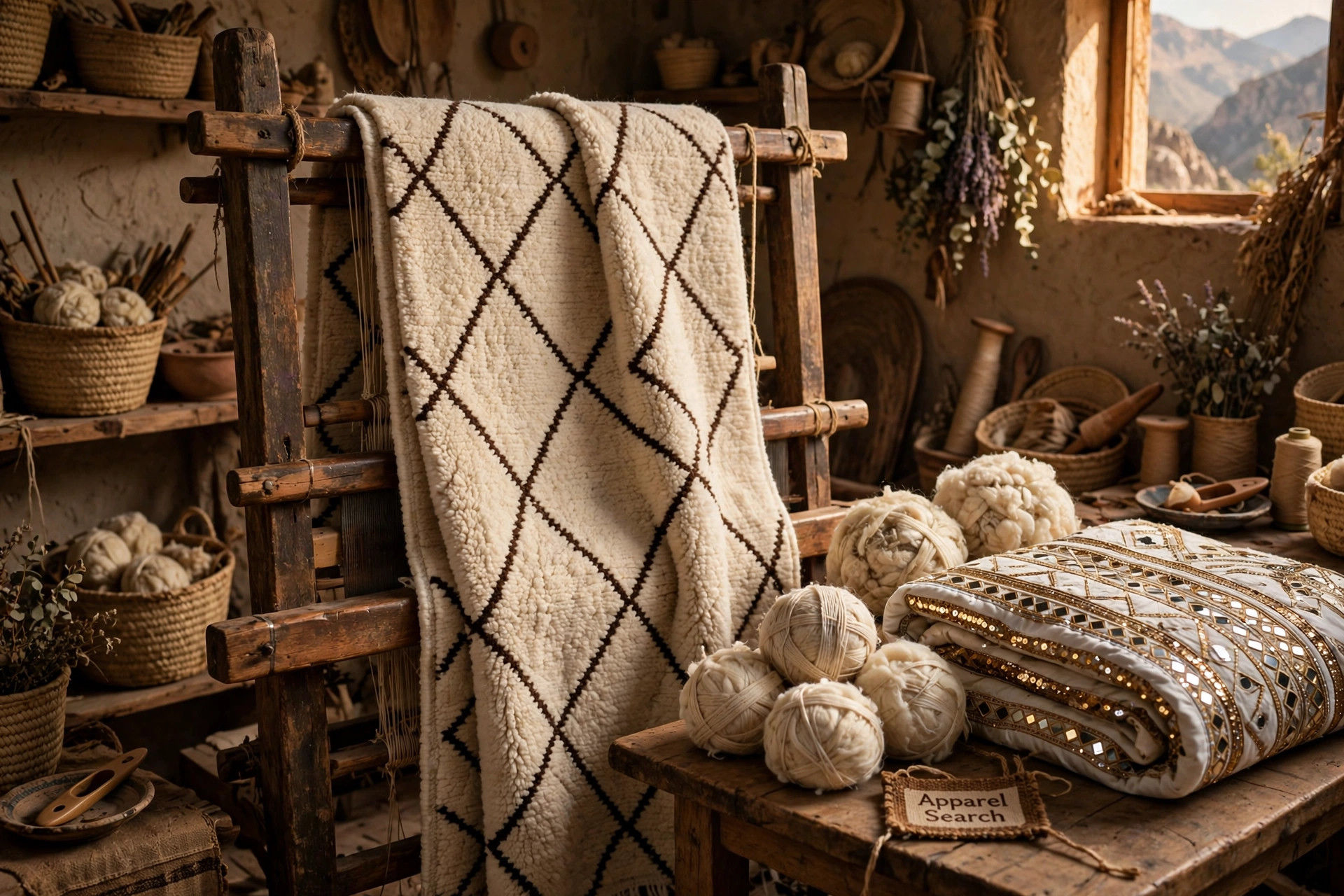
The Woven Morocco
Weaving Only — and Why That Is Plenty
Morocco weaves in wool, and it weaves for a mountain climate. In the Atlas ranges, where winters are cold and households historically lived close to their flocks, women weavers produced the family’s bedding, cloaks, floor coverings and wedding wealth on the loom — thick pile carpets to sleep on as much as to walk on, flatwoven blankets that layered and travelled, and sequinned wedding cloths that caught the light of a procession. This guide covers that weaving world only: the carpets, the hanbel flatweaves, the handira wedding blankets and the glossy cloth sold as sabra. Morocco’s other great textile art — the tarz embroidery, sfifa braid and knotted aakads buttons that finish its famous robes — belongs to the garment story, and it is told in full in our Traditional Dress guide to Morocco’s caftan and djellaba. Read the two together and you have the whole Moroccan textile house: this page is the loom room; that page is the tailor’s bench.
The weavers are Amazigh (Berber) women, working at home and, increasingly, in village cooperatives, on looms set up in houses and courtyards. A carpet or blanket is rarely a commodity first: it is made for a household, a daughter’s marriage, a family’s winter — and only secondarily for a market. That origin explains the character buyers fall for. Designs are drawn from memory and convention rather than cartoons, lines wander slightly as a hand draws them row by row, and no two genuine pieces are ever quite alike.
The Carpets
Beni Ourain and the Pile Traditions
The most famous Moroccan weaving in the world is the Beni Ourain carpet. The name belongs to a confederation of Amazigh tribes of the northeastern Middle Atlas, and the classic carpet follows their cold-country logic exactly: a thick, long pile knotted from undyed sheep’s wool, an ivory or cream ground the colour of the fleece itself, and a spare network of dark brown or black lines — diamonds, lozenges and loose lattices — drawn across it. In the Atlas these carpets were traditionally used as beds and bedding as much as floor coverings, which is why the genuine article is so generously piled: it is insulation you can also walk on, with pile that can stand several centimetres deep.
Construction is the collector’s evidence. In a knotted pile carpet, short lengths of yarn are tied around the warp threads row after row and cut to form the raised surface; traditional Beni Ourain work uses natural white wool warp and weft and a Berber knot, worked by hand over weeks or months for a large piece. The dark line work is not printed or embroidered afterwards — it is knotted in, colour by colour, as the carpet grows, which is why the geometry breathes: diamonds lean, lines thicken and thin, and the lattice never quite becomes a grid. Interior designers in Europe and America made the style famous in the twentieth century, and the market now overflows with “Beni Ourain style” machine-made copies. The copies copy the palette; they do not copy the weight, the irregular hand-spun wool, or the months at the loom.
Beni Ourain is the headline, not the whole atlas. Neighbouring Middle Atlas weaving, such as the dense-piled work associated with M’rirt, and the freer, more colourful carpets of Azilal in the High Atlas — thinner pile, often on a cotton or wool warp, with abstract colour drawn boldly across a cream ground — show how quickly the language changes from valley to valley. Tribal and place names in this market are not brands: they are shorthand for a real community’s materials, palette and habits, and a knowledgeable seller can tell you which habits to expect.
Flatweaves
Hanbel: The Everyday Weave
Where pile is Morocco’s winter weight, the hanbel is its everyday weave. A hanbel is a flatweave — warp and weft interlaced with no pile at all, the family the wider world often calls kilim — and in Morocco it serves as blanket, bedding layer, floor covering and ceremonial cloth in one. Hanbels are typically striped, in bold horizontal bands, sometimes with small brocaded or sequinned detail worked into the bands, and their virtues are practical: light, reversible, easy to roll, carry and layer, and quicker to weave than a knotted carpet, which puts them within every household’s reach.
Do not mistake practical for plain. The stripe is a design field of its own — band widths, colour order and the placement of a single contrasting line are where a weaver’s judgement shows — and regional habits differ, from the striped hanbels of the Middle Atlas to the more densely patterned flatweaves of the south. A related rag-weave tradition, boucherouite, works recycled clothing and textile scraps into vivid, irregular rugs: thrift turned into exuberance, and now collected in its own right. For a first piece of Moroccan weaving, a hanbel is often the wisest buy — genuinely handmade, genuinely useful, and priced by weeks of work rather than months.
Handira: The Wedding Blanket
The most photogenic Moroccan textile is a wedding gift. The handira — also called a wedding blanket, and in some Middle Atlas traditions a cape-like bridal cloth — is traditionally woven by Amazigh women of the Middle Atlas for a specific bride: a handwoven blanket of ivory or undyed wool, often striped, and covered with hundreds of small metal sequins sewn on by hand in geometric rows. The sequins are the point and, as Moroccan storytellers like to add, not the point. They flash in sunlight and lamplight as the bride is carried in procession — pure celebration — and in the weaving culture’s own reading they do protective work too, the metal discs traditionally believed to ward off the evil eye and bring the bride good fortune, while the woven diamonds and zigzags carry blessings for the marriage. A handira can take weeks to weave and finish, and it was made as a message from the women of one family to a daughter crossing into another: protection, blessing and wealth, in wool and light. Today vintage and new handiras travel the world as throws, bed covers and wall hangings. Buy them kindly — a genuine piece is someone’s weeks of work, sequin by sequin — and handle them as the delicate, sequinned wool they are. For the wedding itself — the caftans, the procession and the night of costume changes the handira belongs to — see our Moroccan wedding attire guide.
The Glossy Cloth
Sabra: What “Cactus Silk” Actually Is
The fourth Moroccan weave on every visitor’s list is the shiny one: flatwoven, lustrous cloth sold as sabra, sabra silk or cactus silk, woven into cushion covers, throws and light rugs with small geometric motifs and a sheen that shifts as the light moves. Here a buyer deserves the honest, verified version, because the marketing story and the supply-chain evidence part company.
Sabra is a Moroccan term for lustrous yarns and textiles; it has no single standardised fibre definition, and it is sometimes used interchangeably with hrir, the Arabic word for silk. The popular account describes fibre harvested from agave or “Saharan aloe” plants. Agave fibre genuinely exists — sisal and its relatives are agave fibres, and Moroccan scientific literature does use the name sabra for fibre from Agave americana. But when the Moroccan artisan organisation Anou investigated the commercial sabra yarn trade in 2018, tracing and testing the shiny yarn actually sold to weavers, it reported finding imported rayon — a manufactured, regenerated-cellulose fibre — with a second, higher-grade supply chain identified as acetate. Earlier craft sources point the same way: researchers had already documented rayon thread called sabra in Moroccan button-making and weaving. In other words, much of what is sold today as cactus silk is rayon or acetate yarn — handwoven by Moroccan artisans, certainly, and often beautiful, but not a leaf fibre gathered in the desert.
None of this makes a sabra cushion cover a fraud to enjoy; it makes it a purchase to make with open eyes. Judge the piece for its weaving, its dye and its finish, pay for the handwork you can see, and be sceptical of any seller who charges a natural-silk premium for the word sabra alone. The fibre question is separate from the craft: a textile woven by hand from manufactured yarn is still a handmade textile — it is simply not the botanical story on the label.
Buying Honestly
Collecting Moroccan Weaving
Buy Moroccan weaving by construction first and pattern second. Decide whether you want pile or flatweave: pile for warmth, weight and a lifetime floor piece; flatweave — hanbel or sabra — for a light, layerable textile. Then handle the piece. A genuine hand-knotted carpet has an irregular back that mirrors the front design knot by knot, wool with natural variation in tone, and ends finished by hand; a machine copy is unnaturally perfect, identical front to back in a different way, and light for its size. Wool quality drives price and longevity in pile rugs, and hand-spun yarn’s slight unevenness is a feature — it is what gives the surface its life.
Most production still flows from women weaving at home or in cooperatives in the Atlas, through intermediaries, to the shops of Marrakech, Fes and Casablanca — the wider industry around the craft is profiled on our Morocco clothing industry page. Buying through a cooperative or a seller who can name the weaving community shortens that chain in the weaver’s favour. Care is simple and old-fashioned: wool carpets want airing, gentle beating rather than harsh vacuuming, prompt spot-cleaning and rotation out of strong sun; sequinned handiras should never be machine-washed — spot-clean, air, and store flat or rolled. Kept so, a Moroccan carpet is not a souvenir. It is the household textile it was always designed to be, and it will outlast the room you bought it for.
Common Questions
Common Questions
What is a Beni Ourain carpet?
A Beni Ourain carpet is a thick pile carpet hand-knotted by Amazigh tribes of Morocco's Middle Atlas from undyed sheep's wool. The classic design is an ivory ground crossed by dark brown or black lines forming diamonds and loose lattices. Traditionally the carpets served as beds and bedding in cold mountain homes as well as floor coverings, which is why the pile is so deep.
What is a hanbel?
A hanbel is a Moroccan flatweave — a textile with no pile, made by interlacing warp and weft, often in bold horizontal stripes. Hanbels serve as blankets, bedding, floor coverings and ceremonial cloths. They are lighter, reversible and quicker to weave than knotted pile carpets, which makes them the everyday weave of Moroccan households.
What is a handira?
A handira is a Moroccan wedding blanket, traditionally woven by Amazigh women of the Middle Atlas for a bride. It is a handwoven cloth of ivory or undyed wool, often striped, decorated with hundreds of hand-sewn metal sequins. The sequins are traditionally believed to ward off the evil eye and bring the bride good fortune, as well as to catch the light in procession.
What is sabra, or cactus silk, really made of?
Sabra is a Moroccan term for lustrous yarns and textiles, with no single standard fibre definition. Although it is marketed as agave or cactus fibre, a 2018 investigation by the Moroccan artisan organisation Anou traced and tested commercial sabra yarn and reported it as imported rayon, with a higher-grade supply identified as acetate. The weaving is genuinely handmade in Morocco; the desert-plant fibre story usually is not.
How can you tell a handmade Moroccan carpet from a machine copy?
Turn it over. A hand-knotted carpet's back shows the design irregularly, knot by knot, with natural variation in the wool and hand-finished ends, and it feels heavy for its size. A machine copy is perfectly regular, often on a uniform foundation, and lighter. Slight wandering in the woven lines is a sign of the hand, not a defect.
Keep Exploring
More to Explore
World Textiles Guides
World Textiles & Traditional Crafts
The section hub — every great cloth tradition in the series.
Visit the hub ↑Harris Tweed & Donegal Tweed
Another protected wool-weaving culture — island looms, the Orb mark and the law behind them.
Read ↑Navajo Weaving
Upright-loom weaving, regional styles and Churro wool — a parallel blanket and rug tradition.
Read ↑Mudcloth: Mali’s Bogolan
African weaving’s painted cousin — cotton strips coloured with leaf dye and fermented mud.
Read ↑Traditional Dress and Wedding Partners
Morocco — Caftan and Djellaba
The garment half of Moroccan textiles: tarz embroidery, sfifa braid and aakads buttons, told in full.
Read ↑Moroccan Wedding Attire
The wedding the handira was woven for — a night of caftans staged by the negafa.
Read ↑Traditional Dress by Country
The companion series hub — dress traditions country by country.
Visit the hub ↑Go Deeper
Morocco Clothing Industry
Morocco’s apparel and textile industry directory — the modern sector around the craft.
Explore ↑Wool Fabric Guide
What wool is, how it performs and how to care for it — the fibre behind the Atlas carpets.
Read ↑Fabric Guides
The full fabric library — fibres, performance, buying and care.
Explore ↑Search Apparel Search