World Textiles & Traditional Crafts · Mali
Mudcloth: Mali’s Bogolan
Bogolan is the cloth the earth colours. Malian weavers build it strip by strip from handwoven cotton, dyers soak it in a bath of crushed leaves until it turns yellow, and women paint it, line by line, with river mud left to ferment for months — and where mud and leaf meet, the cotton turns a permanent, deep brown-black. This guide explains how that chemistry works, what the Bamana symbols say, where the finest cloth is made, and how a ritual cloth became a modern fashion textile.
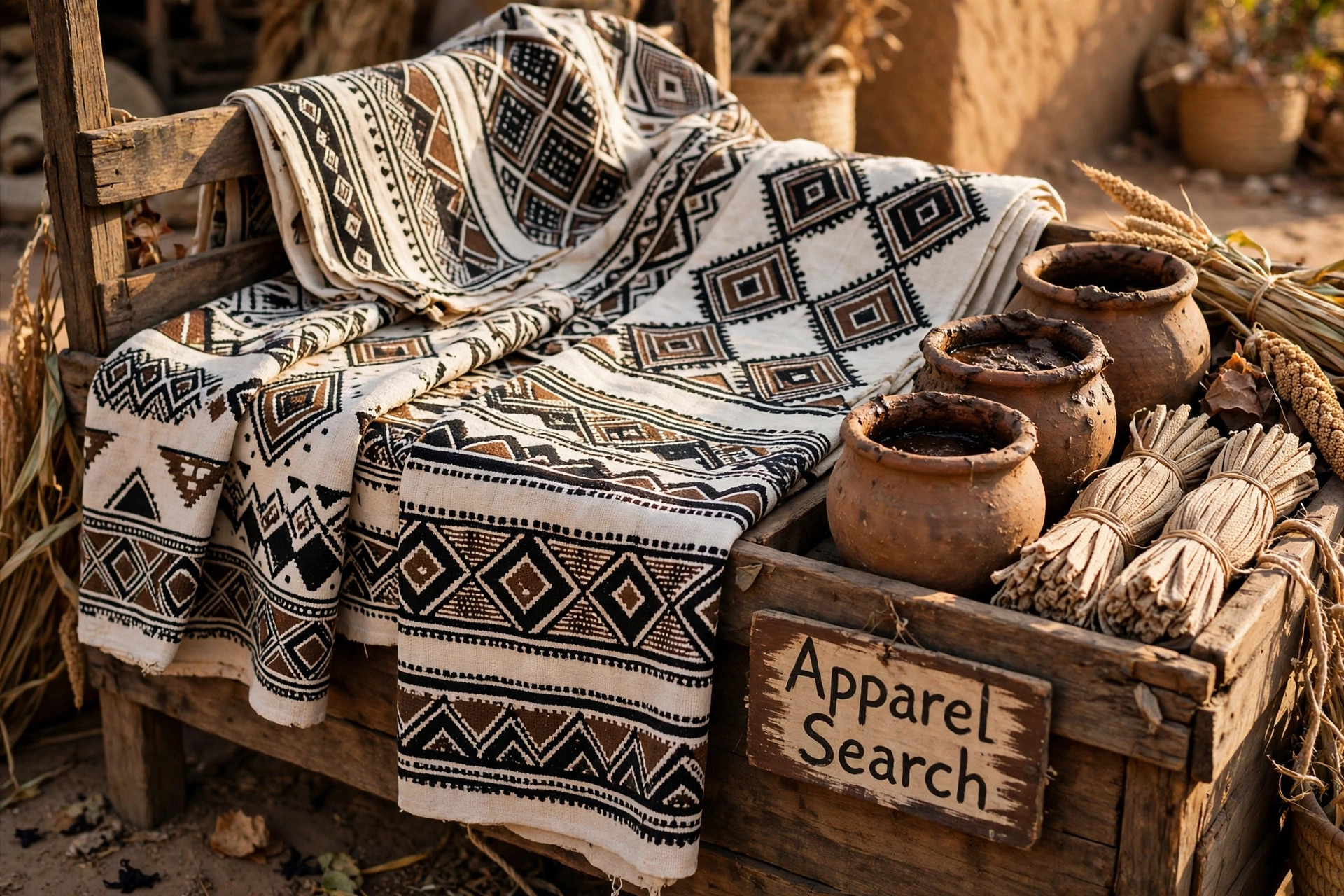
The Cloth
What Bogolan Is
In the Bambara language the full name is bògòlanfini: bɔgɔ, earth or mud; lan, with or by means of; and fini, cloth — cloth made with earth. Strictly, scholars note, bògòlan names the material itself, an iron-rich slip clay whose iron stains cotton black, and the finished textile takes its name from that clay. In English the cloth is sold as mudcloth, mud-dyed cloth or mud-painted cloth, and all three translations are honest: mud is both its dye and its paint.
The technique belongs to several Malian peoples, but the Bamana (Bambara) version is the one the world knows.
The Making
From Cotton Strip to Painted Cloth
Traditional bogolan divides its labour. Men weave; women dye and paint. Each half of the work takes years to learn, and the finished cloth carries both skills in every seam and line.
- Weaving the ground. On narrow looms, weavers produce long strips of plain cotton only about 15 centimetres (about 6 inches) wide. The strips are stitched edge to edge into a cloth roughly 1 metre wide by 1.5 metres long — wrapper size. Hold a genuine cloth up and you can still read those seams: bogolan is an assembled cloth, never a single wide web.
- The leaf bath — the invisible step. The sewn cloth is soaked in a bath made from the mashed leaves of the n’gallama tree (Anogeissus leiocarpa), boiled or steeped, then dried in the sun. The bath turns the cloth yellow — a colour that will mostly disappear from the finished piece — and, crucially, it prepares the cotton to react with the mud. Without this treatment, the mud would simply wash away.
- Fermenting the mud. The painting mud is specially selected from riverbeds and fermented in a clay jar, in traditional accounts for up to a year. Fermentation concentrates the iron that does the colouring work.
- Painting. Working with a metal tool or a wooden stick, the painter lays the design onto the yellowed cloth, applying the mud carefully and repeatedly to build the intricate motifs. In classic bogolan the painter often works the ground around a motif rather than the motif itself, so the pale shapes you read as the design are the places the mud never touched.
- Fixing and clearing. As the mud dries, the reaction between the iron-rich mud and the leaf-treated cloth fixes a dark brown that survives washing the mud off. Finally the yellow n’gallama colour is removed from the unpainted areas with soap or a bleaching preparation, leaving the finished cloth pale — white to cream — with dark marks where it was painted. With long use the very dark brown mellows into a range of rich browns, while the reverse keeps a pale russet tone.
There are regional shortcuts, and connoisseurs distinguish them. Around Mopti and Djenné a simpler method dyes the cloth yellow in wolo, a solution from the leaves of Terminalia avicennoides, and paints black designs over it; the yellow is then either removed for a stark black-and-white cloth or deepened to orange with a bark solution. Since around 2000, simplified and stencilled production for tourist and export markets has made cloth six to seven times faster than the full traditional sequence. That speed has kept bogolan affordable and widespread — and it is exactly why buyers need the buying guidance later in this guide.
Pattern and Meaning
A Vocabulary Painted in Mud
Bogolan patterns are not decoration in the idle sense. They form a Bamana visual vocabulary, rich in cultural significance, in which individual motifs can refer to historical events — one famous example commemorates a battle between a Malian warrior and the French — to crocodiles, which hold an important place in Bamana mythology, to other animals and objects, to mythological concepts, and to proverbs. A cloth can therefore be read, at least in part, by those who know the signs, and a knowledgeable maker chooses motifs the way a speaker chooses words.
Two cautions belong with that idea. The vocabulary is not a printed dictionary: meanings are carried by makers, vary by community, and the same geometry can carry different weight in different hands. Stencilled export cloth often borrows the look of the signs without their grammar. A serious buyer therefore asks who made a piece and what its maker intended, rather than trusting a hang-tag translation.
The classic palette is part of the meaning too. Bogolan works in the colours its materials give it — the near-black and deep browns of the mud, the cream of cleared cotton, and, where the yellow leaf dye or orange bark tones are left in, warm ochres. Later and contemporary work adds further plant and mineral tones, but the earth palette remains the cloth’s signature: this is a textile that quite literally wears the colours of its landscape.
Hunters, Thresholds and Protection
In traditional Malian culture bogolan’s first wearers were hunters. For them the cloth served three purposes at once: its earth tones worked as camouflage in the bush, it was believed to offer ritual protection, and it marked the hunter’s status — a badge of a respected and powerful calling, recognised on sight. The cloth also stands guard at the thresholds of women’s lives: girls have traditionally been wrapped in bogolan after initiation into adulthood, and women immediately after childbirth, because the cloth is believed to have the power to absorb the dangerous forces released at such moments. A textile that protects hunters in the bush and mothers in childbirth is not merely clothing in Bamana thought — it is a safeguard you can wear, and that protective reputation still clings to the cloth wherever it travels.
Places and Makers
San, Ségou, Bamako — and the Artists
Scholarly accounts name the town of San as the centre of bogolan production and the source of the highest-quality cloth, with Ségou and the Bélédougou region among its other heartlands and Bamako, the capital, as its great market and workshop city. Production is a household and workshop economy: weaving, dyeing and painting skills pass through families and apprenticeships, traditionally year-long for the painting, and a fine cloth represents the coordinated work of several hands before it reaches a stall.
Bogolan also has named artists, and they changed what the cloth could be. The Groupe Bogolan Kasobané — six artists collaborating since 1978 — took the mud-and-vegetable-dye technique off the wrapper and onto the wall, producing bogolan as fine art, often with new motifs that have since flowed back into clothing. Nakunte Diarra of Kolokani, in the Bélédougou region, who learned the craft from her grandmother and practised it from the 1950s, is recognised by the Smithsonian’s National Museum of African Art as one of Mali’s greatest bogolan artists, her work held in museum collections.
The economics shifted after 1991, when democratic reforms following the overthrow of Moussa Traoré ended many guaranteed government jobs and scholarships. Many young men took up bogolan production, so that much cloth is now painted by men rather than women, and long apprenticeships have often given way to short, informal training. Mali’s wider textile economy, from cotton growing to the Bamako workshops, is profiled on our Africa clothing industry page.
The Afterlife
From Ritual Cloth to Runway
The designer who carried bogolan onto the international runway was Mali’s own Chris Seydou (1949–1994). Seydou began working with the cloth in Paris in the mid-1970s — he recalled finding gifted pieces of bogolan in his suitcase after a trip home and seeing the familiar hunters’ cloth with new eyes — and he built jackets, miniskirts and bell-bottom trousers from it, showing Malian textiles as haute couture rather than ethnographic dress. Because ceremonial cloth carries dense, meaningful patterning, Seydou commissioned his own versions, often isolating a single motif, rather than cutting freely into ritual designs — a designer’s compromise between respect and the tailor’s shears that still frames how thoughtful fashion uses bogolan today.
After Seydou, the cloth’s fashion life widened fast. In Mali it is worn across ethnicities as an expression of national identity — in Malian cinema, on musicians, and among young people who cut it into everything from flowing boubous to Western jackets and miniskirts. Abroad, and notably in the United States, it is marketed as mud cloth both as a symbol of African American cultural connection and, more loosely, as a decorative “ethnic” textile for interiors. Bogolan designs now appear on everything from curtains and upholstery to book covers and coffee mugs.
Bogolan also has a West African cousin worth meeting alongside it. Ghana’s kente is likewise built from narrow woven strips sewn edge to edge into a great cloth — but where bogolan paints its meaning in mud on plain cotton, kente weaves its meaning in coloured pattern blocks on the loom. Our Traditional Dress guide to the kente of Ghana tells that strip-cloth story in full.
Acquiring
Buying, Collecting and Care
Buy bogolan the way you would buy any handmade cloth: in your hands, with questions. Genuine cloth shows its construction — narrow strips, real seams, a firm cotton hand — and its painting: lines with the slight wander of a hand-held stick, darks that sit in the fibre and show, paler, on the reverse, and small irregularities that no stencil repeats. Ask where it was made, by whom, and by which method; a seller of traditional cloth can usually describe the leaf bath and the mud, while a purely stencilled tourist piece will be priced — fairly — for speed rather than for the full process. Expect the price ladder to follow the labour: a large, traditionally painted cloth represents days of weaving, dyeing and repeated painting, and cannot honestly cost what a screen-printed copy costs.
Care follows from the chemistry. The mud colour is a true dye reaction and is durable, but it rewards gentleness: hand-wash rarely, in cool water with mild soap, never bleach a traditional piece, and dry it in shade. Over years of use the deepest browns soften into a family of rich tones — collectors regard that mellowing as character, not damage. Store cloth dry, folded along its strip seams, and refold it from time to time. Framed or hung, bogolan should be kept out of harsh direct sun, like any dyed cotton.
Common Questions
Common Questions
What is bogolan?
Bogolan, or bogolanfini, is Mali’s handmade mudcloth: cotton woven in narrow strips, sewn into a cloth, soaked in a bath of ngalama leaves and then painted with fermented iron-rich mud. The mud reacts with the leaf treatment to leave a permanent dark brown or black design. The name joins the Bambara words for earth, with, and cloth.
Who makes bogolan — men or women?
Traditionally both, in divided work: men weave the narrow cotton strips on looms and the strips are sewn together, while women carry out the dyeing and mud-painting, skills learned over long apprenticeships. Since the 1990s, faster tourist and export production has brought many younger men into painting as well.
What do bogolan symbols mean?
Bogolan motifs form a Bamana visual vocabulary. Individual signs can refer to historical events, crocodiles and other animals important in Bamana mythology, everyday objects, mythological ideas and proverbs. Meanings are held by makers and vary by community, so a serious seller or artist is the best interpreter of a particular cloth.
How can you tell real bogolan from a print?
Look for the cloth itself: narrow woven strips with visible seams, a slightly irregular hand-drawn line, and dark marks that sit in the fibre rather than on its surface. Printed mudcloth copies the geometry on flat, seamless cloth and repeats perfectly. Genuine bogolan also softens and deepens in tone with age and washing.
How should bogolan be washed and stored?
Wash gently and rarely, by hand in cool water with mild soap, and dry in shade. The mud-and-leaf colour is durable but not indestructible, and harsh detergents or bleach will strip it. Store the cloth folded along its strip seams, dry and away from damp, and refold it occasionally so creases do not become permanent.
Keep Exploring
More to Explore
World Textiles Guides
World Textiles & Traditional Crafts
The section hub — every great cloth tradition in the series, from suzani to Harris tweed.
Visit the hub ↑African Wax Prints
The other great West African cloth story — batik, Dutch mills, the Nana Benz traders and named patterns.
Read ↑Moroccan Weaving
Amazigh carpets, hanbel flatweaves and handira wedding blankets from the Atlas mountains.
Read ↑Felt of the Steppe: Shyrdak
Another cloth built by hand from raw fibre — Kyrgyz mosaic felt rugs and yurt felt.
Read ↑Traditional Dress Partners
Ghana — Kente
West Africa’s other strip cloth: narrow woven strips sewn into prestige cloth, pattern woven in rather than painted on.
Read ↑Nigeria — Dashiki and Agbada
The celebration wardrobe of Nigeria, and the ankara and aso oke cloths behind it.
Read ↑Traditional Dress by Country
The companion series hub — how the world’s cloths become dress, country by country.
Visit the hub ↑Go Deeper
Africa Clothing Industry
The continent-wide apparel and textile directory for the region Mali’s weavers work within.
Explore ↑Resist Printing & Batik
How resist methods compare — wax, paste, binding and mud — in the Textile Printing Methods series.
Read ↑Fabric Guides
What fibres and fabrics are, how they perform and how to care for them.
Explore ↑Search Apparel Search