Wedding Attire Around the World · Morocco
Wedding Attire in Morocco
A Moroccan wedding is measured in dresses. Across one long night the bride may appear four, five, even seven times, each time transformed — carried in on a decorated palanquin, crowned, belted in gold — while a professional dresser, the negafa, runs the whole wardrobe from behind the scenes. Her stage garment is the takchita, the two-layer ceremonial dress built on the caftan; for the caftan itself as a garment, begin with our caftan of Morocco guide. This page is about what happens to it at a wedding: the henna night in green, the sequence of regional looks, the wide gold belt, and the groom waiting in his white djellaba.
The Shape of It
A Night Run Like a Wardrobe
Most weddings ask the bride to choose a dress. A traditional Moroccan wedding asks her to choose a wardrobe — and then hires a professional to run it. The celebration is a long evening event, often beginning around nine or ten at night and running until three, four, even dawn, and its central entertainment is the bride herself, presented again and again in a new outfit, with new jewelry, to new music, like a one-woman tour of Morocco's regions staged inside a single hall.
The woman who makes that possible is the negafa (also spelled neggafa). She is part stylist, part dresser, part stage manager: she supplies or arranges the outfits, the jewelry and the headpieces, dresses and re-dresses the bride between appearances — a change can take eight to fifteen minutes of experienced hands — and choreographs each entrance with the band. A sought-after negafa is booked months ahead, and without her the choreography of the night simply does not work. Around her turn the other fixed points of the celebration: the henna night before it, the palanquin entrance, and the couple enthroned to receive their guests. The tailors, embroiderers and goldsmiths behind the wardrobe belong to the craft economy our Morocco clothing industry page profiles from the industry side.
The Night, Change by Change
The Evening's Changes
The henna night — green for blessing
A night or two before the wedding night comes laylat al-henna, the henna night, traditionally a women's gathering. The bride sits in a place of honor while a henna artist paints intricate designs on her hands and feet — henna for protection, fertility and good fortune, with the saying that the darker the stain, the stronger the blessing. Her dress for the night is traditionally green, the color of blessing, usually a lighter caftan rather than a full takchita, worn with gold. Female relatives and friends gather around her with singing, sweets and the milk-and-dates hospitality that opens Moroccan celebrations.
The amaria — carried in like royalty
The wedding night's defining image is the amaria (also spelled ammariya): an ornate, throne-like palanquin, canopied and decorated, on which the bride — and often the groom beside her — is lifted onto the shoulders of bearers and carried around the hall, high above the guests, to drums, music and the women's ululations, the zaghareet. It is the bride's triumphant entry into her new life, and it may happen more than once in the night, for more than one outfit. Between entrances the couple sit enthroned on the decorated seat, the mida, to receive congratulations — the still point between transformations.
The sequence — four to seven looks
Tradition counts seven outfits; at most weddings today, three to five changes are common, and every source agrees the number bends to family tradition, budget and the length of the night. The order varies too, but a representative sequence runs: the henna-night green; a grand first takchita for the entrance, often white, ivory or a jewel tone and the most heavily embroidered piece of the night; then one or more regional changes — the bride appears in turn in the dress of Fes, of the Sahara, of the Rif or the north, each with its own jewelry; and finally, at many modern and diaspora weddings, a Western-style white gown to close the evening. Each change is a staged reveal: the bride withdraws, the negafa's team re-dresses her, and she returns to a new song as someone new.
The Bride
Takchita: Two Layers and a Belt of Gold
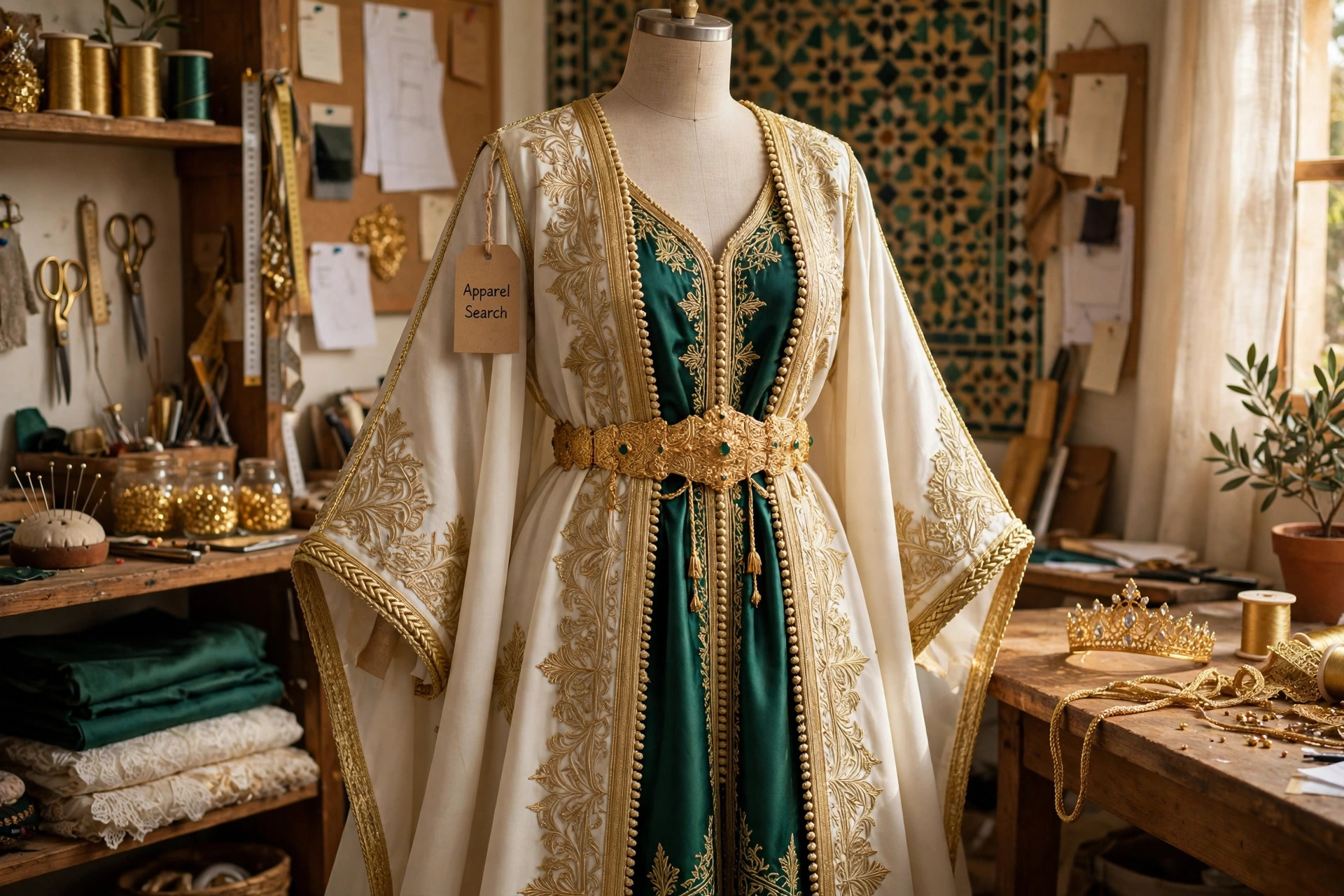
The bride's centerpiece is the takchita, and its construction is the first thing to understand. Where a caftan is a single long robe, a takchita is built in two layers: an inner dress, the tahtia, worn under an open, richly worked overdress, the dfina (or fouqia), which lets the underlayer show through at the front and sleeves. The two layers are cinched at the waist by the garment's signature: the mdamma, a wide ornamental belt — in beaten and engraved metal, braided cord or embroidered cloth — that can be as wide as a corset and is often the most finished, most valuable single element of the whole outfit. Count the layers and find the belt, and you can tell a takchita from a caftan at a glance.
The cloth and the handwork carry the price and the prestige. Grand entrance takchitas are often cut from kamkha, a dense silk brocade whose light-catching weave holds heavy embroidery; velvet serves winter weddings, lighter silks and chiffons the later changes. Quality is judged up close, by three signatures: the sfifa, braided trim framing the opening, neckline and cuffs; the aqad, hand-knotted silk-thread buttons, each caught in its own loop; and the embroidery itself, worked by a maalema, a master artisan, often in metallic thread. The regional changes are a geography lesson worn on the body:
| Look | What it is | Signature details |
|---|---|---|
| Fassi (Fes) | The ceremonial dress of Fes, Morocco's old embroidery capital | Refined silk embroidery, a structured silhouette, rich gold jewelry — the connoisseur's change |
| Tetouan / the north | Andalusian-influenced dress of the northern cities | Typically cream or white with elaborate gold embroidery, a legacy of al-Andalus |
| Sahraoui | The melhfa of the Sahara | A great length of cloth wrapped and draped around the body, often in deep indigo or bright colors |
| Amazigh | Berber dress, as worn in the Atlas and the south | Dramatic silver jewelry, woven belts and fibula brooches — silver where the cities wear gold |
| White finale | The closing look of the modern night | At many weddings today, a Western white gown — or a final white-and-gold takchita — worn for the last entrance and the photographs |
Casablanca, the country's great modern city, stages the fullest version of the night — the biggest halls, the most changes, the negafa's art at its most theatrical — while Fes is spoken of as the guardian of the classical repertoire, its embroidery schools and its Fassi look setting the standard the other regions answer. But every Moroccan wedding, however grand or modest, keeps the same grammar: layers, a belt, gold, and another entrance still to come.
The Groom
The Groom: White Djellaba, Tailored Jabador
Against the bride's seven transformations, the groom's dress is a study in calm. His classic wedding outfit is white or cream, and it comes in two forms. The first is the djellaba: the long, hooded robe worn by Moroccan men every day, raised for a wedding into fine cloth with sfifa braid trim — a dressed-up version, sometimes named for its city of making, a Fassi or Ouazzani djellaba, worn with the red tarbouche cap in Fes and the north. The second, and now the groom's most usual choice, is the jabador: a tailored two-piece set of tunic and matching trousers, embroidered at the neck and front, that reads as Morocco's answer to a suit — formal, neat, and easy beside a takchita's splendor.
- The jabador
- A men's two-piece — tunic over matching trousers — in white, cream or soft colors, finished with thread buttons and fine embroidery. The standard groom's outfit at modern weddings, and the usual dress for the henna night too.
- The djellaba
- The hooded robe, in its finest wedding form: good cloth, braided sfifa edging, worn for the entrance and the amaria, where the groom is carried in beside the bride in matching white.
- Babouche slippers
- The flat, pointed leather slippers that finish every traditional outfit, men's and women's alike — plain or embroidered, with yellow babouches the classic festive choice for men.
The groom may be carried in on the amaria with the bride, sits with her on the mida, and in photographs the design intention is clear: his white stillness is the frame that lets her changes blaze. His wardrobe work is done in a single fitting; hers takes a professional and a timetable.
Jewelry
Gold, Layered — and the Crown
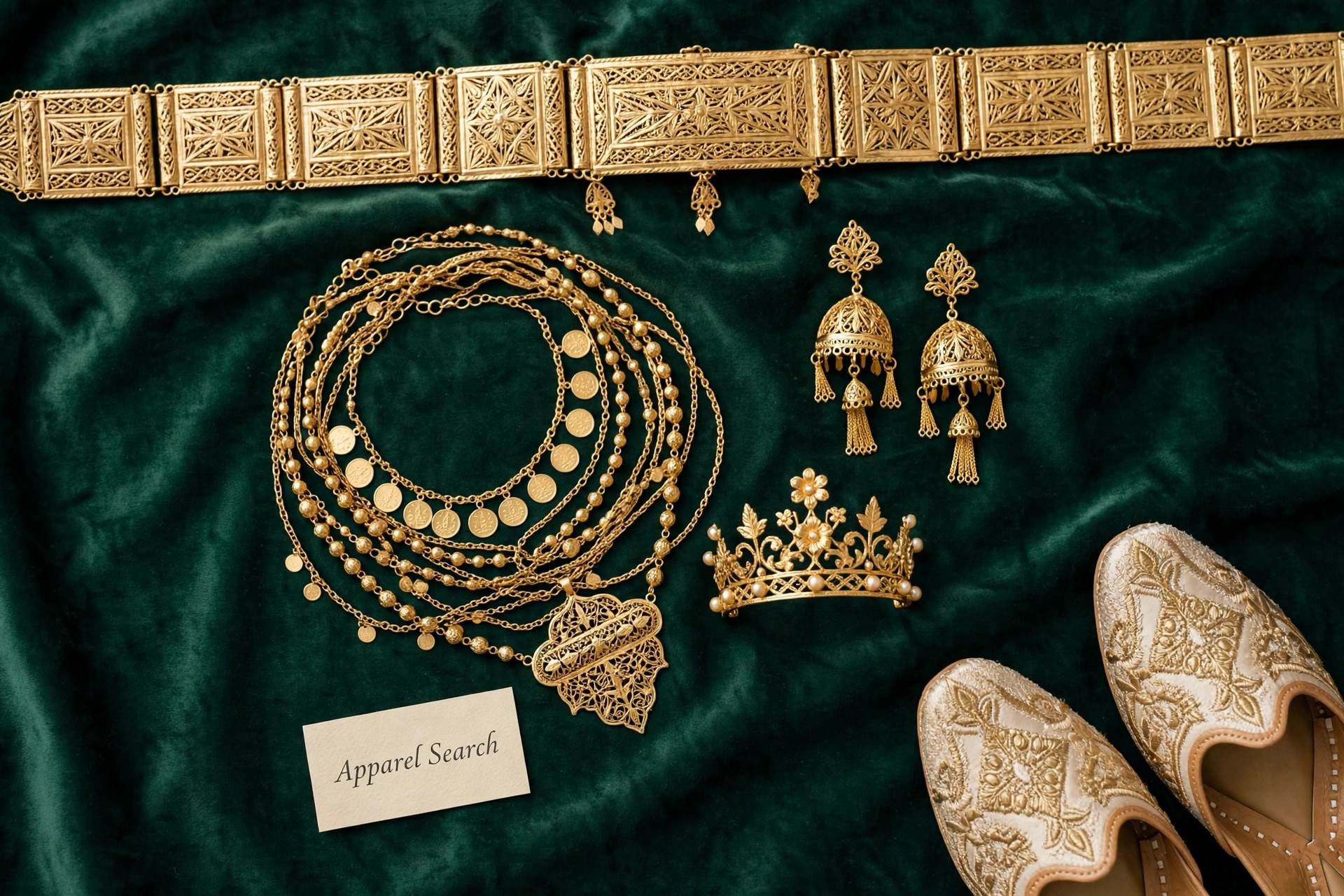
Moroccan bridal jewelry is gold, and it is worn the way the dresses are worn — in layers, and changed with them. Each of the bride's looks carries its own set: layered gold necklaces, earrings, bracelets and rings, matched by the negafa to the color and region of the outfit, so that the jewelry wardrobe across a night can look like a small treasury moving from dress to dress. The gold is rarely the bride's own. The great sets are traditionally supplied for the night by the negafa herself, from her own wardrobe of bridal jewelry — one more reason her role is closer to a production company than to a dresser.
Two pieces anchor every look. The first is the mdamma, the wide belt already met as the takchita's closure: in its grandest form a band of engraved, chased gold links, worn over both layers, doing the structural work of the silhouette and the decorative work of a jewel at once. The second is the crown moment: for her grandest entrance the bride is crowned — a tiara or full crown set on her styled hair by the negafa as the final touch before the amaria, the gesture that turns the dressed bride into a queen for her procession. Guests read the night by these two flashes of gold: the belt at the waist, the crown above.
The Amazigh change breaks the gold rule beautifully — there the jewelry is silver: heavy necklaces, fibula brooches and woven belts, the historic metal of the mountains and the south. A bride who makes the Amazigh change wears both metals in one night, and the contrast is part of the tour. Our guide to bridal necklaces covers the Western necklace tradition that sits, by comparison, at a single quiet strand.
Acquiring
Buying — and Borrowing — the Wardrobe
A Moroccan wedding wardrobe is assembled from three sources, and knowing which piece comes from which is the buyer's whole art. First, the commissioned piece: the signature takchita, made to measure by a tailor or atelier — order three to five months ahead for a hand-embroidered piece, because the cloth must be sourced, the two layers cut, the buttons knotted and the embroidery laid by hand. This is the dress the bride keeps for life. Second, the negafa's wardrobe: the regional changes, the jewelry sets, the crowns and often the amaria itself are supplied by the negafa as part of her service — rented splendor, professionally managed. Third, the family's own caftans and gold, brought out, altered and re-worn.
That division is the honest cost logic of the Moroccan wedding: spend permanently on the one dress that is yours, and rent the tour of Morocco. It is also why the negafa's fee buys far more than dressing — it buys the dresses. Brides who do commission several pieces build them over months with a trusted tailor, exactly as their mothers did, and a fine caftan is never a one-night garment: it returns for Eid, for family weddings, for a daughter's own henna night. Guests, too, rent or buy takchitas for the night — renting a guest caftan is entirely normal — because at a Moroccan wedding the room itself is expected to shine.
Today
The Modern Mix
The modern Moroccan wedding is editing, not abandoning, the sequence. The clearest trend is toward fewer changes — three or four beautifully chosen looks instead of seven — with the saved effort poured into quality: a single couture-level takchita from a named designer, its embroidery and kamkha brocade carrying the whole night. Designer caftans have become a fashion category in their own right, shown, photographed and collected, and diaspora weddings — in Paris, Brussels, Montreal — run the full grammar in a hotel ballroom: henna night, negafa, amaria and all, with the Western white gown folded into the sequence as simply one more regional change, the bride of the evening's final country.
What has not changed is the structure underneath: a bride presented in successive transformations, a professional who dresses her, gold at the waist and a crown for the entrance. If you are attending rather than starring, our Wedding Guest Attire section covers what to wear from the other side of the amaria — including the one firm rule of the Moroccan night, that white and ivory belong to the bride.
Common Questions
Common Questions
How many outfits does a Moroccan bride wear?
Traditionally seven, each often representing a region or style of Morocco. At most weddings today, three to five changes are more common, and the exact number depends on family tradition, budget and how long the celebration runs. A professional dresser, the negafa, manages every change.
What is a negafa?
The negafa is the professional bridal dresser and stylist who runs a Moroccan wedding night. She supplies or arranges the bride's outfits, jewelry, headpieces and often the amaria palanquin, dresses and re-dresses the bride between appearances, and choreographs each entrance with the band. Good negafas are booked months in advance.
What is the difference between a caftan and a takchita?
A caftan is a single long robe. A takchita is its two-layer ceremonial form: an inner dress (tahtia) worn under an open, richly worked overdress (dfina), cinched at the waist with a wide ornamental belt, the mdamma. The takchita is the more formal garment and the bride's usual centerpiece; the caftan serves for the henna night and lighter moments.
What is the amaria?
The amaria (also spelled ammariya) is the ornate, throne-like palanquin on which the bride — and often the groom — is carried into and around the wedding hall on the shoulders of bearers, to music and ululations. It is the bride's grand entrance and the most photographed moment of a Moroccan wedding night.
Why does the Moroccan bride wear green at the henna night?
Green is the color of blessing in Moroccan tradition. At laylat al-henna, the henna night held a night or two before the wedding, the bride traditionally wears a green caftan with gold while a henna artist paints her hands and feet with designs meant to bring protection, fertility and good fortune.
Keep Exploring
More to Explore
In This Series
Wedding Attire Around the World
The series hub — wedding dress country by country, from China's qun kua to Scotland's tartan, as each guide is published.
Visit the hub ↑Morocco — The Caftan
The base garment behind this page: the caftan and takchita, their embroidery, belts and regional forms, in the Traditional Dress series.
Read ↑Go Deeper on Morocco
Morocco Clothing Industry
Morocco's apparel and textile industry directory — the sector behind the ateliers that cut and embroider the wedding caftans.
Explore ↑Bridal Necklaces
Bridal necklaces in the Western tradition — a counterpoint to the layered gold sets a negafa drapes over a takchita.
Read ↑Wedding Bands
Wedding bands and rings explained — the small, permanent jewelry set against Morocco's night of borrowed gold.
Read ↑Attending a Wedding?
Search Apparel Search