Wedding Attire Around the World · Nigeria
Wedding Attire in Nigeria
In Nigeria, the traditional wedding is not the rehearsal for the real thing — for many families it is the real thing: a full ceremony of its own, often held on a separate day from the church or registry "white wedding," with its own wardrobe, its own protocol and its own hundreds of guests. What the couple wears depends on who they are — Yoruba, Igbo, Hausa or one of Nigeria's hundreds of other peoples — but the grammar is shared: handwoven prestige cloth, sculpted headwraps, robes built to command a hall, and coral beads worn like a crown's family. For the agbada as a garment, begin with our dashiki and agbada of Nigeria guide; this page is about the wedding itself, and how a whole hall comes to be dressed by it.
The Shape of It
Two Weddings, One Marriage
A Nigerian marriage commonly arrives in two full ceremonies. The traditional wedding — called the engagement in Yoruba practice, igba nkwu (wine-carrying) among the Igbo, the fatiha in the Muslim north — is the ceremony of the families: proposals are formally made and answered, gifts and bride-wealth are presented, elders bless, and the couple are married in the eyes of their community and their ancestors. The white wedding — a church service or registry ceremony in a white gown and suit — follows on the same weekend or another day entirely. Many couples will tell you the traditional day is the bigger production, and it is certainly the bigger wardrobe.
Nigeria holds more than 250 ethnic groups, so no single description fits every family; this guide follows the three largest traditions — Yoruba, Igbo and Hausa — whose dress has also become the shared national wedding language, mixed freely at inter-ethnic marriages. Underneath all three runs one brilliant system, aso ebi, which dresses not just the couple but the entire hall (below). The weavers and tailors who produce it all belong to the wider industry our Africa clothing industry page surveys across the continent.
Yoruba
The Yoruba Engagement: Aso-Oke and the Gele
The Yoruba traditional engagement is theatre with a script: the groom's party arrives and prostrates before the bride's family, a proposal letter is read aloud and answered, the veiled bride dances in with her friends, kneels for her parents' prayers, and — the gesture that seals it — places the groom's cap on his head herself. Through all of it, the couple wear aso-oke: the handwoven strip cloth of Yorubaland, woven (traditionally by men) in narrow strips on a loom and sewn edge to edge into prestige fabric. Its classic types are a small education in Yoruba values:
- Etu
- Dark indigo, almost black, with fine white or light-blue stripes — named for the guinea fowl, and historically the cloth of chiefs and elders. The sober, senior aso-oke.
- Sanyan
- Woven from the wild silk of the anaphe moth with cotton, in tan, cream and brown tones. In earlier times the most expensive of all Yoruba woven cloths — quiet luxury.
- Alaari
- The celebratory one: deep red, crimson or purple, its silk traditionally dyed with camwood. The aso-oke of festivity and display.
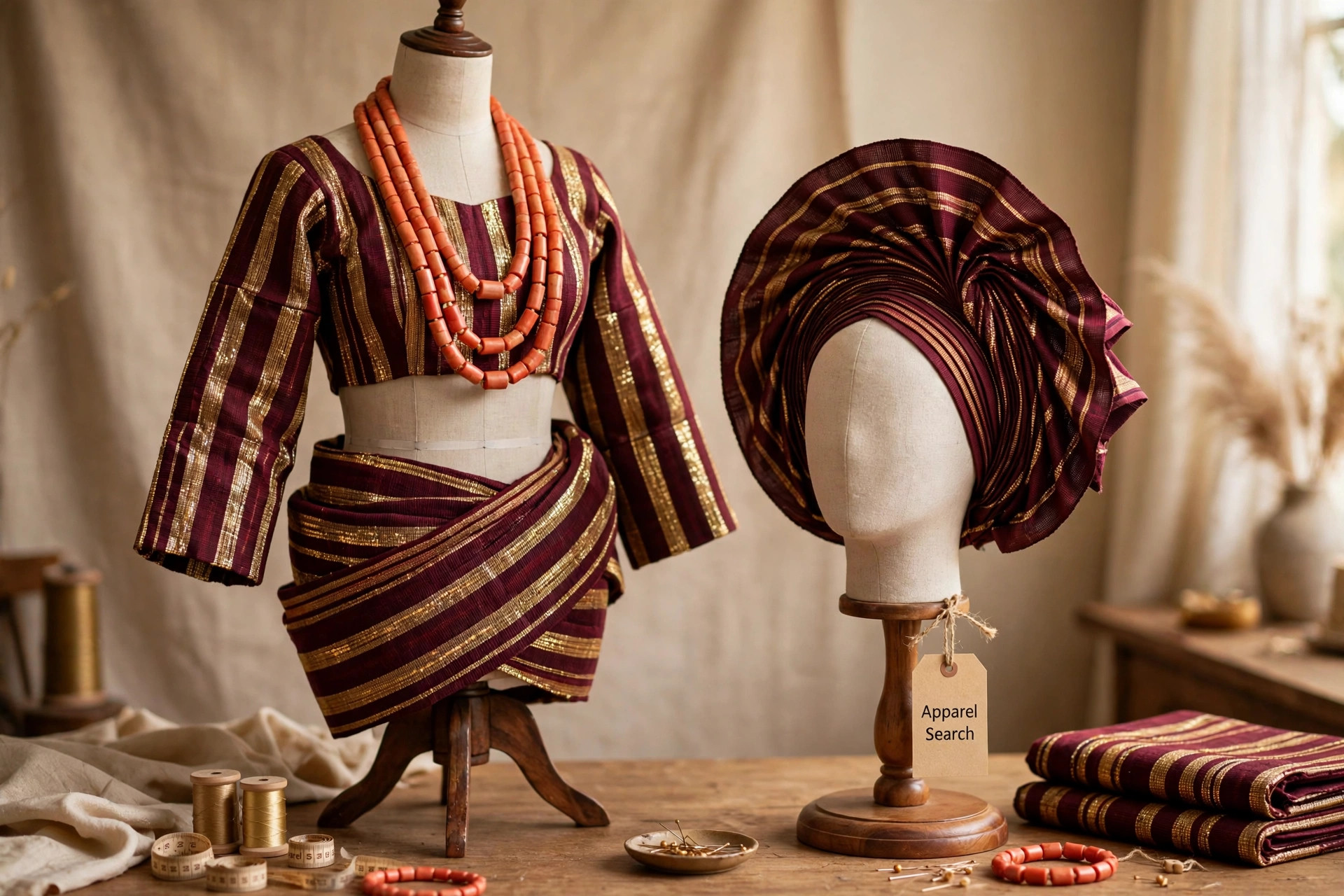
The bride wears aso-oke as iro and buba — a wrapped skirt and a loose blouse — or, in the modern komole form, as a fitted gown cut on the same lines. Over one shoulder goes the ipele (iborun), a sash or shoulder cloth of the same weave. And above everything rises the gele: the headwrap, stiffened and sculpted by expert hands into architecture — pleated fans, roses, and the famous infinity pleats, fold upon fold running in an unbroken circuit. Tying a bridal gele is a profession of its own; brides book a gele artist as they book a makeup artist, and the pre-tied "auto-gele" now exists for the same reason the clip-on tie does. The groom answers in the same cloth: a grand agbada — the vast, wide-sleeved flowing robe, worn over a tunic and trousers — embroidered at the chest, and on his head the fila abeti aja, the cap whose pointed flaps are said to resemble a dog's ears (abeti aja), folded up or down by mood and meaning. Coral beads at both their necks complete the portrait: the couple as royalty for a day, in cloth their families may keep for a generation.
Aso Ebi
Aso Ebi: The Fabric That Dresses the Hall
No account of Nigerian wedding dress is complete without aso ebi — in Yoruba, "family cloth." The couple (or their families) choose a fabric — lace, ankara print, aso-oke, a rich damask — in a chosen color, and family, friends and honored guests buy lengths of it and have outfits tailored, each in their own style. On the day, the hall reads at a glance: here are the bride's people, there the groom's, in waves of one cloth cut fifty ways — gowns, agbadas, geles, caps — a uniform that is somehow also a fashion show, since every wearer commissions a different silhouette from the same material.
The day is stage-managed by professionals of ceremony as well as of cloth. At a Yoruba engagement, two compères — the alaga iduro, who stands for the groom's family, and the alaga ijoko, who sits for the bride's — conduct the negotiation as comedy, praise-singing and protocol at once, themselves dressed for the spotlight. Around the couple stand the day's supporting wardrobes: the bride's ladies in their aso ebi, the groom's men in matching agbadas and filas, the mothers of both families in their own senior versions of the cloth and gele — a hierarchy of dress in which every generation's rank is tailored visibly into the room.
Aso ebi is a fashion system in its own right, with its own economics and etiquette. To be offered the cloth is to be counted inside the circle; to wear it is to declare allegiance in public. It links the couple's look to the whole room — the bride's aso-oke answers the guests' aso ebi across the hall — and it drives a real industry of fabric sellers, tailors and gele artists in the wedding months. Families may choose more than one cloth (bride's family, groom's family, friends), and the "color of the day" extends the idea even to guests who were not given fabric. A Nigerian wedding photograph is therefore never just a portrait of two people: it is a portrait of a community, dressed by committee and by design.
Igbo and Hausa
Igbo Wine-Carrying, Hausa Restraint
Igbo — isi agu and the cup of palm wine
The Igbo traditional wedding, igba nkwu, is named for its central act: the wine-carrying. The bride, given a cup of palm wine by her father, must find her groom hidden among the crowd of guests — who do their cheerful best to misdirect her — then kneel and offer him the cup; he drinks, accepting her and the marriage, to the roar of the hall. Her dress for the search is a blouse and double wrapper, traditionally of rich George cloth, with a head tie or a beaded crown and layers of coral beads; many Igbo brides change two or three times across the day, into lace and contemporary gowns still rooted in the same colors. The groom wears the isi agu: a tunic patterned with lion-head motifs — a symbol of strength, pride and nobility — with a wrapper or trousers, the red cap (okpu agu), coral beads and often a walking stick.
Hausa — babban riga and quiet colors
In the predominantly Muslim north, the marriage is solemnized at the fatiha, and Hausa wedding dress is the most conservative of the three traditions — and, its admirers say, the most refined. The groom wears the babban riga (baban riga), the grand flowing robe of the north, heavily embroidered at the neckline, over a long-sleeved kaftan and trousers (wando), with an embroidered cap, the hula — the tall cylindrical zanna bukar is the famous Kano form of it. The bride wears beautifully tailored dresses or a wrapper and blouse in rich fabrics, with a matching head wrap or veil, soft colors favored over loud ones, and her hands and feet painted with henna, lalle, in flowing designs. Where a Yoruba wedding shouts in scarlet aso-oke, a Hausa wedding speaks in embroidery and understatement — and is no less splendid for it.
| Tradition | The bride | The groom |
|---|---|---|
| Yoruba | Iro and buba (or komole gown) in aso-oke, ipele shoulder cloth, sculpted gele, coral beads | Grand agbada in matching aso-oke, fila abeti aja cap, coral beads |
| Igbo | Blouse and double wrapper in George cloth, coral beads, head tie or beaded crown; two to three changes | Isi agu lion-head tunic, red okpu agu cap, coral beads, walking stick |
| Hausa | Tailored dress or wrapper and blouse, head wrap or veil, lalle henna, soft colors | Babban riga robe, embroidered hula cap, kaftan and wando trousers |
Jewelry
Coral Beads: Royalty You Can Wear
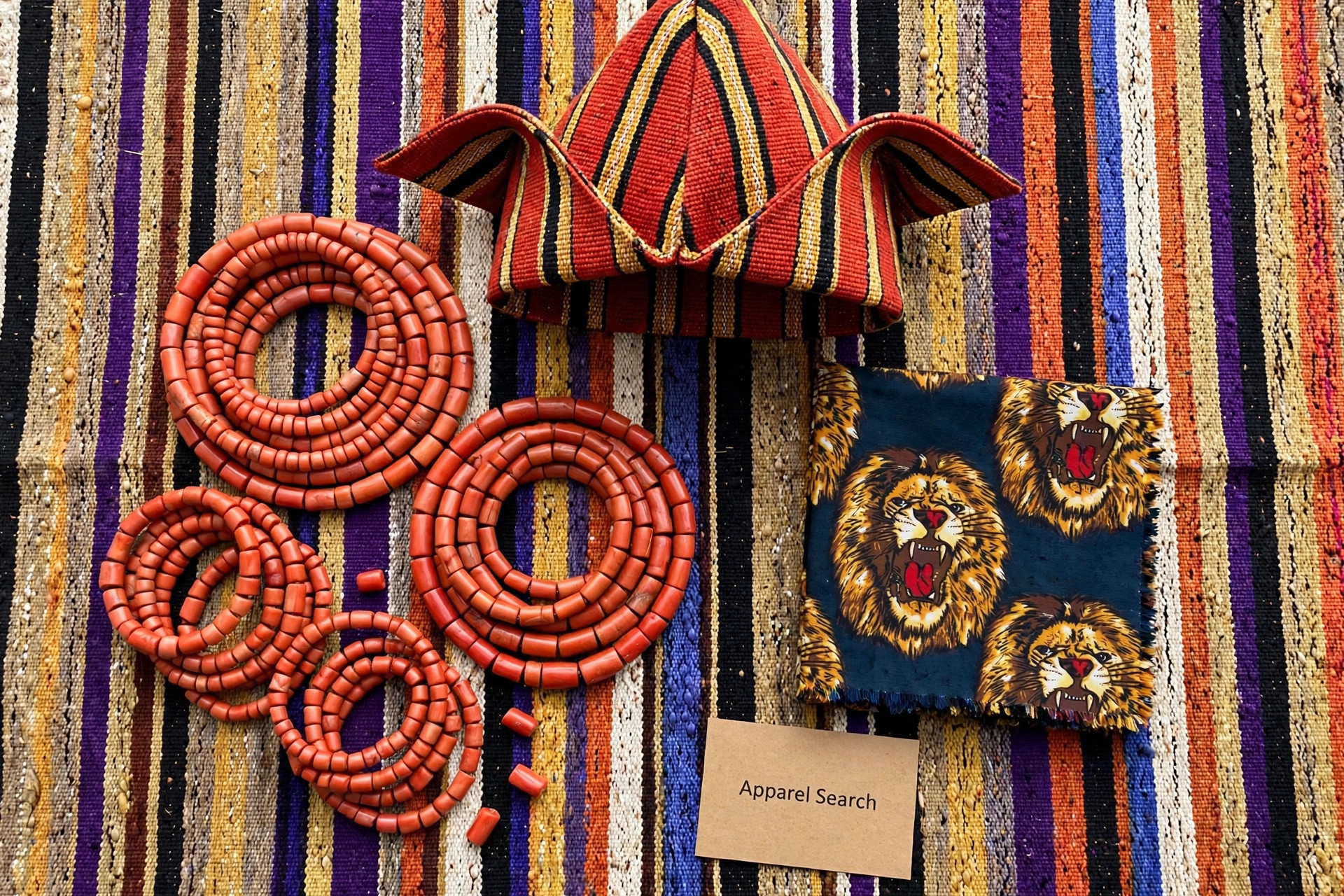
Across southern Nigeria, one jewelry speaks at every traditional wedding: coral beads — ileke in Yoruba. Layered necklaces, bracelets, earrings and beaded crowns in red-orange coral (and its honored glass counterparts) carry a dense cluster of meanings: royalty and status — coral was the regalia of kings and chiefs, above all in the Benin kingdom — wealth, blessing, and spiritual protection for the couple. A bride in full coral over aso-oke is not accessorizing; she is dressing as the royalty the day declares her to be, and grooms wear coral too, a strand or two at the neck and wrist answering hers.
The beads also tie the wedding to the family: fine coral is kept, restrung and handed down, so a bride may marry in her grandmother's ileke. A word of buying honesty that Nigerian jewelers themselves repeat: much of the affordable red "coral" in the market is glass mock-coral — a legitimate, beautiful tradition of its own for two centuries — but it should be sold, and priced, as glass, not as Mediterranean sea coral. Ask which you are buying. Our bridal necklaces guide covers the Western counterpoint, where one strand is asked to do the work Nigeria gives to a treasury.
Acquiring
Buying the Wedding Wardrobe
Nigerian wedding dress is overwhelmingly made to order, not bought ready-made. The couple choose their cloth — handwoven aso-oke from weavers in centers such as Iseyin and Ilorin for the Yoruba wardrobe, George and lace for the Igbo, brocades for the north — and take it to tailors and designers who cut it to the person and the day. Lead time is measured in weeks and months, and the wedding season books the good hands early. Into the same plan go the specialists the day has created: the gele artist, booked to sculpt the bride's headwrap on the morning itself; the coral seller; the aso ebi coordinator who distributes the family cloth.
The two-wedding structure doubles the wardrobe budget by design: a full traditional wardrobe and a white-wedding wardrobe, the bride in a gown, the groom in a suit or tuxedo, each event with its own photographs, its own guests, its own aso ebi. Families plan for it the way they plan for the feasts — as the marriage's public architecture, worth doing properly. Cloth is the durable part of the spending: a good aso-oke set outlives the day by decades, re-worn at naming ceremonies, birthdays and other people's weddings, which is exactly what prestige cloth is for.
Today
The Modern Mix
Contemporary Nigerian wedding fashion runs on designers. Bridal aso-oke is now cut into corseted gowns, sculpted sleeves and trains that owe as much to the red carpet as to the loom — the cloth is traditional, the silhouette is this season. Aso ebi has become a design brief in itself, with guests commissioning couture from the family fabric and photographers shooting the hall like a runway. Gele artistry has its own stars, its own social-media fame and its own signature styles, launched at one wedding and copied at fifty.
And the two-wedding wardrobe is now a deliberate design project: couples plan the traditional and white wardrobes as a pair, echoing a color or a motif from the aso-oke day in the gown day, so the album reads as one story in two languages. Nothing in the modern mix has diluted the traditional day — if anything it grows grander, because it is the day that is unmistakably Nigeria's own. If you are attending rather than starring, our Wedding Guest Attire section covers the guest's side — starting with the happiest instruction in world wedding dress: if they offer you the aso ebi, wear it.
Common Questions
Common Questions
What is the difference between a Nigerian traditional wedding and a white wedding?
The traditional wedding is the ceremony of the families — Yoruba engagement, Igbo igba nkwu (wine-carrying) or Hausa fatiha — where the marriage is made before the community in traditional dress. The white wedding is a church or registry ceremony in a white gown and suit. Many couples hold both, often on different days, with a full wardrobe for each.
What is aso ebi?
Aso ebi, Yoruba for 'family cloth,' is a fabric chosen by the couple or their families and bought by family, friends and honored guests, who each have it tailored into their own outfit. Worn together, it dresses the whole hall in the couple's colors, showing who belongs to which side — a uniform that is also a fashion show, since every outfit is cut differently.
What does a Yoruba bride wear?
Traditionally iro (wrapper) and buba (blouse) — or a modern komole gown — cut from aso-oke, the handwoven strip cloth, with an ipele shoulder cloth, coral bead jewelry, and a gele: a stiff headwrap sculpted by a specialist into pleats, fans or roses. The groom wears a grand agbada robe in matching aso-oke with a fila abeti aja cap.
What is the Igbo wine-carrying ceremony?
In the igba nkwu, the bride is given a cup of palm wine by her father and must find her groom hidden among the guests, then kneel and offer him the cup. His drinking accepts the marriage. She wears a blouse and wrapper with coral beads for the search; he wears the isi agu, a tunic with lion-head motifs, with a red cap.
Why do Nigerian couples wear coral beads?
Coral beads (ileke) signify royalty, wealth, blessing and spiritual protection. Coral was historically the regalia of kings and chiefs, so a couple in coral are dressing as the royalty the wedding day declares them to be. Fine sets are kept and handed down through families. Much affordable 'coral' today is glass mock-coral — a long-established tradition, but it should be priced as glass.
Keep Exploring
More to Explore
In This Series
Wedding Attire Around the World
The series hub — wedding dress country by country, from China's qun kua to Scotland's tartan, as each guide is published.
Visit the hub ↑Nigeria — Dashiki and Agbada
The base garments behind this page: the agbada and the wider family of West African robes and tunics, in the Traditional Dress series.
Read ↑Go Deeper on Nigeria
Africa Clothing Industry
The clothing and textile industries of Africa, country by country — the weaving and tailoring economy behind the wedding cloth.
Explore ↑Bridal Necklaces
Bridal necklaces in the Western tradition — set against the layered coral ileke a Nigerian bride wears over her aso-oke.
Read ↑Wedding Bands
Wedding bands explained — the exchanged ring beside Nigeria's older language of beads, cloth and family agreement.
Read ↑Attending a Wedding?
Search Apparel Search